
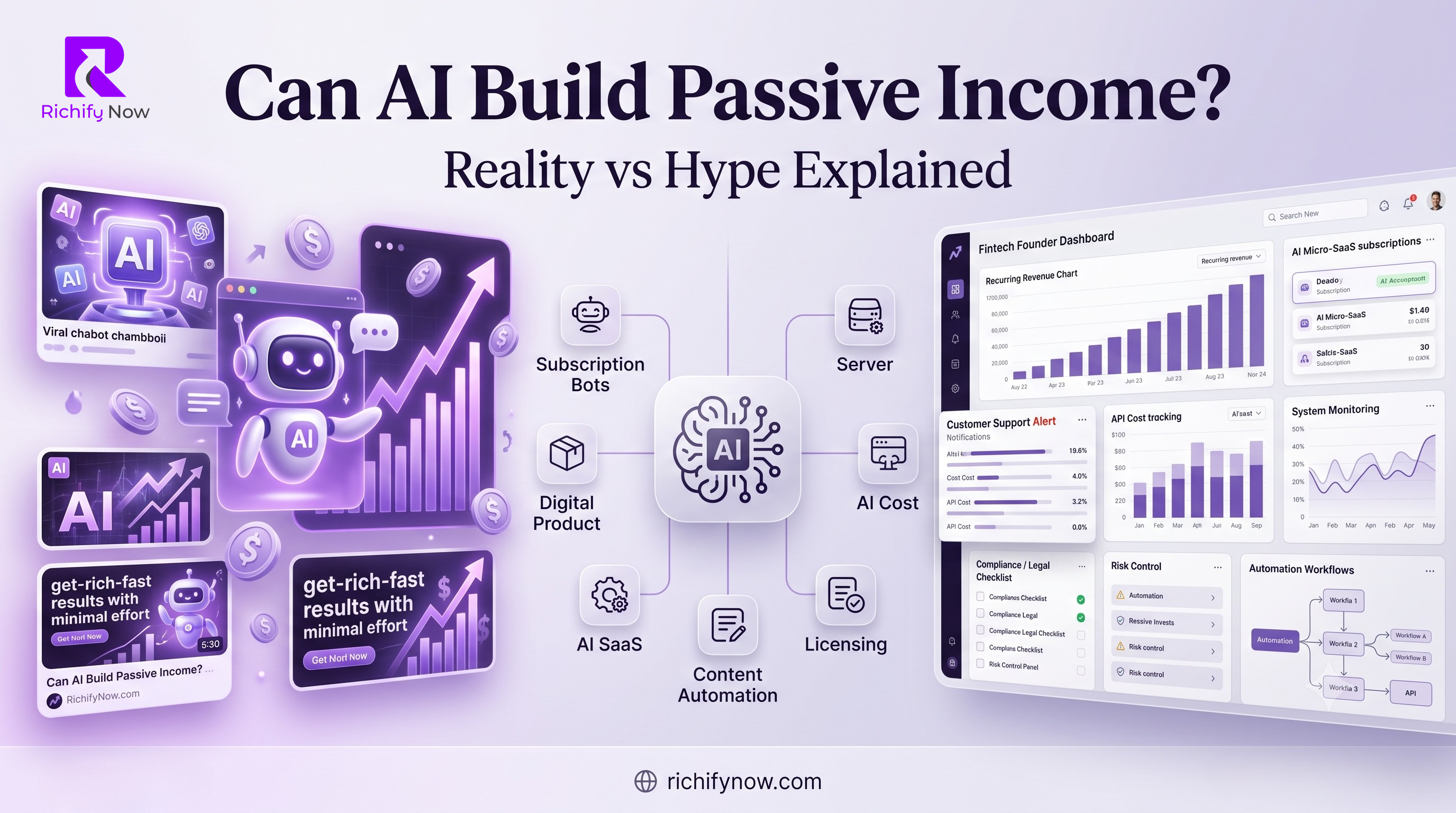
Can AI Build Passive Income? Separating Reality From Hype
AI can help create passive-like income, but it rarely creates money without work. This guide separates reality from hype by explaining AI micro-SaaS, subscription bots, content automation, digital products, licensing, costs, risks, and the systems needed to build sustainable AI-powered income.
Explore whether AI can really build passive income, including AI micro-SaaS, subscription bots, content automation, digital products, licensing, costs, risks, and realistic income models
Key Takeaways
- Explore whether AI can really build passive income, including AI micro-SaaS, subscription bots, content automation, digital products, licensing, costs, risks, and realistic income models
- This guide belongs to Wealth Building, so use it as education before making personal financial, legal, tax, investment, or business decisions.
- Compare the upside, cost, time requirement, and risk before applying any passive income idea.
- The best next step is to review the checklist or related hub, then validate the idea against your own situation.

Passive Income 💜 RichifyNow
Can AI Build Passive Income? Separating Reality From Hype
A practical RichifyNow guide to understanding where AI can create passive-like income, where the hype breaks down, and what risks investors and creators must calculate before building AI-powered revenue systems 🚀
Executive Summary 🧠
AI can help build passive-like income, but it rarely creates income that is truly hands-off
The realistic version is a recurring-revenue business with a strong automation layer, such as a narrow AI micro-SaaS product, a subscription bot, a licensed digital asset, an API-backed workflow, or a content system supported by monetization funnels
The unrealistic version is the social-media fantasy where a general AI tool generates money forever while the owner does nothing
In real life, someone still has to monitor output quality, control costs, handle users, protect data, improve prompts, check legal risk, manage subscriptions, and fix systems when the model or platform changes
NIST’s 2026 monitoring guidance explains that deployed AI systems need ongoing measurement because reliability, drift, unexpected outputs, and harmful consequences can appear after launch
That means AI income can become semi-passive, but only after the business has systems, guardrails, distribution, customer trust, and a clear monetization model
RichifyNow Wealth Note ⚠️
This blog is for educational and business research purposes only
AI-based income models can involve platform risk, legal risk, privacy risk, copyright uncertainty, subscription churn, API cost increases, tax obligations, and changing market demand
Before investing money into any AI passive income idea, review your emergency fund, skill level, target market, cost structure, legal obligations, and ability to maintain the system after launch
The Demand Is Real But The Hype Is Dangerous 📊
The demand side of AI is real
Stanford’s 2026 AI Index reported that estimated U.S. consumer surplus from generative AI reached about $172 billion annually by early 2026
Adobe Analytics also reported that traffic from generative-AI sources to U.S. retail websites rose 1,200% between July 2024 and February 2025
These figures show that users are not only testing AI tools, they are increasingly allowing AI systems to influence search, shopping, workflows, and decision-making
For entrepreneurs, this creates opportunity
If AI can reduce labor, improve conversion, automate repetitive work, create faster content systems, or support a recurring workflow, it can become part of an income-producing asset
But the supply side is not simple
Stanford’s 2026 AI Index also highlighted the massive economics behind frontier AI, estimating OpenAI annualized revenue at $25 billion by January 2026 and Anthropic annualized revenue at $19 billion, while reported 2025 compute spend was about $16.3 billion for OpenAI and $6.8 billion for Anthropic
This does not look like a simple “build an AI model and retire” opportunity for beginners
The better opportunity is not building the whole AI infrastructure
The better opportunity is using existing AI infrastructure to solve a specific problem, serve a specific audience, and charge for a specific outcome
Graph 1: AI Opportunity Versus Reality
This visual compares the attractive opportunity signals with the real operating demands behind AI income models
Generative AI retail traffic growth 1,200%
Estimated U.S. consumer surplus from generative AI $172B
OpenAI estimated 2025 compute spend $16.3B
Anthropic estimated 2025 compute spend $6.8B
Chart note: values are based on high-level research from Stanford AI Index 2026 and Adobe Analytics reporting, shown for educational comparison only
What AI Passive Income Really Means 💸
AI passive income does not mean zero work
A better term is passive-like income
Passive-like AI income appears when AI helps reduce repeated manual delivery while the business continues to earn through subscriptions, licensing, affiliate revenue, usage fees, digital product sales, or automated service delivery
The income becomes more passive only when four conditions are present
1 Repeatable Problem
The customer pain must happen again and again, not just once
2 Recurring Payment
The income should come from subscription, usage, renewals, or repeat demand
3 Controlled Cost
AI usage, hosting, storage, and support costs must stay predictable
4 Limited Human Review
The owner should monitor and improve the system, not manually deliver every output
If these conditions are missing, AI may still make money, but the model behaves more like freelancing, consulting, agency work, or short-term product sales
That is not bad
It is simply not passive income
The AI Passive Income Filter 🧭
Before building any AI income idea, use this decision filter
RichifyNow AI Income Decision Flow
Question 1: Is the customer pain narrow and repeatable?
If no: The idea is probably hype, consulting, or one-off work
Question 2: Can you charge monthly, annually, or by usage?
If no: Revenue resets constantly and becomes less passive
Question 3: Can model and hosting costs stay predictable?
If no: Revenue may grow while profit disappears
Question 4: Do you own distribution, data, audience, or workflow knowledge?
If no: You may become a commodity wrapper around someone else’s AI model
Final result: Only ideas that pass all four questions deserve serious passive-income consideration
5 AI Income Models That Can Actually Work ⚙️
Among all the AI income ideas promoted online, five models deserve serious attention because they connect AI automation with real monetization mechanics
Each model can work, but each has different capital needs, operating complexity, risk, and time-to-break-even
These ranges are planning estimates, not income promises
They are based on typical lean-builder assumptions using hosted AI APIs, serverless hosting, databases, payment systems, and support requirements
The main lesson is simple
AI income is usually affordable to test when you use hosted APIs, but it becomes much more expensive when you train, fine-tune, or host models on GPUs
1. AI Micro-SaaS 🧩
AI micro-SaaS is one of the strongest passive-like income models because it combines recurring billing with a focused workflow
The winning pattern is not a generic chatbot
The winning pattern is a specific tool that solves a specific business problem
Examples may include invoice follow-up automation, ecommerce product description enrichment, compliance document review, real estate listing optimization, meeting summary workflows, lead research, AI-powered reporting, or customer support triage
This model becomes valuable when users do not feel like they are paying for AI
They feel like they are paying for time saved, mistakes reduced, sales improved, or admin work removed
The danger is pricing the product too cheaply while offering unlimited AI usage
If a user pays $19 per month but consumes more than that in model output, hosting, and support, the business grows revenue while damaging margin
RichifyNow Rule 💜
Do not sell “unlimited AI” unless you fully understand your usage cost, abuse risk, support load, and margin ceiling
2. Subscription Bots 🤖
Subscription bots can work when customers repeatedly ask the same kind of questions or need repeated workflow assistance
Examples include internal knowledge bots, appointment support bots, property management bots, legal intake bots, education assistants, documentation assistants, and niche customer support bots
The strength is recurring usage
The weakness is trust
If the bot gives wrong information, the business owner may still be responsible
The Air Canada chatbot case became a warning example because a company was held liable after its chatbot gave incorrect fare guidance
That means subscription bots should be built with clear limits, human review where needed, logs, disclaimers, verified knowledge bases, escalation options, and monitoring
A bot that answers everything confidently is not always a good business
A bot that answers a narrow set of things reliably can be much more valuable
3. Content Automation And Affiliate Funnels 📝
Content automation is one of the most popular AI passive income ideas
It can work, but it is also one of the most overhyped
AI can help with research, outlines, topic clustering, comparisons, summaries, localization, product descriptions, and conversion testing
But revenue still depends on traffic, ranking, search visibility, AI-answer visibility, affiliate terms, email capture, trust, and conversion rate
Adobe Analytics reported a 1,200% increase in generative-AI traffic to U.S. retail sites between July 2024 and February 2025, which shows that AI-driven discovery is becoming commercially relevant
However, automated content without quality control can damage trust quickly
CNET had to correct many AI-written stories, and AP reported a case where AI-aided research led to a newspaper supplement recommending non-existent books
For RichifyNow readers, the conclusion is clear
AI can accelerate content systems, but it cannot replace editorial judgment, source checking, monetization strategy, or audience trust
4. AI Digital Products And Licensing 📦
AI can help create digital products such as templates, prompt packs, training resources, design assets, writing kits, spreadsheet tools, dashboards, audio assets, and niche educational products
These products can create passive-like income when they are sold repeatedly through a landing page, marketplace, email funnel, or brand audience
Adobe Firefly shows that demand for AI-assisted creation is real
Adobe said in 2025 that Firefly users had generated more than 20 billion commercially safe assets globally and were creating more than one billion Firefly assets per month
But digital products also face defensibility problems
OpenAI’s terms say users may own output as between themselves and OpenAI, but they also warn that outputs may not be unique
The U.S. Copyright Office has stated that purely AI-generated content cannot be protected by copyright and that prompts alone generally do not provide enough human control for authorship
That means AI products are strongest when human expertise, brand design, organization, original data, editing, packaging, and audience trust are added
5. Model-As-A-Service Or API Monetization ⚙️
Model-as-a-service can be powerful when the builder owns a specialized dataset, a niche benchmark, a strong developer audience, or a workflow that others want to integrate through API access
But this is usually not the best beginner model
It requires stronger technical skill, documentation, uptime planning, pricing design, abuse prevention, latency control, and cost monitoring
For most builders, the better path is to prove demand through a product first, then expose API access later if customers request integration
Trying to monetize an API before proving the workflow can lead to high development cost and weak adoption
Graph 2: Illustrative AI Micro-SaaS Break-Even Model 📈
The next graph shows a simplified example of a $19 per month AI micro-SaaS product
The line shows monthly revenue and the bars show estimated monthly operating cost
This is an educational model, not a promise of profit
Monthly Revenue Versus Estimated Cost
10 subscribers Revenue $190 / Cost $71
25 subscribers Revenue $475 / Cost $103
50 subscribers Revenue $950 / Cost $155
100 subscribers Revenue $1,900 / Cost $260
250 subscribers Revenue $4,750 / Cost $575
Chart assumptions: $19 monthly subscription, lightweight text usage, hosted API model, about $50 fixed monthly stack cost, and estimated variable usage cost per customer
The Cost Stack Behind AI Income 💳
The biggest misunderstanding in AI passive income is that API cost is the only cost
In practice, an AI product may include app hosting, database usage, authentication, payment processing, AI model usage, storage, monitoring, analytics, email tools, customer support, legal review, and security tools
OpenAI and Anthropic publish token-based pricing for API models, while platforms such as Cloudflare, Vercel, Supabase, AWS, and Lambda publish hosting, database, serverless, storage, and GPU cost structures
A lightweight AI tool can be cheap to test
A heavy AI product with long prompts, large outputs, document processing, images, audio, video, or GPU hosting can become expensive quickly
Break-Even Timeline: What Is Realistic? ⏳
Different AI income models have different timelines
A narrow subscription bot sold to an existing audience may break even in two to six months
An AI micro-SaaS product may need four to twelve months because onboarding, retention, positioning, and customer acquisition take time
A content and affiliate system may need six to eighteen months because authority, traffic, email capture, and search visibility take time
A model-as-a-service business may need six to twenty-four months because technical trust and developer adoption are harder to earn
These are planning estimates, not guaranteed results
Graph 3: Estimated Time To Break Even
Subscription bot 2 to 6 months
AI micro-SaaS 4 to 12 months
Content and affiliate system 6 to 18 months
Model-as-a-service 6 to 24 months
Chart note: timeline ranges are educational estimates based on product complexity, distribution difficulty, and operating requirements
Case Studies: What Real Companies Teach Us 🏢
Duolingo Shows AI Subscription Monetization Can Work
Duolingo’s investor materials showed that higher-priced tiers including Max helped increase subscription ARPU, while generative-AI and hosting costs still affected gross margin
This is an important lesson
AI subscriptions can create value when the product already has user trust, retention, and pricing power
But AI features are not free
Compute becomes part of the cost of goods sold
Shutterstock Shows Licensing Can Be Valuable But Uneven
Shutterstock reported strong revenue from its Data, Distribution, and Services category in 2025, including data-related business connected with AI demand
This shows that data licensing and content licensing can be serious business models
But licensing revenue can be lumpy because contracts, delivery timing, and recognition schedules do not always create smooth monthly income
Adobe Firefly Shows Demand For AI Creation Is Massive
Adobe said Firefly users generated more than 20 billion commercially safe assets and were creating more than one billion assets per month
This proves that users want AI-assisted creation tools
But it also shows the importance of brand trust, licensing clarity, and workflow integration
A random AI image pack is much weaker than a trusted creative system with clear commercial positioning
Air Canada Shows AI Errors Can Create Liability
The Air Canada chatbot case showed that businesses may still be held responsible when an AI chatbot gives incorrect information
This matters for anyone building subscription bots, AI assistants, legal tools, financial tools, travel tools, customer support bots, or any product where wrong answers can cause real harm
Legal, Copyright, Privacy, And Tax Risks ⚖️
AI income models also carry risks that many beginners ignore
Copyright is one of the biggest issues
OpenAI’s terms may assign output ownership to users as between the user and OpenAI, but outputs may not be unique
The U.S. Copyright Office has stated that purely AI-generated content cannot be protected by copyright and that prompts alone usually do not provide enough human authorship
This means AI-generated digital products, images, ebooks, music, prompts, templates, and brand assets must be reviewed carefully before being sold as exclusive property
Privacy is another issue
The European Data Protection Board has warned that AI models trained with personal data cannot always be considered anonymous, and the EU AI Act creates a broader regulatory framework for AI systems in Europe
Tax is also important
SaaS subscriptions, affiliate commissions, digital product revenue, and licensing income may be taxed differently depending on jurisdiction, business structure, and whether the income is treated as business income, royalty income, or self-employment income
The OECD VAT/GST guidance and IRS royalty guidance both show that digital and intangible income should be treated as a real business issue, not an afterthought
Risk Checklist Before Launch 🚨
- Do you have clear terms of service?
- Do you explain AI limitations to users?
- Do you monitor wrong outputs?
- Do you control API usage and abuse?
- Do you understand copyright ownership limits?
- Do you store user data safely?
- Do you have a refund and support process?
- Do you track tax obligations?
- Do you have a backup plan if model pricing changes?
The RichifyNow AI Passive Income Playbook 💜
If the goal is reliable passive-like income rather than AI hype, use a disciplined sequence
Use The A I S E Framework
A — Audience: Know exactly who has the problem and why they will pay
I — Income model: Choose recurring billing, licensing, usage fees, affiliate revenue, or digital product sales
S — System: Build automation, cost guards, monitoring, and repeatable delivery
E — Evidence: Prove demand through users, retention, conversion, or paying customers before scaling
The best AI income ideas usually begin manually
You solve the problem for real users first
Then you automate the repeatable parts
Then you package the system into a subscription, product, or licensing model
This is slower than hype content suggests, but it creates a stronger asset
Common Mistakes To Avoid 🚫
The first mistake is building an AI tool before confirming that people will pay for the outcome
The second mistake is creating a generic chatbot with no niche advantage
The third mistake is ignoring model cost and offering unlimited usage
The fourth mistake is assuming AI-generated content is automatically copyright-protected
The fifth mistake is publishing AI content without source checking
The sixth mistake is depending on one platform, one API provider, one social channel, or one affiliate partner
The seventh mistake is confusing revenue with profit
The eighth mistake is calling a business passive before support, monitoring, refunds, and updates are included
Internal Reading Path For RichifyNow Readers 🔗
FAQs ❓
Can AI really create passive income?
Yes, AI can help create passive-like income when it supports recurring revenue, automation, digital product sales, licensing, or subscription systems, but it usually requires setup, monitoring, customer support, and continuous improvement
What is the best AI passive income model?
For many builders, AI micro-SaaS is one of the strongest models because it solves a narrow workflow problem and can charge recurring subscription fees
Is AI content automation a good passive income idea?
It can work if combined with strong editorial quality, source checking, SEO strategy, affiliate offers, email capture, and audience trust, but fully automated low-quality content is risky
Can AI-generated products be sold legally?
They can be sold in many cases, but copyright protection and exclusivity may be limited if the product is entirely AI-generated without meaningful human authorship, so sellers should review legal guidance carefully
How much does it cost to start an AI income project?
A simple AI content or digital product project may start with a few hundred dollars, while AI micro-SaaS may require several thousand dollars depending on design, development, hosting, API usage, and customer support needs
Final Verdict 💜
AI can build passive-like income, but it does not remove the need for business judgment
The hype says AI will do the work while you sleep
The reality is that AI can reduce repeated labor after you build a real system around it
The best opportunities are not generic prompts, random chatbots, or mass-produced content farms
The best opportunities are focused AI products that solve repeatable problems, charge recurring fees, control usage costs, protect user trust, and improve over time
For RichifyNow readers, the key lesson is simple
Do not chase AI passive income because it sounds easy
Build AI income because you understand a real problem, can automate part of the solution, and can turn that solution into a durable digital asset
AI can become a wealth accelerator, but only when it is connected to strategy, distribution, risk control, and execution
RichifyNow Insight 🚀
AI does not magically create passive income, but it can turn a repeatable workflow into a scalable asset when the business has a clear audience, controlled costs, recurring revenue, and real monitoring behind the scenes
Explore More Passive Income GuidesReferences 📚
- Stanford HAI, The 2026 AI Index Report, economy and responsible AI sections
- Stanford HAI, The 2025 AI Index Report, inference cost decline summaries
- NIST, Challenges to the Monitoring of Deployed AI Systems, March 2026
- NIST, AI Risk Management Framework 1.0 and Generative AI Profile
- Adobe Analytics report on generative AI traffic to U.S. retail websites
- Adobe Firefly usage and plan information from Adobe
- OpenAI API pricing, deprecation guidance, data controls, and terms of use
- Anthropic Claude API pricing, rate limits, and data retention guidance
- Cloudflare Workers and Workers AI pricing, spend limits, and model deprecation updates
- Vercel, Supabase, AWS, and Lambda pricing pages for infrastructure and GPU cost references
- Duolingo investor materials discussing AI product tiers, subscription ARPU, and hosting cost impact
- Shutterstock 2025 financial results discussing data, distribution, and services revenue
- U.S. Copyright Office report on copyrightability and artificial intelligence
- European Data Protection Board Opinion 28/2024 on AI models and personal data
- Regulation EU 2024/1689, commonly known as the EU AI Act
- OECD International VAT/GST Guidelines and IRS guidance on taxable income and royalties
- Reporting and legal commentary on the Air Canada chatbot case
- Reporting on AI-assisted publishing errors involving CNET and AI-recommended non-existent books
What is Can AI Build Passive Income? Separating Reality From Hype?
Explore whether AI can really build passive income, including AI micro-SaaS, subscription bots, content automation, digital products, licensing, costs, risks, and realistic income models
Why Passive Income matters
Passive income is income designed to continue after the initial work is done, but most passive income systems still require upfront effort, maintenance, capital, or skill. These guides explain realistic passive income assets, their risks, costs, timelines, and long-term potential.
How it works
Start by identifying the outcome you want, then compare the practical steps, required resources, risks, and evidence behind each option. RichifyNow frames this topic as education so readers can think more clearly before acting.
Step-by-step framework
- Clarify the main goal and the decision you are trying to make.
- Separate facts, assumptions, examples, and opinion before acting.
- Compare costs, risks, time horizon, complexity, and required skill.
- Use a small test, checklist, or expert review before committing more capital or time.
- Document what you learned and update the system when conditions change.
Comparison table / checklist
| Check | Why it matters |
|---|---|
| What problem does this solve? | Use this question to avoid one-size-fits-all decisions and compare options responsibly. |
| What result is realistic, and what result would be hype? | Use this question to avoid one-size-fits-all decisions and compare options responsibly. |
| What money, time, legal, tax, operational, or market risks matter? | Use this question to avoid one-size-fits-all decisions and compare options responsibly. |
| What source or professional should verify the decision? | Use this question to avoid one-size-fits-all decisions and compare options responsibly. |
| What is the smallest responsible next action? | Use this question to avoid one-size-fits-all decisions and compare options responsibly. |
Common mistakes
- Treating an educational example as personal advice.
- Ignoring fees, taxes, legal structure, compliance, or operational complexity.
- Assuming past performance, online examples, or case studies guarantee future results.
- Skipping verification from qualified professionals for high-stakes decisions.
Risks and limitations
Every money, business, investing, legal, tax, SaaS, or risk-management topic has limitations. Rules, pricing, market conditions, tools, and laws can change. Readers should verify current details and consult qualified professionals before making decisions that affect capital, liability, tax exposure, contracts, or business operations.
Best next step
FAQs
What is Can AI Build Passive Income? Separating Reality From Hype?
Explore whether AI can really build passive income, including AI micro-SaaS, subscription bots, content automation, digital products, licensing, costs, risks, and realistic income models
Why does Passive Income matter?
Passive income is income that can continue with less daily effort after setup, such as digital products, content assets, dividends, rentals, memberships, or automated systems. It is rarely effortless and usually requires capital, time, skill, or ongoing management.
What risks should readers understand?
Readers should consider financial loss, legal or tax complexity, changing market conditions, execution risk, data quality, vendor reliability, and personal fit before acting.
What is the best next step?
Get the Passive Income Asset Scorecard.
Sources and methodology
This page follows the RichifyNow research method: identify reader intent, explain the main answer early, organize the topic into practical sections, include risk notes, and point readers toward responsible next steps. For changing topics such as laws, taxes, software pricing, markets, and regulations, readers should verify the latest details with official sources or qualified professionals.

Comments