
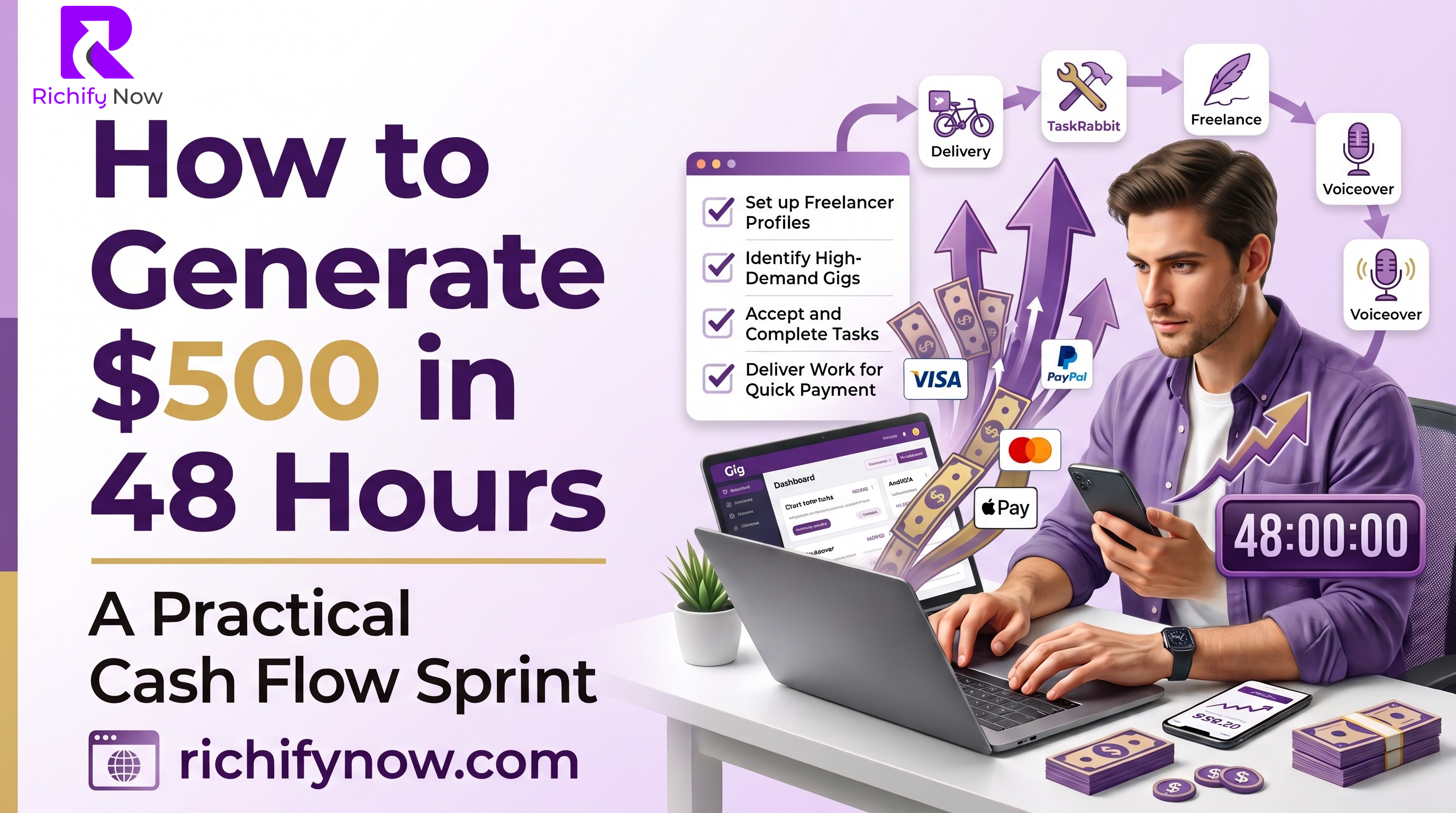
How to Generate $500 in 48 Hours: A Practical Cash Flow Sprint
A short-cycle framework for generating $500 liquidity within 24–48 hours using fast, low-barrier income methods and rapid execution strategies.
Generating $500 quickly usually requires selling a simple service, asset, product, or offer to people with immediate demand. It is an execution sprint, not a guaranteed income formula.
Key Takeaways
- Generating $500 quickly usually requires selling a simple service, asset, product, or offer to people with immediate demand. It is an execution sprint, not a guaranteed income formula.
- This guide belongs to Business Growth, so use it as education before making personal financial, legal, tax, investment, or business decisions.
- Compare the upside, cost, time requirement, and risk before applying any sales systems idea.
- The best next step is to review the checklist or related hub, then validate the idea against your own situation.

🚀 Introduction: The Concept of Liquidity Speed
Modern financial survival is no longer defined by long-term accumulation alone, but by the ability to generate **instant liquidity under constrained conditions**.
The Liquidity Sprint is a structured methodology designed to create a **$500 working capital floor within 24–48 hours** using high-intent, low-barrier execution systems.
🔄 1. Understanding the Liquidity Sprint Model
The Liquidity Sprint is based on a short-cycle capital activation framework designed for immediate cash flow creation.
📉 Traditional Approach
- Long-term income planning
- Delayed revenue realization
- High dependency on stability
⚡ Sprint Model
- 24–48 hour execution window
- High-frequency micro revenue actions
- Immediate settlement focus
⚙️ 2. Core Framework of Rapid Capitalization
The sprint model operates through three structured layers:
📥 Input Layer: Resource Activation
- Existing skills
- Available tools
- Immediate-access platforms
⚙️ Execution Layer: Fast Monetization
- Service delivery
- Task-based revenue
- Micro transactions
💰 Output Layer: Liquidity Capture
- Instant payments
- Daily settlements
- Rapid reinvestment potential
📈 3. High-Intent Revenue Channels
The liquidity sprint focuses on channels with **immediate demand and low entry friction**.
- ⚡ Freelance micro-services
- 📊 Digital task completion
- 🧾 Resale arbitrage opportunities
- 📱 Local service fulfillment
- 🤝 Direct client outreach systems
🧠 4. Execution Psychology
The success of a liquidity sprint is determined by execution speed, not strategy complexity.
- ❌ Overthinking reduces output
- ⚡ Speed increases conversion probability
- 📊 Iteration replaces perfection
⚖️ 5. Risk Management in Short-Term Capital Cycles
- 📉 Avoid high-lock capital systems
- 💧 Maintain immediate liquidity access
- 🔁 Focus on repeatable low-risk cycles
- 📊 Diversify micro income attempts
🔁 6. Cycle Acceleration Strategy
Instead of relying on a single income event, the sprint model focuses on multiple rapid cycles.
🧩 7. Structural Blueprint for $500 Liquidity Floor
- 🎯 Define immediate income targets
- ⚙️ Select 2–3 fast conversion methods
- 📊 Execute in parallel cycles
- 💰 Capture and consolidate earnings
📡 8. Operational Constraints & Realities
Liquidity sprint models operate under real-world constraints that must be acknowledged.
- ⏱️ Time sensitivity (24–48 hours)
- 📉 Market availability limits
- 💼 Skill-dependent execution speed
🔮 9. Evolution of Micro-Liquidity Systems
Future financial systems will increasingly support real-time income generation structures.
- 🤖 AI-assisted micro work systems
- 📱 Instant payout platforms
- 🌐 Decentralized gig economies
- ⚡ Real-time labor marketplaces
🏁 Conclusion: Liquidity as an Activation Problem
The Liquidity Sprint reframes financial survival and growth as a function of execution speed rather than long-term planning.
What is How to Generate $500 in 48 Hours: Practical Cash Flow Sprint?
Generating $500 quickly usually requires selling a simple service, asset, product, or offer to people with immediate demand. It is an execution sprint, not a guaranteed income formula.
Why Sales Systems matters
Sales systems turn offers, conversations, pricing, and fulfillment into repeatable revenue. These guides explain practical ways to generate cash flow through services, resale, short-term campaigns, and structured execution.
How it works
Start by identifying the outcome you want, then compare the practical steps, required resources, risks, and evidence behind each option. RichifyNow frames this topic as education so readers can think more clearly before acting.
Step-by-step framework
- Clarify the main goal and the decision you are trying to make.
- Separate facts, assumptions, examples, and opinion before acting.
- Compare costs, risks, time horizon, complexity, and required skill.
- Use a small test, checklist, or expert review before committing more capital or time.
- Document what you learned and update the system when conditions change.
Comparison table / checklist
| Check | Why it matters |
|---|---|
| What problem does this solve? | Use this question to avoid one-size-fits-all decisions and compare options responsibly. |
| What result is realistic, and what result would be hype? | Use this question to avoid one-size-fits-all decisions and compare options responsibly. |
| What money, time, legal, tax, operational, or market risks matter? | Use this question to avoid one-size-fits-all decisions and compare options responsibly. |
| What source or professional should verify the decision? | Use this question to avoid one-size-fits-all decisions and compare options responsibly. |
| What is the smallest responsible next action? | Use this question to avoid one-size-fits-all decisions and compare options responsibly. |
Common mistakes
- Treating an educational example as personal advice.
- Ignoring fees, taxes, legal structure, compliance, or operational complexity.
- Assuming past performance, online examples, or case studies guarantee future results.
- Skipping verification from qualified professionals for high-stakes decisions.
Risks and limitations
Every money, business, investing, legal, tax, SaaS, or risk-management topic has limitations. Rules, pricing, market conditions, tools, and laws can change. Readers should verify current details and consult qualified professionals before making decisions that affect capital, liability, tax exposure, contracts, or business operations.
Best next step
FAQs
What is How to Generate $500 in 48 Hours: Practical Cash Flow Sprint?
Generating $500 quickly usually requires selling a simple service, asset, product, or offer to people with immediate demand. It is an execution sprint, not a guaranteed income formula.
Why does Sales Systems matter?
A sales system is a repeatable process for finding prospects, presenting an offer, converting buyers, delivering value, and reinvesting revenue. Beginners can use simple service offers, resale, outreach, and focused revenue sprints to build cash flow.
What risks should readers understand?
Readers should consider financial loss, legal or tax complexity, changing market conditions, execution risk, data quality, vendor reliability, and personal fit before acting.
What is the best next step?
$500 Sprint Planner
Sources and methodology
This page follows the RichifyNow research method: identify reader intent, explain the main answer early, organize the topic into practical sections, include risk notes, and point readers toward responsible next steps. For changing topics such as laws, taxes, software pricing, markets, and regulations, readers should verify the latest details with official sources or qualified professionals.

Comments