
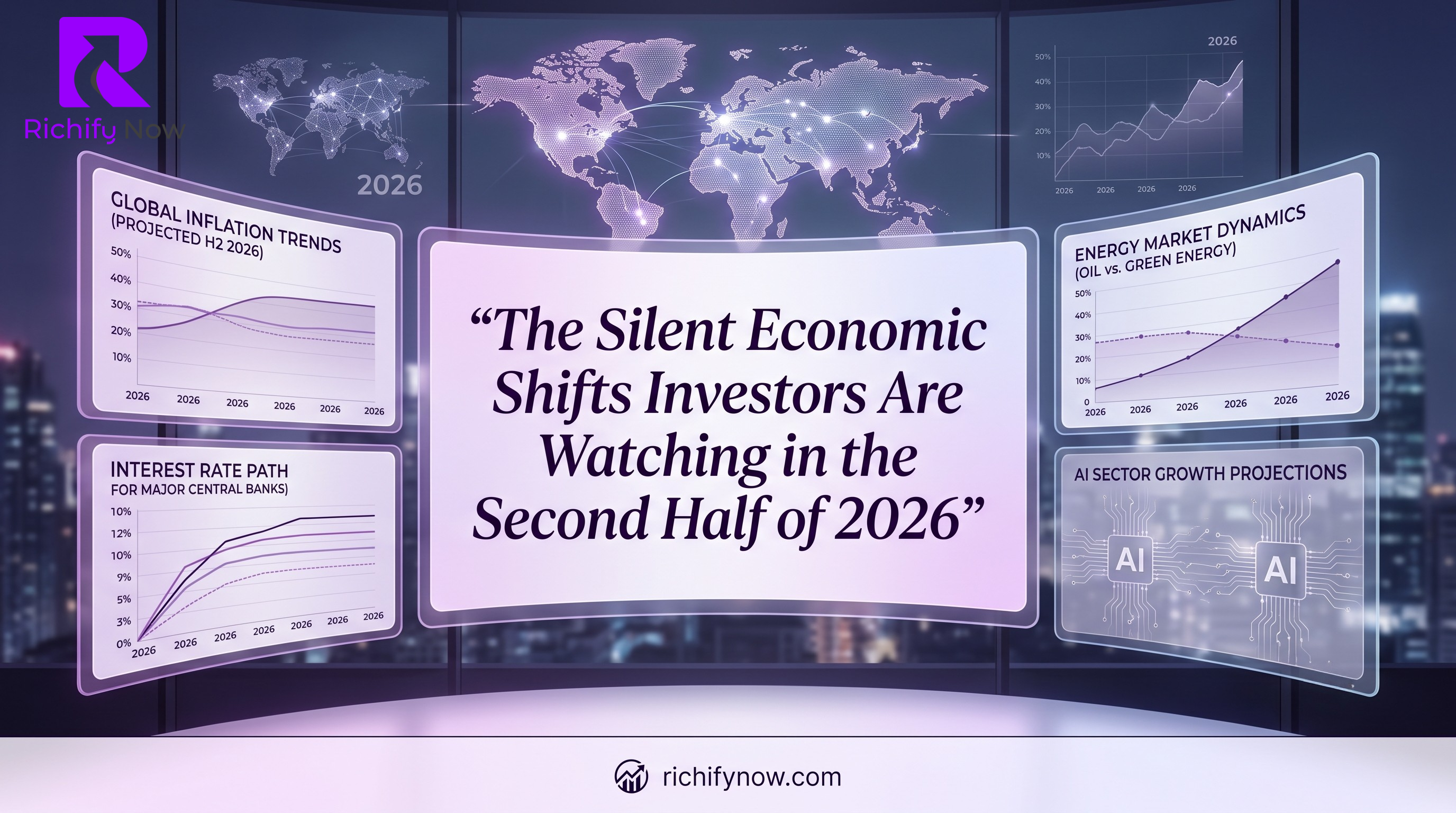
The Silent Economic Shifts Investors Are Watching in the Second Half of 2026
Explore the silent economic shifts investors are watching in the second half of 2026, from inflation and interest rates to AI spending, energy pressure, debt risks, and uneven global growth.
Investors watch economic shifts such as inflation, interest rates, AI spending, energy pressure, debt risk, labor changes, and global growth because these forces can affect asset prices, business strategy, and risk. Readers should treat trend analysis as educational, not predictive.
Key Takeaways
- Investors watch economic shifts such as inflation, interest rates, AI spending, energy pressure, debt risk, labor changes, and global growth because these forces can affect asset prices, business strategy, and risk. Readers should treat trend analysis as educational, not predictive.
- This guide belongs to Capital Intelligence, so use it as education before making personal financial, legal, tax, investment, or business decisions.
- Compare the upside, cost, time requirement, and risk before applying any market trends idea.
- The best next step is to review the checklist or related hub, then validate the idea against your own situation.

Introduction
Markets rarely move because of one single event. They move because of several quiet forces building pressure beneath the surface. A headline may create the reaction, but the real shift usually starts much earlier. Inflation changes slowly. Interest-rate expectations adjust gradually. Consumer behavior weakens before it becomes visible in earnings. Debt pressure grows before it becomes a crisis. Technology cycles attract capital before they reshape entire industries.
That is why the second half of 2026 is an important period for investors. The world is not standing still. Economies are adjusting to higher borrowing costs, persistent inflation, energy uncertainty, geopolitical tension, AI-led investment, changing labor markets, and tighter household budgets. These movements may not always look dramatic at first, but they can influence where money flows next.
For investors, the real question is not simply whether the market goes up or down in the next few months. The better question is: which economic shifts are strong enough to change the investment landscape?
In this article, we will explore the silent economic shifts investors are watching in the second half of 2026, and why these trends matter for portfolios, businesses, and long-term wealth planning.
1. Inflation Is Not Gone — It Has Changed Shape 🔥
One of the biggest mistakes investors can make in 2026 is assuming inflation has disappeared just because the most extreme price shocks of earlier years are no longer dominating every conversation. Inflation has become more complex. Instead of one clear wave, it is now appearing through energy costs, services pricing, wages, insurance, housing, logistics, and supply disruptions.
This matters because inflation affects almost every asset class. It influences central bank policy, bond yields, company margins, consumer purchasing power, and currency strength. When inflation stays above comfort levels, markets begin to question whether interest rates can fall quickly. If rates remain higher for longer, growth stocks, real estate, debt-heavy companies, and speculative assets can face pressure.
Investors are now looking beyond headline inflation. They are watching core inflation, producer prices, energy prices, rent trends, wage growth, and business cost structures. A company may show revenue growth, but if its costs are rising faster than sales, profit margins can shrink. That is why inflation is not just a consumer problem. It is also an earnings problem.
What investors are watching
- Whether inflation continues to stay above central bank targets
- How energy and commodity prices affect production costs
- Whether companies can pass higher costs to customers
- How wage pressure affects corporate margins
- Whether inflation delays expected rate cuts
The silent shift is that inflation is moving from a temporary shock story to a structural pricing-pressure story. Investors who understand this difference are less likely to be surprised when markets react strongly to inflation data.
2. Interest Rates Are Becoming a Confidence Test 🏦
Interest rates are more than numbers set by central banks. They are a confidence test for the entire financial system. When rates are low, money is cheaper, valuations usually expand, borrowing becomes easier, and investors are more willing to take risks. When rates stay high, every decision becomes more expensive.
In the second half of 2026, investors are watching whether central banks can control inflation without damaging growth. This is a difficult balance. If rates stay too high for too long, businesses may reduce investment, consumers may spend less, and debt pressure may rise. If rates fall too quickly while inflation remains sticky, markets may worry that price instability will return.
This uncertainty affects bonds, stocks, real estate, currencies, and private markets. Bond investors watch rate expectations closely because even small changes can affect yields and prices. Equity investors watch rates because higher yields can make future earnings less valuable today. Real estate investors watch rates because mortgage costs and financing conditions directly affect demand.
The silent shift is that investors are no longer only asking, “When will rates fall?” They are asking, “What if the economy has entered a higher-rate environment for longer than expected?”
Why this matters
- Higher rates can pressure expensive growth stocks
- Borrowing costs can slow business expansion
- Mortgage rates can affect property demand
- Debt-heavy companies can face refinancing pressure
- Cash and bonds may become more competitive against stocks
Investors who built strategies around the old low-rate world may need to adjust. A higher-rate environment rewards stronger balance sheets, reliable cash flows, pricing power, and disciplined capital allocation.
3. AI Spending Is Becoming a Market Engine 🤖
Artificial intelligence is no longer only a technology theme. It has become a capital spending theme, an infrastructure theme, an energy theme, and a productivity theme. Companies are investing heavily in chips, data centers, cloud infrastructure, automation, software, cybersecurity, and AI-enabled workflows.
This is why investors are watching AI from two angles. The first angle is growth. AI can improve productivity, reduce operating costs, create new products, and open new markets. The second angle is risk. If companies spend aggressively without producing returns, investors may start questioning valuations.
The second half of 2026 may test whether AI optimism can translate into real earnings. Markets have rewarded many companies connected to AI infrastructure, but the next stage will be more selective. Investors will want to know which businesses are truly benefiting from AI and which are only using the theme to attract attention.
AI-related areas investors are watching
- Semiconductors and advanced chips
- Cloud infrastructure and data centers
- Energy demand linked to AI computing
- Enterprise software adoption
- Automation and productivity improvement
- Cybersecurity and data protection
The silent shift is that AI is moving from hype to proof. The market may still reward the theme, but it will increasingly ask for evidence. Companies that can show real revenue growth, margin expansion, productivity gains, or customer adoption may stand out. Companies with only promises may face harder questions.
4. Energy Markets Are Back in the Inflation Conversation ⚡
Energy prices affect much more than fuel bills. They influence shipping costs, manufacturing costs, food prices, electricity prices, government budgets, trade balances, and household spending. When energy markets become unstable, investors quickly start reassessing inflation and growth expectations.
In 2026, energy has returned as a serious macroeconomic variable. Geopolitical conflict, supply risks, shipping routes, production decisions, and demand from technology infrastructure are all part of the conversation. AI data centers also add a new layer because advanced computing requires large amounts of power.
Investors are watching whether energy prices remain contained or create a second wave of inflation pressure. A temporary spike may cause volatility, but a longer period of high energy prices can damage consumer confidence, pressure corporate margins, and complicate central bank decisions.
Why energy matters for portfolios
- It can influence inflation expectations
- It affects transportation and logistics costs
- It changes profitability for energy producers and importers
- It impacts consumer disposable income
- It can affect central bank policy decisions
The silent shift is that energy is no longer only a commodity-sector story. It is connected to technology, security, inflation, trade, and national policy. Investors who ignore energy may miss one of the strongest forces shaping markets in the second half of 2026.
5. Consumers Are Becoming More Selective 🛒
Consumer spending has supported many economies in recent years, but higher prices and borrowing costs are changing behavior. Consumers are not necessarily disappearing from the market, but they are becoming more selective. They compare more, delay bigger purchases, search for value, reduce non-essential spending, and become more sensitive to price increases.
This matters because consumer behavior directly affects corporate earnings. Retailers, restaurants, travel companies, subscription platforms, financial services, housing markets, and automotive businesses all depend on consumer confidence. If households feel pressure from rent, food, debt payments, insurance, or energy, discretionary spending can weaken.
Investors are watching the difference between premium consumers and budget-conscious consumers. Some companies may continue performing well because they serve higher-income customers or essential needs. Others may struggle if their products are easy to delay, replace, or cancel.
Signals investors monitor
- Retail sales trends
- Credit card balances and delinquencies
- Consumer confidence data
- Travel and entertainment spending
- Subscription cancellation rates
- Discounting and promotional activity
The silent shift is not a sudden consumer collapse. It is a gradual change in spending quality. Investors are looking for companies that can keep customers loyal even when budgets tighten.
6. Debt Pressure Is Becoming Harder to Ignore 💳
Debt becomes more dangerous when interest rates stay elevated. Governments, businesses, and households all feel the impact. A loan that looked manageable in a low-rate environment can become difficult when refinancing costs rise. This is why investors are paying closer attention to debt quality in 2026.
For companies, debt pressure can reduce flexibility. More money goes toward interest payments, leaving less available for hiring, expansion, research, dividends, or buybacks. For governments, debt pressure can limit fiscal support and increase borrowing costs. For households, debt pressure can weaken spending power.
In the second half of 2026, investors are watching refinancing walls, credit spreads, default risks, and balance sheet strength. Strong companies with low debt and stable cash flow may be rewarded. Highly leveraged companies may face more scrutiny.
Debt-related warning signs
- Rising interest expense
- Weak cash flow coverage
- Large refinancing needs
- Falling credit ratings
- Wider credit spreads
- Debt-funded growth without profit improvement
The silent shift is that investors are becoming less impressed by growth that depends too heavily on borrowed money. In a tighter financial environment, balance sheet strength becomes a competitive advantage.
7. Global Growth Is Becoming More Uneven 🌍
The global economy is not moving in one direction at the same speed. Some regions are still growing with resilience, while others are dealing with energy exposure, debt pressure, currency weakness, conflict risk, or weaker demand. This uneven growth creates both risks and opportunities for investors.
Emerging markets may offer long-term growth potential, but they can also face pressure from strong currencies, higher borrowing costs, capital outflows, and commodity shocks. Developed markets may offer stability, but slower growth and high valuations can limit upside. Commodity exporters may benefit from higher prices, while importers may suffer from cost pressure.
Investors are watching which economies have policy strength, fiscal discipline, energy security, digital infrastructure, and private investment momentum. The second half of 2026 may reward countries and sectors that can handle volatility rather than simply chase fast growth.
What makes global growth uneven
- Different inflation levels across countries
- Different exposure to energy imports
- Currency volatility
- Debt sustainability concerns
- Geopolitical risk
- Unequal AI and technology adoption
The silent shift is that global investing requires more selectivity. Broad exposure may not be enough. Investors are paying closer attention to quality, region-specific risk, and policy direction.
8. Defensive Quality Is Regaining Respect 🛡️
In strong bull markets, investors often reward excitement. Fast growth, bold promises, and future potential can attract huge amounts of capital. But when uncertainty rises, quality becomes more important. Investors begin to ask whether a business can survive pressure, protect margins, maintain customers, and keep generating cash.
Defensive quality does not mean avoiding growth. It means focusing on businesses and assets with resilience. These may include companies with strong balance sheets, recurring revenue, essential products, pricing power, positive cash flow, and disciplined management.
In the second half of 2026, investors are not only looking for upside. They are looking for durability. A company that can grow during easy conditions is attractive. A company that can protect itself during difficult conditions is even more valuable.
Signs of defensive quality
- Consistent free cash flow
- Low or manageable debt
- Strong customer retention
- Pricing power
- Essential products or services
- Clear profitability path
The silent shift is that investors are becoming more selective about risk. They may still seek growth, but they want growth supported by real fundamentals.
What This Means for Investors
The second half of 2026 is not a simple risk-on or risk-off environment. It is a more selective market. Some sectors may continue benefiting from AI, infrastructure, energy transformation, and productivity investment. Others may face pressure from inflation, rates, consumer weakness, debt costs, or slowing demand.
This type of market rewards patience, research, diversification, and discipline. Investors may need to look beyond headlines and study the deeper signals: margins, cash flow, debt levels, pricing power, capital spending, policy direction, and consumer behavior.
The most important skill may be separating noise from structure. Noise is the daily headline. Structure is the long-term economic force changing how money moves.
How Investors Can Think About the Second Half of 2026
Investors do not need to predict every market move to make better decisions. They need a framework. A useful framework begins with asking what can damage a portfolio, what can support it, and what can surprise it.
Inflation can damage purchasing power and valuation multiples. Interest-rate uncertainty can create volatility in bonds, stocks, and real estate. Energy shocks can change inflation expectations. Debt pressure can expose weak balance sheets. Slower global growth can reduce earnings expectations. At the same time, AI investment, productivity gains, infrastructure spending, and selective consumer strength can support growth in certain areas.
This is why diversification still matters. A portfolio built around only one theme can perform well during favorable conditions but suffer when the theme weakens. A more balanced approach can include growth exposure, income assets, defensive sectors, cash flexibility, and long-term investments aligned with structural trends.
The second half of 2026 may not reward blind optimism or extreme fear. It may reward investors who stay informed, avoid emotional decisions, and understand that economic shifts often begin silently before they become obvious.
Conclusion: The Quiet Signals Matter Most
The biggest market changes are not always loud at the beginning. They often start as quiet shifts in inflation, interest rates, capital spending, consumer behavior, debt pressure, and global growth. By the time they become obvious, markets may have already adjusted.
That is why investors are paying close attention to the second half of 2026. Inflation is still shaping policy. Interest rates remain a major confidence test. AI spending is creating both excitement and valuation risk. Energy markets are influencing inflation expectations. Consumers are becoming more selective. Debt pressure is exposing weak balance sheets. Global growth is uneven. Defensive quality is becoming more valuable.
These are not isolated stories. They are connected forces. Together, they define the market environment investors must navigate.
The opportunity is not only in predicting the next move. The opportunity is in understanding the direction of change. Investors who recognize these silent shifts early can make smarter, calmer, and more strategic decisions.
In the second half of 2026, the market may continue to move quickly, but the strongest investors will not be the ones reacting to every headline. They will be the ones reading the deeper economic signals before the crowd notices.
Stay Ahead of the Market Before the Headlines Arrive 🚀
Smart investing begins with understanding the forces beneath the surface. Watch the silent shifts, study the signals, and build strategies that can survive more than one market season.
What is Economic Shifts Investors Are Watching in 2026?
Investors watch economic shifts such as inflation, interest rates, AI spending, energy pressure, debt risk, labor changes, and global growth because these forces can affect asset prices, business strategy, and risk. Readers should treat trend analysis as educational, not predictive.
Why Market Trends matters
Market trends help investors, founders, and operators understand the forces shaping business and financial decisions. These guides explain major shifts without turning short-term headlines into predictions.
How it works
Start by identifying the outcome you want, then compare the practical steps, required resources, risks, and evidence behind each option. RichifyNow frames this topic as education so readers can think more clearly before acting.
Step-by-step framework
- Clarify the main goal and the decision you are trying to make.
- Separate facts, assumptions, examples, and opinion before acting.
- Compare costs, risks, time horizon, complexity, and required skill.
- Use a small test, checklist, or expert review before committing more capital or time.
- Document what you learned and update the system when conditions change.
Comparison table / checklist
| Check | Why it matters |
|---|---|
| What problem does this solve? | Use this question to avoid one-size-fits-all decisions and compare options responsibly. |
| What result is realistic, and what result would be hype? | Use this question to avoid one-size-fits-all decisions and compare options responsibly. |
| What money, time, legal, tax, operational, or market risks matter? | Use this question to avoid one-size-fits-all decisions and compare options responsibly. |
| What source or professional should verify the decision? | Use this question to avoid one-size-fits-all decisions and compare options responsibly. |
| What is the smallest responsible next action? | Use this question to avoid one-size-fits-all decisions and compare options responsibly. |
Common mistakes
- Treating an educational example as personal advice.
- Ignoring fees, taxes, legal structure, compliance, or operational complexity.
- Assuming past performance, online examples, or case studies guarantee future results.
- Skipping verification from qualified professionals for high-stakes decisions.
Risks and limitations
Every money, business, investing, legal, tax, SaaS, or risk-management topic has limitations. Rules, pricing, market conditions, tools, and laws can change. Readers should verify current details and consult qualified professionals before making decisions that affect capital, liability, tax exposure, contracts, or business operations.
Best next step
FAQs
What is Economic Shifts Investors Are Watching in 2026?
Investors watch economic shifts such as inflation, interest rates, AI spending, energy pressure, debt risk, labor changes, and global growth because these forces can affect asset prices, business strategy, and risk. Readers should treat trend analysis as educational, not predictive.
Why does Market Trends matter?
Market trends are broad patterns in the economy, technology, consumer behavior, interest rates, inflation, capital flows, or industry demand. They help decision-makers understand what may affect risk, growth, and opportunity.
What risks should readers understand?
Readers should consider financial loss, legal or tax complexity, changing market conditions, execution risk, data quality, vendor reliability, and personal fit before acting.
What is the best next step?
Market Briefing Signup
Sources and methodology
This page follows the RichifyNow research method: identify reader intent, explain the main answer early, organize the topic into practical sections, include risk notes, and point readers toward responsible next steps. For changing topics such as laws, taxes, software pricing, markets, and regulations, readers should verify the latest details with official sources or qualified professionals.
Comments