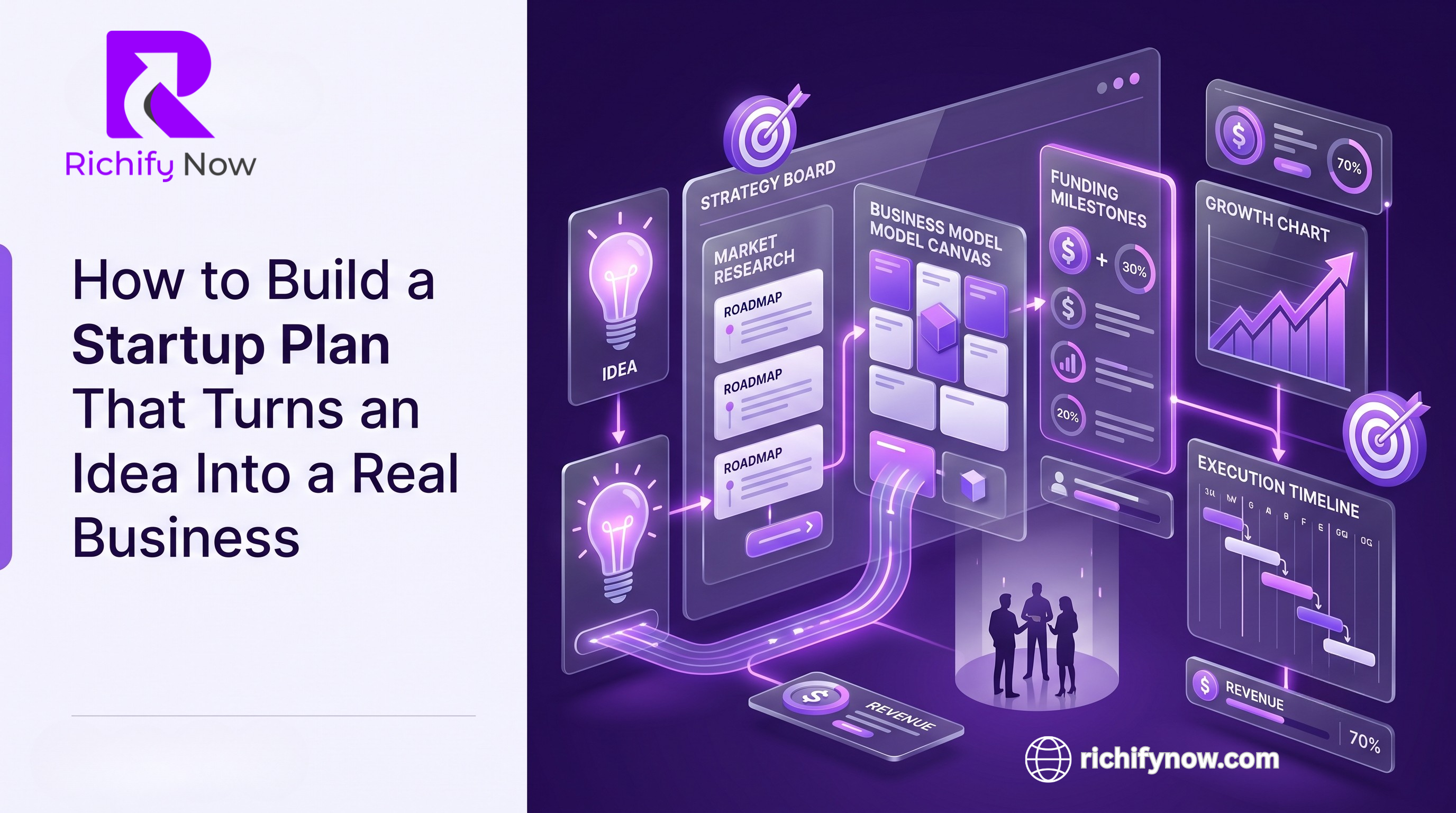
How to Build a Startup Plan That Turns an Idea Into a Real Business
A simple framework for founders to turn ideas into structured, credible, and scalable business plans.
A startup plan turns an idea into a clear model by defining the customer, problem, offer, market, pricing, costs, operations, risks, milestones, and next actions.
Key Takeaways
- A startup plan turns an idea into a clear model by defining the customer, problem, offer, market, pricing, costs, operations, risks, milestones, and next actions.
- This guide belongs to Business Growth, so use it as education before making personal financial, legal, tax, investment, or business decisions.
- Compare the upside, cost, time requirement, and risk before applying any startups idea.
- The best next step is to review the checklist or related hub, then validate the idea against your own situation.

🚀 Introduction: Planning Beyond the Pitch Deck
Most founders assume that once they have a polished pitch deck, they are ready to build a business. The slides look good, the numbers feel promising, and the story sounds convincing. But the reality is different.
A pitch deck is only a surface-level tool. It is designed to capture attention, not to build a company. What actually builds a business is a well-structured plan, something that goes deeper than visuals and forces you to think through every part of your venture.
For private ventures, especially those aiming for serious growth, planning is not optional. It is the difference between reacting to problems and preparing for them.
🧠 1. The Real Purpose of Strategic Planning
Strategic planning is not about writing documents for investors. It is about building clarity for yourself. It forces you to slow down, think critically, and define how your business will actually operate in the real world.
Without planning, decisions become reactive. You respond to situations as they happen. But with planning, you operate with intention. You understand your direction, your priorities, and your limits.
This clarity becomes even more important when pressure increases. When things don’t go as expected, a structured plan helps you stay grounded instead of making impulsive decisions.
🎯 2. Vision, Mission, and Intent
Every strong business begins with clarity at the top. Your vision defines where you are going. Your mission defines what you are doing today. Your intent explains why your business exists in the first place.
Many founders overlook this step because it feels simple. But without it, everything else becomes unstable. Your strategy loses direction, and your decisions become inconsistent.
📊 3. Market Understanding
Assumptions are one of the biggest risks in early-stage businesses. Many founders believe they understand the market, but that understanding is often based on guesswork rather than actual insight.
A strong plan replaces assumptions with clarity. You need to know who your customers are, what problems they face, and what alternatives already exist.
When you clearly understand the market, your decisions become more focused. Your messaging improves, your offers become stronger, and your chances of success increase.
💡 4. Value Proposition
Your value proposition defines why your business matters. It is not about what you offer, it is about the result you create for your customer.
People are not interested in features. They are interested in outcomes. They want solutions, not descriptions.
💰 5. Business Model
A business without a clear revenue model is incomplete. You need to define how money enters your business, how often it comes in, and what your pricing structure looks like.
The goal is not to make it look impressive. The goal is to make it realistic and sustainable.
⚙️ 6. Operational Structure
Execution is where ideas succeed or fail. Your operational plan should clearly explain how your product or service will be delivered.
This includes processes, workflows, and systems that ensure consistency. Without this, growth becomes difficult because everything depends on manual effort.
📈 7. Financial Planning
Financial clarity brings discipline to your business. It forces you to look at numbers realistically instead of relying on assumptions.
You don’t need complex spreadsheets. You need honest numbers.
⚠️ 8. Risk Assessment
Every business has risks. Ignoring them does not eliminate them, it only delays the impact.
Identifying risks early allows you to prepare responses instead of reacting under pressure.
📍 9. Strategic Positioning
Your position in the market defines how people perceive your business. Whether you compete on price, quality, or specialization, that choice shapes your entire strategy.
📊 10. Growth Strategy
Growth should be intentional, not accidental. You need a clear plan for how you will attract customers, retain them, and expand over time.
🏛️ 11. Institutional Credibility
If your goal is to gain trust from serious investors or partners, your plan must feel structured, logical, and realistic.
🏁 Conclusion
Strategic planning is not about creating documents, it is about creating direction. It turns ideas into structured ventures and helps you move with clarity instead of uncertainty.
When your foundation is strong, your growth becomes sustainable.
What is Startup Plan Template: Turn an Idea Into a Real Business?
A startup plan turns an idea into a clear model by defining the customer, problem, offer, market, pricing, costs, operations, risks, milestones, and next actions.
Why Startups matters
A startup needs more than an idea. Founders need a clear customer, a problem worth solving, a business model, a path to revenue, a capital plan, and the mindset to make decisions under uncertainty.
How it works
Start by identifying the outcome you want, then compare the practical steps, required resources, risks, and evidence behind each option. RichifyNow frames this topic as education so readers can think more clearly before acting.
Step-by-step framework
- Clarify the main goal and the decision you are trying to make.
- Separate facts, assumptions, examples, and opinion before acting.
- Compare costs, risks, time horizon, complexity, and required skill.
- Use a small test, checklist, or expert review before committing more capital or time.
- Document what you learned and update the system when conditions change.
Comparison table / checklist
| Check | Why it matters |
|---|---|
| What problem does this solve? | Use this question to avoid one-size-fits-all decisions and compare options responsibly. |
| What result is realistic, and what result would be hype? | Use this question to avoid one-size-fits-all decisions and compare options responsibly. |
| What money, time, legal, tax, operational, or market risks matter? | Use this question to avoid one-size-fits-all decisions and compare options responsibly. |
| What source or professional should verify the decision? | Use this question to avoid one-size-fits-all decisions and compare options responsibly. |
| What is the smallest responsible next action? | Use this question to avoid one-size-fits-all decisions and compare options responsibly. |
Common mistakes
- Treating an educational example as personal advice.
- Ignoring fees, taxes, legal structure, compliance, or operational complexity.
- Assuming past performance, online examples, or case studies guarantee future results.
- Skipping verification from qualified professionals for high-stakes decisions.
Risks and limitations
Every money, business, investing, legal, tax, SaaS, or risk-management topic has limitations. Rules, pricing, market conditions, tools, and laws can change. Readers should verify current details and consult qualified professionals before making decisions that affect capital, liability, tax exposure, contracts, or business operations.
Best next step
FAQs
What is Startup Plan Template: Turn an Idea Into a Real Business?
A startup plan turns an idea into a clear model by defining the customer, problem, offer, market, pricing, costs, operations, risks, milestones, and next actions.
Why does Startups matter?
A startup is a business designed to test, validate, and scale a product, service, platform, or business model. The best startup plans clarify the customer, problem, offer, revenue model, costs, risks, and execution roadmap.
What risks should readers understand?
Readers should consider financial loss, legal or tax complexity, changing market conditions, execution risk, data quality, vendor reliability, and personal fit before acting.
What is the best next step?
Startup Plan Template
Sources and methodology
This page follows the RichifyNow research method: identify reader intent, explain the main answer early, organize the topic into practical sections, include risk notes, and point readers toward responsible next steps. For changing topics such as laws, taxes, software pricing, markets, and regulations, readers should verify the latest details with official sources or qualified professionals.


Comments