
Institutional Risk in 2026: How Fast-Moving Threats Can Damage Any Organization
Traditional asset protection strategies were built for a slower world. In 2026, organizations face institutional risks that spread at unprecedented speed through digital systems, automated decision-making, and interconnected markets. Learn why structural firewalls and resilience frameworks have become essential for long-term protection.

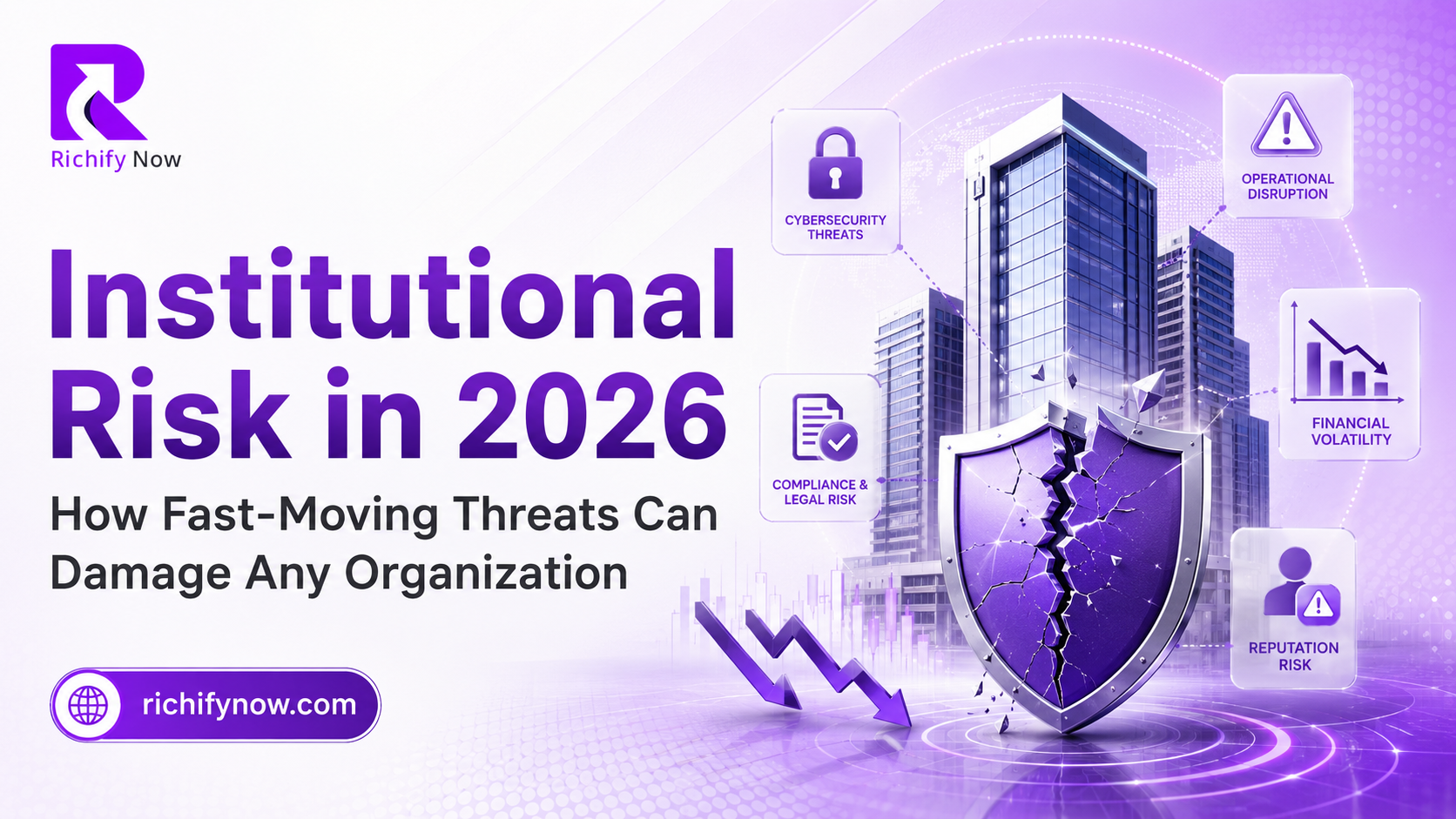
The Velocity of Exposure: Defining Institutional Risk in 2026
Why traditional asset protection is failing in the algorithmic economy — and how structural firewalls, resilience strategies, and institutional risk frameworks are reshaping protection.
📚 Table of Contents
- 🚀 Introduction
- 🌐 Understanding Exposure
- ⚡ The Rise of Risk Velocity
- 🏛️ Defining Institutional Risk
- 🔒 Why Traditional Protection Fails
- 🤖 The Algorithmic Economy
- 🛡️ Structural Firewalls
- 📈 Building Resilience
- 🔮 Future Risks
- ✅ Key Takeaways
AEO Answer Card
Institutional risk includes threats from markets, regulation, cyberattacks, litigation, liquidity shocks, operational failures, and reputational damage. Modern organizations need layered resilience rather than one defensive tactic.
🚀 Introduction
For generations, asset protection followed a relatively simple formula. Businesses acquired insurance policies. Families diversified investments. Organizations established legal agreements and compliance procedures. These safeguards were considered sufficient because most risks developed gradually and remained relatively isolated.
The environment of 2026 is fundamentally different. Digital transformation has connected economies, institutions, and individuals on a scale never before experienced. Information now travels globally in seconds. Artificial intelligence systems analyze millions of data points in real time. Public perception can shift dramatically within hours.
As a result, risk has evolved. Threats no longer move in a straight line. Instead, they spread rapidly across interconnected systems, creating cascading effects that impact operations, governance, compliance, reputation, and financial stability simultaneously.
This evolution has given rise to a new category of concern known as institutional risk.
Unlike traditional risks that target specific assets or operational areas, institutional risk affects the structures supporting an entire organization. It threatens the frameworks that enable businesses, investment groups, family offices, and enterprises to function effectively.
Understanding institutional risk is becoming a strategic necessity for leaders who want to build resilient organizations capable of surviving long-term uncertainty.
🌐 Understanding Exposure in a Connected World
Before institutional risk can be understood, exposure must first be examined.
Exposure refers to the degree to which an individual, organization, or institution is vulnerable to potential threats. Historically, exposure was relatively easy to identify. Risks generally existed within physical, operational, or legal boundaries that were straightforward to understand.
A manufacturing company worried about equipment failure. A retailer focused on inventory losses. A financial institution prioritized fraud prevention and regulatory compliance. Each category of risk was managed independently.
That model is rapidly becoming outdated.
Today's organizations operate within interconnected ecosystems where events rarely remain isolated. A cybersecurity breach may trigger legal consequences. Regulatory investigations may damage public trust. A reputational controversy can affect investor confidence, customer retention, and employee morale simultaneously.
The challenge is no longer identifying individual threats. The challenge is understanding how those threats interact and amplify one another.
📌 Modern Exposure Includes:
- Digital vulnerabilities
- Data privacy concerns
- Algorithmic decision-making risks
- Regulatory uncertainty
- Operational dependencies
- Reputational fragility
- Third-party vendor risks
- Cross-border compliance obligations
As organizations become more interconnected, exposure becomes increasingly difficult to isolate. What affects one system may quickly affect many others.
⚡ The Rise of Risk Velocity
One of the most important concepts in modern risk management is risk velocity.
Risk velocity refers to the speed at which a threat moves from emergence to impact.
In previous decades, organizations often had time to react. Problems developed slowly enough for leadership teams to investigate, coordinate responses, and implement corrective actions before significant damage occurred.
That window is shrinking.
Consider a simple example. An employee accidentally shares sensitive customer information through a public platform. Within minutes, automated systems detect the information. Search engines index it. Screenshots begin circulating online. Journalists become aware. Regulators may receive notifications.
Before the organization finishes its first internal meeting, the issue may already be visible to thousands—or even millions—of people.
This acceleration fundamentally changes the nature of organizational protection.
Traditional responses designed for slower environments often fail because they cannot keep pace with the speed of modern exposure.
🏛️ Defining Institutional Risk
Institutional risk is one of the most misunderstood concepts in modern business. Many leaders assume it applies only to multinational corporations, government agencies, or large financial institutions. In reality, institutional risk affects organizations of every size because it targets the systems and structures that support long-term operations.
Traditional risk management often focuses on individual threats. A business might insure its property against fire, implement cybersecurity measures to prevent hacking, or establish contracts to reduce legal disputes. These actions remain important, but they address specific categories of risk.
Institutional risk operates differently.
Rather than targeting individual assets, institutional risk threatens the framework that allows an organization to function. It impacts governance, operational continuity, strategic decision-making, compliance structures, stakeholder trust, and organizational resilience.
In simple terms, institutional risk asks a critical question:
If the answer is uncertain, institutional risk likely exists.
The significance of institutional risk becomes clear when examining modern organizational failures. Many businesses do not collapse because of a single financial loss. They collapse because one problem exposes weaknesses across multiple systems simultaneously.
🏢 Areas Affected by Institutional Risk
- Corporate governance structures
- Executive decision-making processes
- Compliance frameworks
- Technology infrastructure
- Data management systems
- Brand reputation
- Stakeholder relationships
- Business continuity planning
- Strategic adaptability
- Financial resilience
When one of these areas experiences disruption, the effects often spread throughout the organization. This interconnected nature is what makes institutional risk particularly dangerous in 2026.
The objective is not simply to avoid problems. The objective is to build structures capable of absorbing shocks without experiencing systemic failure.
🔒 Why Traditional Asset Protection Is No Longer Enough
For decades, asset protection was viewed as the foundation of organizational security.
The logic was straightforward. Protect physical assets. Diversify investments. Purchase insurance. Maintain legal safeguards. These measures provided meaningful protection because threats generally remained localized and manageable.
However, the modern environment introduces challenges that traditional protection mechanisms were never designed to address.
Insurance can compensate for certain financial losses. Legal contracts can help resolve disputes. Trust structures may provide asset separation. Yet none of these tools can instantly repair damaged trust, restore lost credibility, or reverse viral reputational crises.
This distinction is critical.
Organizations increasingly derive value from intangible assets such as trust, reputation, intellectual property, data, relationships, and digital visibility. These assets often represent far greater value than physical property.
When intangible assets are compromised, traditional protection mechanisms frequently prove insufficient.
⚠️ Traditional Protection vs Modern Exposure
Traditional Protection Focused On:
- Property ownership
- Physical security
- Insurance coverage
- Legal agreements
- Financial reserves
Modern Exposure Includes:
- Algorithmic visibility
- Digital reputation
- Data integrity
- Stakeholder trust
- Operational continuity
- Technology dependencies
This does not mean traditional protection should be abandoned. It remains an important component of risk management.
The challenge is that traditional tools alone no longer provide sufficient protection against the speed and complexity of modern threats.
Organizations require broader frameworks capable of protecting both tangible and intangible assets simultaneously.
🤖 The Algorithmic Economy and the New Risk Landscape
To fully understand institutional risk in 2026, it is necessary to understand the algorithmic economy.
The algorithmic economy refers to an environment where automated systems increasingly influence economic outcomes, operational decisions, public visibility, and organizational reputation.
Algorithms now shape countless aspects of daily life and business operations.
⚙️ Algorithms Influence:
- Search engine rankings
- Online reputation scores
- Credit assessments
- Fraud detection systems
- Consumer recommendations
- Advertising visibility
- Compliance monitoring
- Investment decisions
- Hiring processes
- Content distribution
Most organizations interact with hundreds of algorithms every day, often without realizing it.
These systems continuously evaluate behavior, analyze data, and make decisions at a speed impossible for human teams to match.
As organizations become increasingly dependent on algorithm-driven environments, new forms of exposure emerge.
For example, a company may possess strong financial performance and exceptional products, yet experience declining visibility because search algorithms reduce exposure. Similarly, automated compliance systems may flag transactions that trigger regulatory scrutiny even when no intentional wrongdoing exists.
The risk is not necessarily physical or financial at first.
The risk is operational.
It affects access, visibility, trust, and functionality.
These forms of exposure often spread rapidly because algorithmic systems operate continuously and globally.
This reality requires organizations to rethink how protection is structured.
Rather than reacting to problems after they emerge, leaders must develop systems capable of identifying vulnerabilities before they become crises.
🌍 The Interconnected Nature of Modern Threats
One of the defining characteristics of institutional risk is interconnectedness.
Traditional risk models often treated threats as separate categories. Cybersecurity teams handled technology risks. Legal departments managed compliance issues. Marketing teams addressed reputation concerns.
In practice, these categories increasingly overlap.
A cybersecurity incident may create legal liabilities. Regulatory investigations may generate media attention. Reputational controversies may reduce customer confidence and revenue simultaneously.
The modern organization operates as a network rather than a collection of independent departments.
This interconnected structure creates efficiency, but it also creates vulnerability.
🔄 Example of Cascading Institutional Risk
- Data breach occurs.
- Customer information becomes exposed.
- Regulatory investigation begins.
- Media coverage increases.
- Public trust declines.
- Customers leave.
- Revenue decreases.
- Investors become concerned.
- Expansion plans are delayed.
- Long-term growth suffers.
Notice how a single event evolves into multiple organizational challenges.
This is precisely why institutional risk requires a broader perspective than traditional risk management approaches.
The objective is not merely to prevent individual incidents. The objective is to prevent incidents from triggering widespread organizational disruption.
📊 The Cost of Ignoring Institutional Risk
Many organizations underestimate institutional risk because its consequences are often invisible until a crisis occurs.
Unlike direct financial losses, institutional weaknesses may remain hidden for years. Governance failures, outdated technology systems, insufficient compliance controls, and poor crisis planning frequently go unnoticed during periods of stability.
However, when disruption occurs, these weaknesses become immediately apparent.
The costs can be substantial.
- Loss of customer confidence
- Regulatory penalties
- Operational downtime
- Increased legal expenses
- Reduced investor trust
- Talent retention challenges
- Brand deterioration
- Strategic setbacks
More importantly, institutional failures often require years to rebuild.
Financial losses may be recoverable. Trust is significantly harder to restore.
This reality is driving organizations to place greater emphasis on resilience, governance, and structural protection than ever before.
🛡️ Structural Firewalls: The Foundation of Institutional Protection
As institutional risk becomes more complex, organizations need protection mechanisms capable of containing disruption before it spreads. This is where structural firewalls become essential.
Most people associate firewalls with cybersecurity, but the concept extends far beyond technology. A structural firewall is any system, process, governance model, or organizational design that prevents a problem in one area from creating widespread damage elsewhere.
Think of a ship divided into watertight compartments. If one compartment takes on water, the entire vessel does not immediately sink. Structural firewalls operate according to the same principle.
Their purpose is containment.
🛡️ Examples of Structural Firewalls
- Separate governance responsibilities
- Independent compliance oversight
- Data access restrictions
- Financial segregation mechanisms
- Vendor diversification strategies
- Business continuity frameworks
- Multi-layer cybersecurity systems
- Crisis communication protocols
- Independent audit functions
- Backup operational infrastructure
Organizations that invest in structural firewalls are often better positioned to absorb disruption because failures remain localized rather than becoming systemic.
This containment mindset represents one of the most important shifts in modern risk management.
💻 Digital Risk: The New Front Line
Few areas illustrate the evolution of institutional risk more clearly than digital infrastructure.
Technology now powers communication, operations, customer experiences, financial transactions, data management, and strategic decision-making. As dependence on digital systems increases, so does organizational exposure.
Digital risk extends far beyond cybersecurity.
⚠️ Common Digital Risks
- Cyberattacks
- Ransomware incidents
- Cloud service disruptions
- Data privacy violations
- Software vulnerabilities
- Unauthorized access
- Third-party technology failures
- Artificial intelligence misuse
- Infrastructure outages
- Data integrity failures
A modern organization can possess strong financial resources and talented leadership, yet remain vulnerable if critical digital systems are compromised.
Because digital systems connect nearly every department, disruptions often create cascading effects throughout the institution.
This makes digital resilience a central component of institutional protection.
🌟 Reputational Risk: Trust as an Asset
Trust has become one of the most valuable assets in the modern economy.
Customers buy from organizations they trust. Investors allocate capital to businesses they believe in. Employees join institutions they respect.
Unfortunately, trust can be fragile.
In a world driven by social platforms, online reviews, and real-time information sharing, reputational events spread rapidly.
📣 Sources of Reputational Risk
- Customer complaints
- Data breaches
- Executive misconduct
- Regulatory actions
- Public controversies
- Operational failures
- Social media backlash
- Ethical concerns
- Poor crisis responses
- Misinformation campaigns
Reputation often takes years to build and only moments to damage.
This reality requires organizations to treat trust as a strategic asset rather than a marketing concern.
Institutions that proactively protect credibility are often more resilient during periods of uncertainty.
⚖️ Regulatory Risk and the Expanding Compliance Environment
Regulatory expectations continue expanding across industries and jurisdictions.
Governments increasingly focus on data privacy, financial transparency, consumer protection, cybersecurity, environmental responsibility, and operational accountability.
Organizations must now navigate a complex web of regulations that often overlap and evolve rapidly.
Regulatory risk is no longer limited to legal departments.
Compliance influences strategy, technology investments, operational design, customer relationships, and governance frameworks.
📋 Key Regulatory Challenges in 2026
- Cross-border compliance obligations
- Data protection requirements
- Cybersecurity reporting standards
- Financial disclosure expectations
- Industry-specific regulations
- AI governance requirements
- Consumer privacy laws
- Operational transparency demands
Organizations that fail to adapt often face more than financial penalties. They risk damaging stakeholder trust and long-term credibility.
⚙️ Operational Risk and Hidden Weaknesses
Operational risk originates from failures within processes, systems, people, or organizational structures.
Unlike external threats, operational weaknesses often develop internally over time. They remain hidden until a disruption exposes them.
Examples include:
- Inefficient workflows
- Outdated technology
- Insufficient oversight
- Poor communication channels
- Overdependence on key personnel
- Lack of contingency planning
These vulnerabilities may seem manageable during periods of stability. However, they often become significant liabilities during crises.
Strong operational resilience requires ongoing evaluation, improvement, and adaptation.
📈 Building Organizational Resilience
Protection and resilience are often discussed together, but they represent different concepts.
Protection seeks to prevent incidents. Resilience ensures survival when incidents occur.
No organization can eliminate all risk. Unexpected events are inevitable. What distinguishes resilient institutions is their ability to absorb shocks, adapt quickly, and continue operating effectively.
🚀 Characteristics of Resilient Organizations
- Strong governance structures
- Adaptive leadership teams
- Diversified operational capabilities
- Robust crisis management plans
- Reliable technology infrastructure
- Continuous risk assessment processes
- Transparent communication practices
- Long-term strategic thinking
Resilience transforms risk management from a defensive activity into a strategic advantage.
Organizations that recover quickly often outperform competitors during periods of disruption.
🔮 The Future of Institutional Risk
Institutional risk will continue evolving throughout the coming decade.
Several powerful forces are accelerating exposure across industries:
- Artificial intelligence adoption
- Automation expansion
- Digital transformation
- Global interconnectivity
- Regulatory complexity
- Data-driven decision-making
- Public transparency expectations
- Geopolitical uncertainty
These trends create extraordinary opportunities, but they also introduce new vulnerabilities.
Organizations that proactively strengthen governance, technology infrastructure, compliance frameworks, and resilience capabilities will be better prepared for future uncertainty.
Those relying exclusively on traditional protection models may find themselves increasingly exposed.
The institutions that thrive in 2026 and beyond will not necessarily be the largest or wealthiest.
They will be the most adaptable.
🎯 Key Takeaways
- Institutional risk affects the systems supporting organizational success.
- Risk velocity has accelerated dramatically in the digital economy.
- Traditional asset protection remains valuable but is no longer sufficient.
- Algorithms increasingly influence exposure, trust, and operational continuity.
- Structural firewalls help prevent localized problems from becoming systemic failures.
- Digital, reputational, regulatory, and operational risks are increasingly interconnected.
- Resilience is becoming more important than prevention alone.
- Organizations must continuously adapt to evolving risk environments.
❓ Frequently Asked Questions
What is institutional risk?
Institutional risk refers to threats that affect the governance, operations, reputation, compliance, and long-term resilience of an organization rather than targeting individual assets alone.
Why is institutional risk more important in 2026?
Because digital transformation, artificial intelligence, automation, and interconnected systems allow risks to spread faster and impact multiple organizational areas simultaneously.
What are structural firewalls?
Structural firewalls are organizational safeguards designed to contain disruptions and prevent localized problems from spreading throughout an institution.
How does resilience differ from protection?
Protection seeks to prevent incidents. Resilience focuses on ensuring the organization can recover and continue operating when incidents occur.
Can small businesses face institutional risk?
Yes. Institutional risk affects organizations of all sizes because every business relies on systems, processes, relationships, and trust.
🏁 Conclusion
The velocity of exposure is reshaping how organizations think about protection, governance, and long-term stability.
Traditional asset protection remains an important foundation, but the realities of 2026 demand a broader perspective. Institutional risk extends beyond physical assets and financial resources. It encompasses reputation, compliance, technology, governance, trust, and resilience.
Organizations can no longer assume that individual safeguards will protect them from interconnected threats. They must develop structural firewalls capable of containing disruption before it spreads.
Most importantly, they must embrace resilience as a strategic capability.
The future belongs to institutions that can adapt, recover, and evolve in environments defined by constant change.
As the first chapter in the Foundational Shielding series, this exploration of institutional risk establishes an essential principle for modern leaders:
Institutional Risk Dashboard
Download the editable RichifyNow workbook with instructions, working fields, disclaimer, and the complete source-document specification.

Loading comments…