
Digital Asset Security: Fortifying Corporate Networks Against Asymmetric Threat Actors
Explore practical strategies for strengthening corporate digital asset security against ransomware, spear-phishing, executive account takeovers, vendor risks, and modern asymmetric cyber threats.

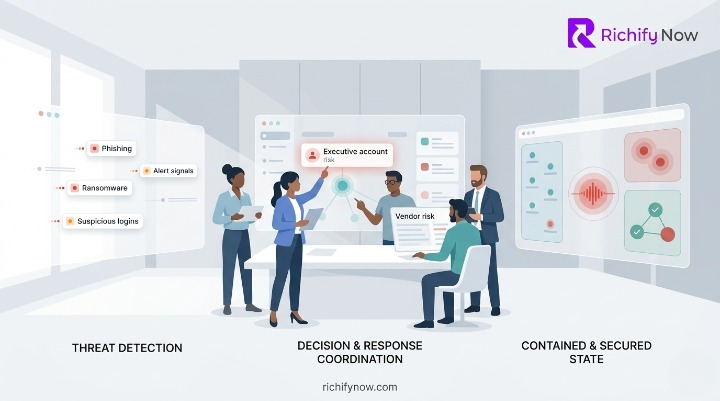
🔐 Digital Asset Security: Fortifying Corporate Networks Against Asymmetric Threat Actors
A strategic guide to protecting corporate networks, executive accounts, sensitive data, and digital assets from ransomware, spear-phishing, credential theft, and high-impact cyber disruption.
AEO Answer Card
Digital asset security protects business accounts, websites, data, software, crypto, intellectual property, and digital infrastructure from phishing, ransomware, account takeover, vendor risk, and unauthorized access.
In the modern corporate environment, digital assets are no longer limited to files, servers, and software licenses. They include executive email accounts, customer databases, payment systems, cloud infrastructure, intellectual property, operational platforms, financial records, and the trust that keeps a business functioning. When these assets are exposed, the damage is not only technical. It can become financial, legal, reputational, and operational.
The challenge is that companies are not always facing traditional attackers with equal resources. Many cyber risks now come from asymmetric threat actors: individuals, criminal groups, ransomware affiliates, credential brokers, state-linked operators, and social engineering teams that use small, targeted actions to create large business consequences. A single stolen executive password, one malicious attachment, or one unpatched system can create a chain reaction across the entire organization.
Digital asset security is therefore not just an IT issue. It is an institutional risk issue. It belongs in the same conversation as legal exposure, financial continuity, governance, business resilience, and operational security.
🧠 Understanding Asymmetric Cyber Threats
An asymmetric threat is a threat where the attacker does not need the same size, budget, or resources as the target to cause major damage. A company may spend millions on infrastructure, employees, marketing, and operations, but an attacker may only need one successful phishing email to gain access. That imbalance is what makes modern cyber risk so dangerous.
In cybersecurity, asymmetry appears in several forms. Attackers can automate reconnaissance, purchase stolen credentials, rent malware infrastructure, use artificial intelligence to improve phishing messages, and exploit public vulnerabilities faster than many organizations can patch them. Meanwhile, the business must defend every endpoint, every user, every vendor connection, every cloud account, and every executive communication channel.
This does not mean defense is hopeless. It means companies need a security model that assumes pressure, deception, and speed. The goal is not to create a perfect wall. The goal is to reduce entry points, detect abnormal behavior early, contain incidents quickly, and preserve business continuity when something goes wrong.
💣 Ransomware: The Business Disruption Weapon
Ransomware remains one of the most severe digital asset threats because it attacks availability, confidentiality, and trust at the same time. A ransomware incident may encrypt systems, steal sensitive files, halt operations, disrupt customer service, trigger legal notification duties, damage reputation, and create pressure on leadership to make urgent payment decisions.
The most dangerous ransomware groups no longer rely only on encryption. Many use double extortion or multi-layer extortion. This means they may steal data before encrypting systems, threaten public leaks, contact customers, pressure employees, or target executives directly. The attack becomes a business crisis rather than a purely technical event.
The first defensive step is reducing the attacker's ability to move across the network. If one compromised account gives broad access to file servers, backups, cloud consoles, email, and finance systems, the company has created a high-impact failure point. Segmentation, least privilege, strong authentication, and monitored administrative access reduce the blast radius.
🛡️ Ransomware Defense Priorities
- Maintain offline or immutable backups: Backups should not be easily deleted, encrypted, or modified by the same accounts used in production.
- Patch critical vulnerabilities quickly: Internet-facing systems, VPNs, firewalls, and remote access tools require urgent attention.
- Limit administrative privileges: Admin rights should be rare, monitored, and separated from daily user activity.
- Segment critical systems: Finance, identity, backups, production servers, and sensitive data stores should not sit on one flat network.
- Test restoration: A backup that has never been restored is only a theory, not a recovery plan.
🎯 Spear-Phishing: Precision Attacks on Human Trust
Spear-phishing is more targeted than ordinary spam. Instead of sending generic messages to thousands of people, attackers research a specific company, department, executive, vendor, or employee. They may reference real projects, imitate known contacts, copy writing styles, use business timing, or create urgency around invoices, hiring, legal documents, shipping issues, or account verification.
The reason spear-phishing works is simple: business depends on communication. Employees are trained to respond quickly, help customers, support managers, process requests, and move work forward. Attackers exploit that helpfulness. They do not always need malware. Sometimes they only need an employee to approve a payment, share a document, reset a password, or enter credentials into a fake login page.
Defensive training must therefore move beyond basic reminders like "do not click suspicious links." Modern employees need practical recognition patterns. They should know how attackers create urgency, impersonate authority, manipulate routine processes, and move conversations from secure channels to weaker ones.
📩 Spear-Phishing Red Flags
- Unexpected urgency around payment, login, payroll, contracts, or legal requests.
- Sender addresses that look similar but are slightly different from trusted domains.
- Requests to bypass normal approval processes.
- Attachments that require macros, passwords, or unusual access.
- Links that lead to login pages outside normal company systems.
- Messages that pressure employees not to call or verify through another channel.
✅ Practical Control: Verification by Separate Channel
For high-risk requests, employees should verify through a separate trusted channel. If an email requests a payment change, the employee should call a known phone number already on file, not the number listed in the suspicious email. If an executive requests confidential data, the employee should verify through an internal chat, direct call, or approved workflow.
👔 Executive Account Takeovers: High-Value Identity Compromise
Executive accounts are attractive targets because they carry authority. A compromised CEO, CFO, managing partner, board member, or senior administrator account can be used to request payments, approve transactions, access sensitive files, influence employees, or deceive vendors. The attacker is not only stealing an account. They are borrowing institutional trust.
Executive account takeover can happen through phishing, reused passwords, session token theft, compromised personal devices, weak MFA methods, malicious OAuth applications, or credential exposure from unrelated breaches. Once inside, attackers may quietly read emails, study communication patterns, create forwarding rules, monitor invoices, and wait for the right moment to act.
Protecting executives requires stronger controls than ordinary user accounts. This is not because executives are careless, but because the risk concentration is higher. Their inboxes often contain contracts, legal discussions, acquisition plans, investor communication, customer escalations, payroll matters, and sensitive strategic information.
🔐 Executive Protection Controls
- Phishing-resistant MFA: Hardware security keys or strong authentication methods reduce credential-based compromise.
- Conditional access: Block suspicious logins from unusual locations, unknown devices, or risky sessions.
- Email rule monitoring: Alert on suspicious forwarding rules, hidden inbox rules, and external auto-forwarding.
- Privileged account separation: Executives should not use the same account for daily email and sensitive administrative actions.
- VIP monitoring: High-risk accounts should have enhanced logging, alerts, and security review.
🏢 Mapping the Corporate Digital Asset Surface
A company cannot protect what it has not identified. Digital asset security begins with a realistic asset map. This includes internal servers, cloud services, SaaS platforms, endpoints, mobile devices, email systems, admin portals, code repositories, payment systems, customer databases, marketing tools, vendor integrations, backup environments, and identity providers.
Many breaches occur because a forgotten system remains exposed, a former employee retains access, a vendor integration has excessive permissions, or a cloud storage bucket is misconfigured. These are not always dramatic technical failures. They are often inventory and governance failures.
Asset mapping should answer four questions: What do we own? Who can access it? How is it protected? What happens if it fails? Without these answers, security teams are forced to guess, and attackers benefit from blind spots.
| Digital Asset | Main Risk | Recommended Control |
|---|---|---|
| Executive Email Accounts | Impersonation, payment fraud, data theft | Phishing-resistant MFA, VIP monitoring, email rule alerts |
| Cloud Admin Consoles | Full environment compromise | Privileged access management, conditional access, logging |
| Backup Systems | Ransomware destruction or encryption | Immutable backups, offline copies, restoration testing |
| Finance Platforms | Fraudulent transfers, invoice manipulation | Dual approval, callback verification, transaction limits |
| Customer Databases | Privacy breach, compliance exposure | Encryption, access control, data loss prevention |
| Employee Devices | Malware, credential theft, lateral movement | Endpoint detection, patching, device encryption |
🧱 Zero Trust as an Operating Principle
Zero Trust is often discussed as a technology framework, but its real value is operational discipline. The core idea is that access should not be granted simply because a user is inside the network or has a password. Every request should be evaluated based on identity, device health, location, behavior, sensitivity, and context.
In practice, Zero Trust means employees receive only the access required for their roles. Devices must meet security standards before connecting. Sensitive actions require stronger verification. Admin privileges are temporary and monitored. Logs are collected centrally. Unusual behavior triggers review.
This approach is especially important against asymmetric actors because it reduces the value of a single compromise. If an attacker steals one password but cannot satisfy MFA, cannot access from an unmanaged device, cannot reach sensitive systems, and cannot elevate privileges, the attack chain is interrupted.
🧩 Zero Trust Building Blocks
- Strong identity verification for users and administrators.
- Device compliance checks before access is granted.
- Least-privilege permissions across applications and data.
- Network segmentation between sensitive environments.
- Continuous monitoring of risky behavior and abnormal access.
- Rapid removal of access when employees leave or roles change.
🕵️ Monitoring, Detection, and Response
Preventive controls are essential, but they are not enough. Companies also need visibility. If an attacker gains access and nobody notices, the organization may lose days or weeks before detection. During that time, the attacker can study systems, steal data, create backdoors, and prepare a larger attack.
Monitoring should focus on meaningful signals rather than endless noise. Examples include impossible travel logins, repeated failed MFA attempts, new admin accounts, unusual data downloads, suspicious mailbox rules, privilege escalation, disabled security tools, unexpected remote access, and unusual login times.
Response planning is equally important. The company should know who makes decisions, who contacts legal counsel, who speaks to insurers, who communicates with customers, who preserves evidence, and who leads technical containment. Incident response cannot be improvised successfully in the middle of a crisis.
🚨 Incident Response Question
If your company discovered a ransomware attack at 2:00 AM, who would have authority to shut down systems, contact outside counsel, notify insurers, preserve logs, communicate with leadership, and begin restoration? If the answer is unclear, the response plan needs improvement.
🤝 Vendor and Supply Chain Risk
Corporate networks are no longer isolated. Businesses rely on payroll providers, cloud platforms, marketing tools, payment processors, IT vendors, software developers, logistics partners, outsourced support teams, and managed service providers. Each connection can become a pathway for risk.
Vendor risk management should not be limited to a contract signature. Companies should evaluate what data the vendor can access, how the vendor authenticates users, whether the vendor supports MFA, how incidents are reported, what subcontractors are involved, where data is stored, and how access is removed when the relationship ends.
The most dangerous vendor relationships are often the ones with high access and low oversight. An IT provider with admin rights, a software integration with broad API permissions, or a contractor with persistent remote access can create serious exposure if not monitored.
📋 Vendor Security Questions
- Does the vendor require MFA for all privileged accounts?
- Can the vendor access sensitive customer or financial data?
- How quickly must the vendor notify your company after a breach?
- Are vendor accounts reviewed and removed when no longer needed?
- Does the contract include security, confidentiality, and audit obligations?
- Is access logged, limited, and reviewed periodically?
🧑💼 Building a Security-Aware Corporate Culture
Technology controls are powerful, but people remain central to security. Employees are often the first to see suspicious emails, unusual requests, system problems, vendor changes, or payment anomalies. A company that punishes every mistake creates silence. A company that encourages reporting creates early warning.
Security culture should be practical and respectful. Employees should know that reporting a suspicious link is helpful, even if they clicked it. Finance teams should feel empowered to challenge unusual executive requests. IT teams should have authority to delay risky access changes. Leaders should model secure behavior by using MFA, following approval workflows, and supporting verification.
The goal is not fear. The goal is shared responsibility. When employees understand that security protects customers, jobs, revenue, reputation, and operational continuity, they are more likely to participate actively.
✅ Practical Implementation Checklist
- Map critical digital assets: Identify systems, data, accounts, cloud platforms, and vendor connections.
- Protect executive accounts: Apply phishing-resistant MFA, monitoring, and conditional access to high-value users.
- Strengthen email security: Use filtering, domain authentication, attachment scanning, and suspicious rule alerts.
- Segment networks: Separate critical systems, backups, finance platforms, and administrative tools.
- Harden backups: Maintain immutable or offline backups and test restoration regularly.
- Limit privileges: Apply least privilege and remove unnecessary admin rights.
- Patch aggressively: Prioritize internet-facing systems and known exploited vulnerabilities.
- Monitor abnormal behavior: Collect logs and alert on suspicious login, access, and data movement patterns.
- Review vendors: Evaluate access, security obligations, breach notification terms, and offboarding processes.
- Practice incident response: Run tabletop exercises for ransomware, account takeover, and data breach scenarios.
⚖️ Governance: Making Cybersecurity a Board-Level Risk
Cybersecurity becomes stronger when leadership treats it as governance, not just technology. Boards and executives should ask clear questions: What are our most critical digital assets? What would stop operations if unavailable? How fast can we restore systems? Which accounts could approve major financial movement? Which vendors have privileged access? What is our incident response chain of command?
Security leaders should translate technical risk into business terms. Instead of saying "endpoint coverage is incomplete," they can explain that certain departments may be harder to isolate during ransomware. Instead of saying "MFA adoption is low," they can explain that executive impersonation and account takeover risk remains elevated. This helps leadership make informed investment decisions.
A mature cybersecurity program should include policies, controls, training, monitoring, response planning, vendor oversight, and periodic audits. The program should evolve as the business grows, adopts new tools, enters new markets, and faces new threat patterns.
🚀 Final Thoughts
Digital asset security is now a core part of operational security. Ransomware can stop revenue. Spear-phishing can manipulate trust. Executive account takeover can turn leadership authority into an attack tool. Vendor compromise can bypass internal controls. Cloud misconfiguration can expose sensitive data. These risks are connected, and they require a connected defense.
The strongest companies do not rely on one product, one policy, or one training session. They build layered resilience. They protect identity, segment systems, harden backups, train employees, monitor behavior, review vendors, and prepare response plans before a crisis begins.
Asymmetric threat actors succeed when businesses are predictable, over-permissive, slow to patch, and unprepared to respond. They struggle when companies verify access, reduce privilege, detect unusual behavior, preserve recovery options, and make security a leadership priority.
🔒 Conclusion: Fortify the Business, Not Just the Network
Corporate cybersecurity is not simply about blocking hackers. It is about protecting the business systems, trusted relationships, executive authority, customer data, and operational continuity that allow an organization to function.
Ransomware, spear-phishing, and executive account takeovers are high-stakes risks because they exploit both technology and trust. A strong defense requires the same balance: technical controls, human awareness, governance discipline, and response readiness.
For institutions, the objective is clear: reduce the attacker's opportunity, limit the damage of compromise, and ensure the company can continue operating even under pressure. That is the foundation of modern digital asset security.
📌 Disclaimer: This article is for educational and informational purposes only. It does not provide legal, forensic, or incident response advice. Organizations should consult qualified cybersecurity, legal, compliance, insurance, and risk management professionals before implementing security programs or responding to active incidents.
Cybersecurity Audit Checklist
Download the editable RichifyNow workbook with instructions, working fields, disclaimer, and the complete source-document specification.

Loading comments…