
Digital Assets That Appreciate Faster Than Traditional Investments
Digital assets can scale quickly through online demand, network effects, and global reach. This guide explains high-growth assets like crypto, domains, websites, SaaS, digital products, and NFTs, along with the risks to understand before investing.

Asset Acquisition 💜 RichifyNow
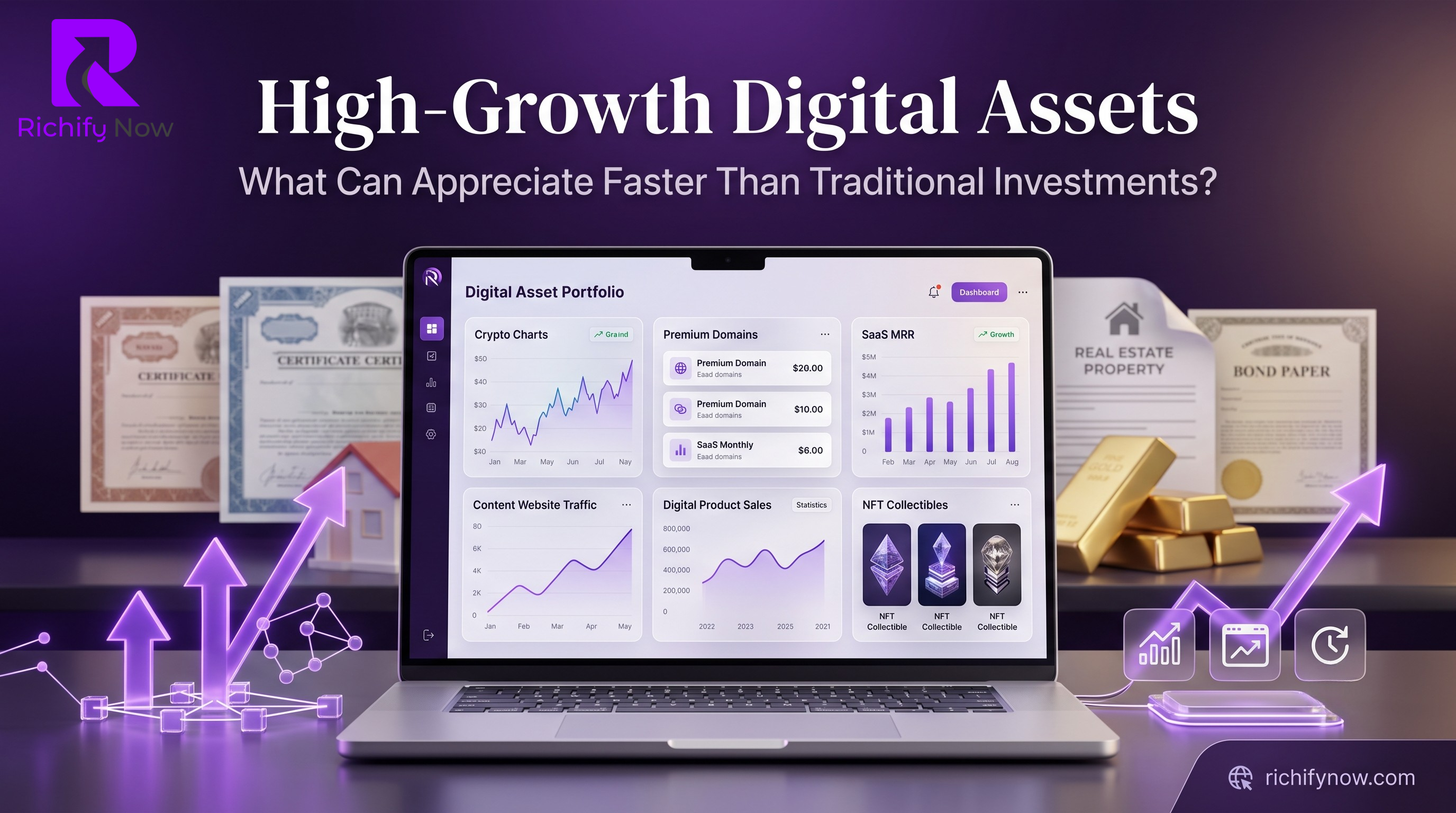
High-Growth Digital Assets: What Can Appreciate Faster Than Traditional Investments?
A practical guide to understanding digital assets, their growth potential, their risks, and how investors can evaluate them before adding them to a wealth-building strategy 🚀
Digital assets can appreciate when they gain traffic, users, revenue, brand value, scarcity, or network effects. Examples include websites, SaaS products, domains, digital products, newsletters, and some blockchain-based assets. They can grow quickly, but they also carry technology, liquidity, valuation, and market risks.
Introduction 🧠
Traditional investments such as stocks, bonds, real estate, and gold have helped investors build wealth for generations
They still matter because they are better understood, more regulated, and often easier to value than many newer assets
But the internet has created a new category of wealth-building opportunities called digital assets
These assets may include cryptocurrencies, blockchain tokens, premium domain names, content websites, monetized blogs, SaaS micro-businesses, mobile apps, digital products, newsletters, online communities, creator brands, and intellectual property that can generate online income
The reason digital assets attract attention is simple
Some of them can scale faster than physical assets because distribution happens online, ownership can be transferred globally, audiences can grow without local borders, and network effects can increase value quickly
However, fast appreciation also comes with fast risk
Crypto can crash, NFTs can lose liquidity, domains can remain unsold, websites can lose traffic after a search update, SaaS products can face churn, and digital products can become obsolete if demand disappears
This RichifyNow guide explains which digital assets can appreciate faster than traditional investments, why that appreciation can happen, where the risks hide, and how investors can evaluate these assets without being blinded by hype
Important Wealth Note ⚠️
This article is educational and should not be treated as personal financial advice
Digital assets can be highly volatile, speculative, illiquid, and exposed to platform, regulatory, technology, cybersecurity, and market-cycle risks
Before buying any digital asset, investors should review their emergency fund, debt position, risk tolerance, time horizon, custody method, tax rules, and ability to lose capital without damaging their financial stability
What Counts As A Digital Asset? 💻
A digital asset is not only a cryptocurrency
For asset acquisition, a digital asset can be understood as an online or digitally native property that has ownership value, income potential, scarcity, transferability, audience value, or utility
Crypto assets are the most visible example, but they are only one part of the digital asset universe
Domain names, websites, SaaS products, paid newsletters, digital templates, online courses, apps, gaming items, tokenized assets, and digital intellectual property can also behave like assets when they can be sold, licensed, monetized, or used to generate cash flow
The difference between a simple digital file and a real digital asset is economic control
If the owner can monetize it, transfer it, protect it, grow it, or use it to generate recurring value, it becomes closer to an asset than a disposable online item
Why Digital Assets Can Appreciate Faster ⚡
Digital assets can appreciate faster than traditional investments because their growth mechanics are different
A physical property usually needs local demand, financing access, legal transfer, maintenance, and location-based appreciation
A digital asset can sometimes scale globally with lower marginal distribution cost
A website can gain readers from multiple countries
A SaaS product can serve many customers with the same software infrastructure
A domain name can become more valuable when a new industry trend makes its keyword more desirable
A crypto asset can move rapidly when liquidity, adoption, investor sentiment, regulatory access, and scarcity all shift at the same time
This speed is exactly why digital assets are attractive and dangerous
The same forces that create rapid upside can also create rapid downside
Graph 1: How Fast Some Digital Assets Moved In 2024 📊
Crypto assets showed how quickly digital markets can move during strong risk-on cycles
Bitcoin rose about 119.6% in 2024, Ether rose about 46.5%, Solana rose about 85.5%, and XRP rose about 238.4%, while the S&P 500 returned about 25% on a total-return basis in 2024 and US national home prices rose about 3.9% annually in December 2024 based on the S&P CoreLogic Case-Shiller index
Selected 2024 Appreciation Comparison
XRP 238.4%
Bitcoin 119.6%
Solana 85.5%
Ether 46.5%
S&P 500 Total Return 25%
US National Home Prices 3.9%
Chart note: values are selected market indicators from 2024 and are not forecasts or recommendations
1. Major Crypto Assets 🪙
Major crypto assets such as Bitcoin and Ether are the most liquid and widely recognized digital assets
The major reason they can appreciate quickly is that market access, sentiment, supply narratives, institutional participation, and global liquidity can change rapidly
In January 2024, the US Securities and Exchange Commission approved the listing and trading of spot Bitcoin exchange-traded products, but SEC Chair Gary Gensler also said the approval did not represent an endorsement of Bitcoin itself and warned investors about risk
That approval helped make Bitcoin exposure easier for mainstream investors through traditional brokerage channels, and Reuters reported that Bitcoin more than doubled in 2024 while the overall crypto market value reached roughly $3.5 trillion near year-end based on CoinGecko data
For asset acquisition, the key point is that crypto is not only an investment story
It is also a liquidity story, a custody story, a regulation story, and a trust story
Investors should separate major crypto assets from speculative tokens because liquidity, security, survivability, and adoption vary dramatically across the market
RichifyNow Rule 💜
Crypto may be a growth satellite, but it should not replace emergency cash, diversified long-term investing, insurance, or debt discipline
2. Premium Domains 🌐
Premium domain names can appreciate because they are scarce, memorable, brandable, and useful for businesses that want digital trust
A short, clear, commercially relevant domain can become more valuable when a sector grows or when a buyer urgently needs that exact identity
Domain demand remains closely tied to online business formation, digital branding, and search behavior
TechRadar reported that Namecheap’s 2025 Domain Insights and Trends report analyzed more than 22 million domains, found .com remained the most popular TLD on the platform, and showed strong growth for some alternative extensions such as .ai, which rose 55% year over year in Namecheap’s dataset
This does not mean every domain will appreciate
Most domains never sell for a meaningful premium
Domain investing works best when the asset has real business use, clean trademark status, strong keyword value, short length, commercial relevance, and a clear buyer pool
3. Content Websites And Monetized Blogs 📝
A content website can become a digital asset when it attracts organic traffic, earns affiliate revenue, collects email subscribers, sells products, or supports a brand
Unlike a passive stock investment, a content website can be improved through content updates, SEO, email capture, product offers, conversion optimization, and internal linking
This makes it closer to a small digital business than a simple investment
The upside is that a strong website can grow from a low-cost acquisition into a cash-flowing asset
The downside is that traffic can fall after search engine updates, affiliate programs can change payout rules, content can become outdated, and competitors can copy topic clusters
For RichifyNow readers, content sites are attractive because they combine asset acquisition with skill acquisition
You can buy a small site, improve its structure, build better content, add email capture, and then monetize it through ads, affiliates, digital products, or services
4. SaaS Micro-Assets And Automation Tools ⚙️
SaaS micro-assets can appreciate quickly when they have recurring revenue, sticky users, low churn, simple operations, and a niche problem that customers pay to solve
A small software product with predictable monthly recurring revenue may become more valuable if revenue grows, churn decreases, support costs remain low, and the product solves a painful workflow problem
Compared with many traditional assets, SaaS can scale because serving one more customer may cost less than serving one more tenant, one more physical store, or one more manufacturing order
The risk is that software is never truly passive
Code needs maintenance, customers need support, competitors improve, security matters, integrations break, and product demand can shift
The best SaaS acquisition is not the one with the fanciest dashboard
The best SaaS acquisition is the one with real users, clear retention, understandable code, simple pricing, and a problem that remains painful even when the market changes
5. Digital Products, Courses, Templates, And IP 📦
Digital products can appreciate when the creator builds distribution around them
A template, course, spreadsheet, prompt pack, ebook, Notion dashboard, design kit, or professional checklist may start as a simple file, but it can become an asset if it has a proven sales page, email funnel, brand trust, and recurring customer demand
The main advantage is margin
A digital product can be sold repeatedly without manufacturing each unit again
The main weakness is defensibility
If the product is generic, competitors can copy it quickly
Digital product assets appreciate when they are attached to audience, authority, trust, practical outcomes, and a strong niche
6. NFTs And Digital Collectibles 🎨
NFTs showed how fast digital scarcity narratives can expand, but they also showed how quickly speculative digital markets can collapse
Reuters reported that UBS’s Art Market Report found global art sales declined 4% to about $65 billion in 2023, while NFT-related speculative transactions had dropped 51% from their 2021 peak and showed no recovery even as crypto prices later rose
Academic research has also highlighted wash-trading risk in some NFT marketplaces, with one 2024 study detecting extremely high wash-trading proportions on certain incentivized NFT platforms
This does not mean every digital collectible is worthless
It means buyers should be extremely careful about liquidity, authenticity, community quality, royalty structure, creator reputation, marketplace transparency, and whether demand is real or manufactured
Graph 2: Digital Asset Risk Ladder 🧭
The next chart is an editorial risk ladder based on common digital asset characteristics such as liquidity, valuation clarity, security risk, regulatory exposure, operating complexity, and dependence on market sentiment
Relative Risk And Complexity Ranking
Major crypto assets High
NFTs and collectibles Very high
Premium domains Medium to high
Content websites Medium
SaaS micro-assets Medium to high
Chart note: this is an editorial framework for investor education, not a performance forecast
Why Faster Appreciation Requires Better Risk Control 🛡️
The biggest mistake investors make with digital assets is confusing speed with safety
A digital asset that can rise quickly can also fall quickly
Crypto hacking risk remains material, with Reuters reporting that losses from crypto hacks rose 21% to $2.2 billion in 2024 according to Chainalysis, marking the fourth consecutive year above $1 billion in hacking losses
Scam risk is also increasing, with reporting based on Chainalysis analysis estimating that crypto scams became significantly more damaging in 2025 as AI-enhanced phishing, deepfakes, impersonation, and pig-butchering tactics expanded
For digital asset investors, the first layer of risk management is custody
The second layer is position sizing
The third layer is due diligence
The fourth layer is exit strategy
The fifth layer is tax and documentation
If an investor cannot explain how the asset is stored, valued, monetized, protected, and sold, the investor does not yet understand the asset well enough
The RichifyNow Digital Asset Evaluation Framework 💜
Use The A C Q L S Framework
A — Asset control: Can you prove ownership and protect access?
C — Cash flow: Does the asset generate revenue or only depend on resale?
Q — Quality of demand: Is demand organic, recurring, and real?
L — Liquidity: Can the asset be sold without a huge discount?
S — Sustainability: Can the asset survive platform changes, regulation, competition, and market cycles?
Digital assets that score well across all five areas are usually stronger than assets that depend only on hype
A Bitcoin position may score high on liquidity but high on volatility
A premium domain may score high on scarcity but low on immediate cash flow
A SaaS micro-asset may score high on cash flow but require operating skill
A content site may score high on monetization but remain vulnerable to search engine changes
A digital product may score high on margin but low on defensibility if the niche is crowded
Where Digital Assets Fit In A Wealth Strategy 🧩
Digital assets should usually be treated as opportunity assets, not financial foundation assets
The foundation should still include cash reserves, debt control, diversified long-term investing, insurance where needed, and stable income
After the foundation is secure, digital assets can be used as a growth layer
For conservative investors, that may mean a small allocation to major crypto or buying one income-producing website after proper due diligence
For entrepreneurial investors, that may mean acquiring and improving a newsletter, SaaS product, digital shop, or niche blog
For brand builders, it may mean buying strategic domains and building authority assets around them
The key is to match asset type with personal skill
A person who understands SEO may have an edge in content websites
A person who understands software may have an edge in SaaS
A person who understands branding may have an edge in premium domains
A person who understands blockchain custody and cycles may have an edge in crypto
Common Mistakes To Avoid 🚫
The first mistake is buying a digital asset only because its price has already risen
Momentum can continue, but buying without understanding value drivers usually turns investing into speculation
The second mistake is ignoring liquidity
A domain may be listed for a high price, but that does not mean a buyer exists today
The third mistake is confusing revenue with profit
A website, SaaS tool, or digital product may show revenue, but fees, refunds, hosting, support, ads, maintenance, and time cost can reduce real return
The fourth mistake is ignoring platform risk
A digital asset that depends on one search engine, one social platform, one app store, one marketplace, or one payment processor can lose value quickly if the platform changes rules
The fifth mistake is weak security
Lost private keys, hacked admin accounts, stolen domains, compromised hosting, and phishing attacks can destroy a digital asset faster than a market decline
The sixth mistake is overconcentration
Even strong digital assets should not absorb money needed for rent, emergency savings, debt repayment, or essential family expenses
Internal Reading Path For RichifyNow Readers 🔗
FAQs ❓
Can digital assets appreciate faster than traditional investments?
Yes, some digital assets can appreciate faster because they can scale online, attract global demand, benefit from network effects, and move quickly during strong market cycles, but the same speed can also produce sharp losses
Which digital assets are best for beginners?
Beginners should usually start with assets they understand, such as small content websites, simple digital products, or limited exposure to major liquid crypto assets, while avoiding complex tokens, illiquid NFTs, and leveraged speculation
Are digital assets safer than stocks or real estate?
No, many digital assets are riskier than traditional investments because they may have weaker regulation, lower liquidity, greater volatility, higher scam risk, and stronger dependence on technology platforms
Are premium domains a real asset?
Yes, premium domains can be real digital assets when they have brand value, commercial relevance, clean ownership, and a likely buyer pool, but most ordinary domains do not become valuable simply because they are registered
Should digital assets replace a diversified portfolio?
Usually no, digital assets should normally be treated as a growth layer or opportunity bucket rather than a full replacement for diversified long-term investing, emergency savings, and debt management
Final Verdict 💜
Digital assets can appreciate faster than traditional investments, but faster does not automatically mean better
Bitcoin, major crypto assets, premium domains, content websites, SaaS micro-assets, digital products, and selected digital IP can all create powerful upside when ownership, demand, monetization, and timing align
But these assets also carry risks that many beginners underestimate
Volatility, scams, platform dependency, liquidity gaps, cybersecurity issues, tax complexity, and regulatory uncertainty can destroy returns quickly
The smartest approach is not to chase every digital trend
The smartest approach is to build a strong financial foundation first, then acquire digital assets that match your skill, strategy, and risk capacity
For RichifyNow readers, the lesson is simple
Digital assets can become powerful wealth accelerators when they are acquired with discipline, protected with security, improved with skill, and sized carefully inside a broader wealth plan
RichifyNow Insight 🚀
The best digital asset is not the one everyone is shouting about, it is the one you can understand, protect, improve, monetize, and hold without risking your financial foundation
Explore More Asset Acquisition GuidesReferences 📚
- Reuters reporting on Bitcoin’s 2024 rise, spot ETF effect, and crypto market value
- MarketWatch reporting on Bitcoin, Ether, XRP, Solana, and crypto-related returns in 2024
- Axios reporting on the S&P 500’s 2024 total return around 25%
- Barron’s reporting on S&P CoreLogic Case-Shiller US home-price gains in December 2024
- Axios reporting on SEC approval of spot Bitcoin ETFs and SEC risk caution
- TechRadar reporting on Namecheap’s 2025 domain trend data, including .com popularity and .ai growth
- Reuters reporting on crypto hacking losses based on Chainalysis data
- Reuters reporting on global art market decline and NFT transaction weakness based on UBS Art Market Report data
- Academic research on NFT wash trading in major marketplaces
Digital Asset Due-Diligence Checklist
Download the editable RichifyNow workbook with instructions, working fields, disclaimer, and the complete source-document specification.



Loading comments…