
Dividend Investing vs Growth Investing: Which Fits Your Financial Goals?
Dividend and growth strategies have different income, volatility, concentration, tax, and time-horizon considerations.

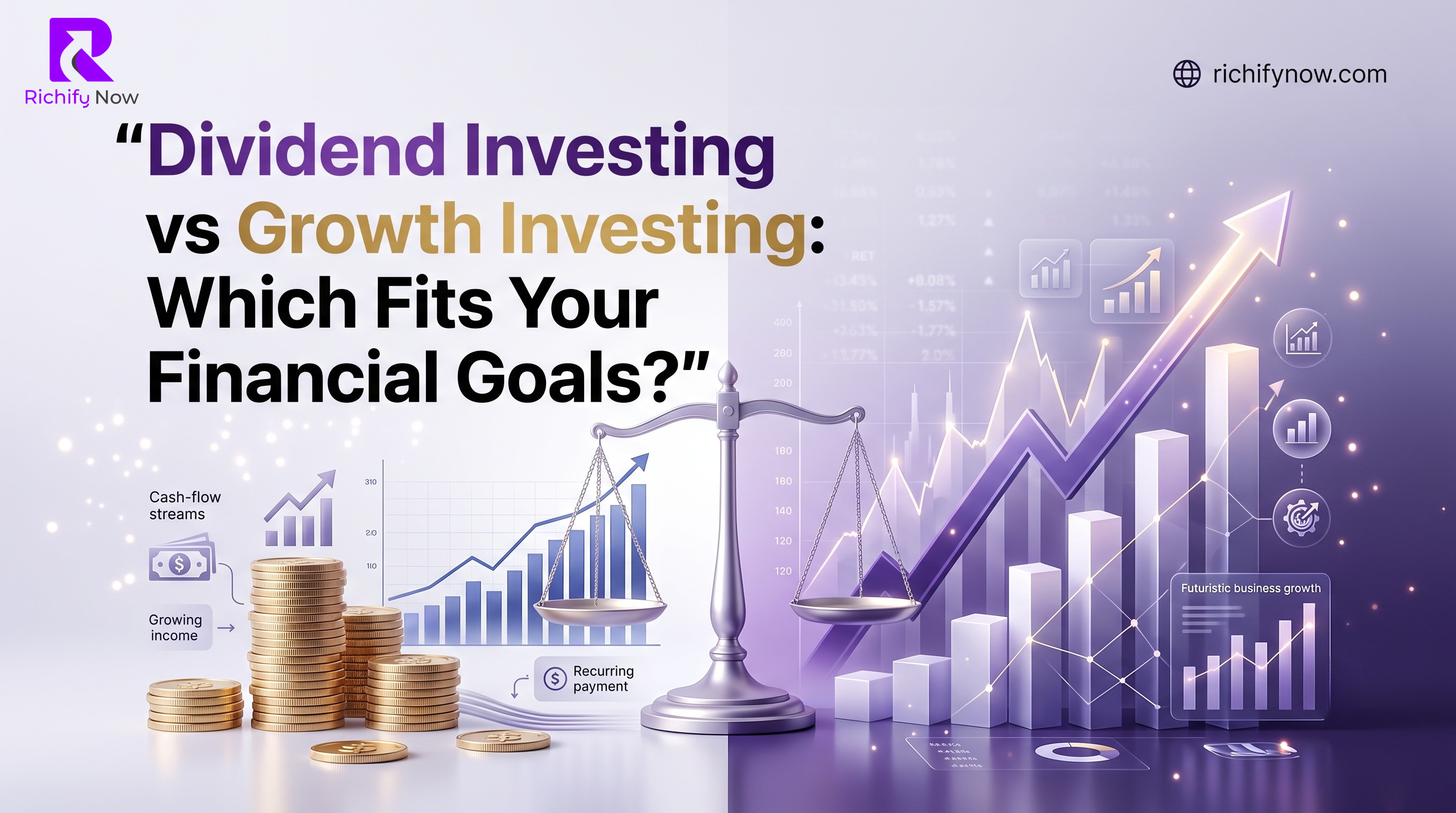
Dividend Investing vs Growth Investing: Which Fits Your Financial Goals?
One strategy is designed to deliver shareholder income today while the other concentrates on creating greater business value for tomorrow This evidence-based guide helps you decide which approach, or combination, fits your income needs, timeline, risk tolerance and financial goals
AEO Answer Card
A trustworthy investing strategy matches your income needs time horizon and risk tolerance Dividend investing provides recurring cash while growth investing focuses on long-term appreciation A blended approach can serve both goals
⚡ Quick Answer
Dividend investing may be more appropriate when you value recurring income, established cash-generating businesses and a potentially steadier return pattern Growth investing may be more appropriate when you have a long investment horizon, do not need immediate income and can tolerate larger price movements while pursuing capital appreciation
Many investors do not need to choose only one A diversified portfolio can combine dividend growers, broader market investments and selected growth exposure The correct mix depends on what your money needs to accomplish rather than which style performed best last year
💡 What It Means
Dividend investing and growth investing are two approaches to owning businesses through the stock market Both aim to increase investor wealth, but they differ in how companies use their profits and how shareholders expect to receive their return
What dividend investing means
A dividend is a distribution made by a company to eligible shareholders Dividend investors generally focus on companies that produce enough earnings and cash flow to distribute part of their capital while continuing to operate and invest in the business
Some investors withdraw those payments as income Others use a dividend-reinvestment plan to purchase additional shares Those new shares may generate additional dividends, creating a compounding cycle over time
Dividend-paying companies are often mature businesses with established products and recurring cash flow However, maturity does not guarantee safety A company may reduce or eliminate its dividend when profits fall, debt becomes difficult to manage or management identifies a more urgent use for cash
What growth investing means
Growth investing focuses on businesses expected to increase revenue, earnings, cash flow or market share faster than the broader market These companies often retain most of their profits rather than paying large dividends
Retained capital may be used for product development, technology, hiring, acquisitions, infrastructure or expansion into new markets Investors accept limited current income because they expect successful reinvestment to make the company more valuable
The investor's return normally comes through share-price appreciation That appreciation remains unrealised until shares are sold A successful growth company may eventually become a dividend payer after its expansion opportunities become more limited
💵 Dividend objective
Convert part of company cash flow into regular shareholder income while retaining the possibility of capital appreciation
📈 Growth objective
Reinvest business capital today in pursuit of higher earnings, larger market value and greater future share-price appreciation
🎯 Why It Matters
The distinction matters because investors do not all need the same type of return Someone building retirement savings over 30 years has different requirements from someone already using a portfolio to fund living expenses
A strategy that produces regular cash distributions may help an income-focused investor avoid frequent share sales A strategy that reinvests company profits may be more suitable for an investor who prioritises long-term wealth accumulation and does not need cash today
Dividends have historically been an important return component
Hartford Funds reports that approximately 85% of the cumulative total return of the S&P 500 Index since 1960 was attributable to reinvested dividends and compounding The same research states that dividends represented about 30% of return on an average annual basis over that period [1]
The 85% figure does not mean that dividends produced 85% of every year's market return It shows how repeated reinvestment can become increasingly influential over a period spanning several decades
Graph 1: Reported Attribution of Cumulative S&P 500 Total Return Since 1960
Source: Hartford Funds using Morningstar data through December 31, 2025 This is a historical attribution of cumulative total return, not a forecast of future returns [1]
Dividend policy has historically been associated with different outcomes
Hartford Funds' presentation of Ned Davis Research data for 1973 through 2025 reports an average annual return of 10.22% for companies classified as dividend growers and initiators Dividend payers returned 9.20%, dividend non-payers returned 4.21% and the equal-weighted S&P 500 comparison returned 7.74% [1]
The dividend growers and initiators group also recorded a standard deviation of 15.97%, compared with 21.91% for dividend non-payers and 24.80% for dividend cutters and eliminators Standard deviation is one measure of how widely returns have fluctuated around their average [1]
Graph 2: Historical Average Annual Return by Dividend Policy, 1973–2025
Historical classifications and results reported by Hartford Funds and Ned Davis Research The figures do not establish that every dividend-growing company will outperform a growth company or broad index [1]
Your cash-flow requirement changes the decision
A retiree may prefer receiving dividends because they provide cash without requiring a deliberate sale A younger investor may prefer that companies retain and reinvest capital Neither approach is automatically better The relevant question is whether the return structure supports the investor's financial obligations and behaviour
⚙️ How It Works
How dividend investing creates returns
Dividend investing has two potential return sources The first is cash income from distributions The second is capital appreciation if the underlying business becomes more valuable
Consider an investor who owns 100 shares of a company paying an annual dividend of $2 per share The position produces $200 in annual dividend income before taxes The investor may withdraw the money or reinvest it Reinvestment increases the number of shares owned, although the price available at each reinvestment date will vary
A sustainable dividend depends on business performance Investors commonly examine the payout ratio, free cash flow, debt burden, earnings stability and management's capital-allocation policy An unusually high dividend yield may be a warning rather than an opportunity because the yield can rise when the share price falls
How growth investing creates returns
Growth investing depends on a company retaining capital and earning an attractive return from it If management invests $1 million in expansion and that investment creates substantially more than $1 million in long-term business value, retaining earnings may benefit shareholders more than distributing the money
Growth investors study revenue expansion, profit margins, market opportunity, customer retention, competitive advantages and management execution They must also study valuation A strong company can still become a poor investment when the purchase price already assumes years of nearly perfect performance
How market conditions affect both approaches
S&P Dow Jones Indices research using annual data from 1927 through 2012 reported that positive market years produced an average price return of approximately 19%, with dividends adding about 5% During negative market years, the average price return was approximately minus 15%, while dividends contributed about 3% [2]
Graph 3: Price and Dividend Return Components in Different Markets
📈 Positive Market Years
📉 Negative Market Years
Source: S&P Dow Jones Indices Data covers annual returns from 1927 through 2012 Dividends may soften a decline but cannot prevent a portfolio from losing value [2]
How taxes can change the result
Dividends received in a taxable account may create a current tax liability even when they are automatically reinvested In the United States, qualified dividends can receive preferential federal tax treatment, while nonqualified dividends are generally taxed as ordinary income [3]
Growth investments can provide greater control over tax timing because unrealised appreciation is generally not taxed until the investment is sold Rules vary by country, account type, security and individual circumstances, so investment decisions should be evaluated on an after-tax basis
🧭 Step-by-Step Framework
Choosing between dividend and growth investing should begin with your financial plan rather than a stock screen The following framework turns the decision into a structured process
Define the portfolio's job
Decide whether the money is intended to produce current income, fund a future objective, preserve purchasing power or accomplish a combination of goals A portfolio without a defined purpose is more vulnerable to emotional strategy changes
Set your time horizon
Investors with decades before they need the money may have more capacity to tolerate growth-stock volatility Investors who need withdrawals soon may place greater emphasis on cash reserves, bonds and sustainable income-producing equities
Assess your need for cash flow
Estimate how much income the portfolio must provide and when it will be required Do not assume that a high dividend yield is the only way to create cash A total-return portfolio can also fund withdrawals through planned share sales
Measure your real risk tolerance
Consider how you responded during previous market declines Growth investing may look attractive during a rising market, but the strategy only works when the investor can remain disciplined through substantial price corrections
Evaluate dividend quality or growth quality
For dividend investments, examine payout coverage, cash flow, debt and dividend growth For growth investments, examine revenue quality, profitability, market opportunity, competitive advantage and valuation
Choose an implementation method
Decide whether to use diversified ETFs, mutual funds or individual stocks Funds can reduce company-specific risk, while individual stocks provide more control but demand deeper research and monitoring
Create allocation and rebalancing rules
Establish a target mix before investing Vanguard describes calendar-based and threshold-based rebalancing and notes that annual rebalancing can be suitable for many investors [5]
Review the plan—not daily market noise
Revisit the strategy when your goals, income requirements, tax circumstances or risk capacity change A falling share price alone does not automatically justify abandoning a long-term plan
✅ Comparison Checklist
| Decision factor | Dividend investing | Growth investing | Question to ask yourself |
|---|---|---|---|
| Primary objective | Income plus potential appreciation | Long-term capital appreciation | Do I need income now or wealth later? |
| Cash distributions | Generally higher and more regular | Often limited or absent | Will I withdraw or reinvest the cash? |
| Typical business stage | Often established and cash-generative | Often expanding and reinvesting heavily | Am I paying for current cash flow or future opportunity? |
| Time horizon | Can support medium- and long-term goals | Normally better suited to longer horizons | When will I need the invested money? |
| Volatility tendency | May be lower for financially strong dividend growers | Can be higher when valuations rely on distant earnings | Can I tolerate a major temporary decline? |
| Tax timing | Tax may apply when dividends are received | Tax on appreciation may be deferred until sale | Which accounts and local rules apply to me? |
| Main analytical focus | Payout sustainability, cash flow and debt | Growth durability, profitability and valuation | Do I understand the company's financial statements? |
| Main behavioural risk | Chasing unusually high yields | Paying any price for a popular story | Am I investing from analysis or recent performance? |
🚫 Common Mistakes
1. Chasing the highest displayed yield
A high yield may result from a collapsing share price Investors should investigate whether earnings and free cash flow can support the dividend Historical Hartford research also indicates that the highest-yielding group did not consistently produce the strongest outcome [1]
2. Assuming every dividend is permanent
Dividends are management and board decisions, not contractual guarantees A company may cut its payment during a recession, industry disruption or balance-sheet crisis
3. Buying growth without considering valuation
A rapidly expanding company can still deliver disappointing shareholder returns when its share price already reflects extremely optimistic assumptions Growth investors must compare business potential with the price being paid
4. Ignoring total return
A 5% dividend yield does not guarantee a positive investment result If the share price declines by 20%, the income does not eliminate the capital loss Investors should evaluate dividend income and price movement together
5. Confusing a company with a diversified strategy
Owning five dividend stocks in one industry does not create a diversified income portfolio The same applies to owning several growth companies exposed to the same technology or economic theme
6. Changing styles after performance has already occurred
Investors may buy growth after an extended rally and switch to dividends after a decline This behaviour can turn a long-term allocation decision into repeated performance chasing
7. Overlooking fees and taxes
Fund expenses, trading costs and taxes reduce the return available for compounding The most attractive pre-tax strategy may not create the best after-tax outcome
8. Treating dividend income as free money
A dividend transfers cash from the company to its shareholders The payment is valuable, but the cash is no longer available inside the business Investors should assess whether distribution or reinvestment represents the more productive use of capital
⚠️ Risks and Limitations
Dividend-cut risk
A company can reduce or eliminate its dividend when financial conditions deteriorate Dividend cuts can also damage the share price because they may signal weaker future cash generation
Inflation risk
A dividend that remains unchanged may lose purchasing power as living costs rise Investors seeking long-term income should distinguish between high current yield and sustainable dividend growth
Growth expectation risk
Growth-company valuations often depend on earnings expected many years into the future A reduction in those expectations can produce a significant price decline even when the business remains profitable
Interest-rate sensitivity
Rising rates can affect both styles High-valuation growth shares may become less attractive when future cash flows are discounted at higher rates Some dividend sectors may also face pressure when bonds and savings products begin offering more competitive income
Sector concentration
Dividend portfolios may become concentrated in financials, utilities, energy, telecommunications or consumer-staples companies Growth portfolios may become concentrated in technology, communication services or other expanding industries
Tax risk
Dividend and capital-gains rules can change Tax treatment also differs across jurisdictions and investment accounts The UK, for example, applies separate dividend allowances and rates, while dividends held inside an ISA generally receive tax-sheltered treatment [4]
Historical-data limitations
The historical dividend-policy data cited in this article does not represent a direct, controlled comparison between a dividend portfolio and every possible growth strategy Dividend categories, growth indexes and broad-market benchmarks can differ in sector composition, valuation, company size and rebalancing methodology
Historical outperformance can also be influenced by the period selected A different start date, end date or index methodology may produce a different conclusion The data should therefore inform decision-making rather than serve as a performance promise
🚀 Best Next Step
The best next step is not immediately searching for the highest-yielding dividend stock or the fastest-growing company Begin by writing a one-page investment policy for yourself
Your one-page policy should answer five questions
- What financial goal is this portfolio intended to fund?
- When will the money be required?
- How much recurring income must the portfolio generate?
- How large a temporary decline can you tolerate without abandoning the plan?
- What dividend-growth, growth-stock and broader diversification mix supports those answers?
After defining the goal, consider beginning with diversified funds rather than attempting to identify individual winners Review the fund's methodology, expense ratio, sector allocation, turnover, valuation and dividend policy
An income-focused investor may emphasise financially strong dividend growers rather than simply selecting the highest yields A long-horizon investor may emphasise profitable growth and broad diversification rather than speculative companies with compelling stories but weak fundamentals
A blended investor could combine both approaches and rebalance periodically Vanguard notes that investors can use new contributions, dividends and other portfolio cash flows to direct money toward underweight assets, which may reduce the need for taxable sales [5]
❓ FAQs
Are dividend stocks always safer than growth stocks?
No Risk depends on financial strength, debt, business quality, valuation and diversification A weak company with a high yield may be riskier than a profitable growth company with substantial cash
Can a company be both a dividend and growth investment?
Yes Some businesses generate enough cash to finance expansion while also paying and increasing dividends Investment styles exist on a spectrum rather than in completely separate categories
Should younger investors avoid dividend stocks?
Not necessarily Reinvested dividends can support long-term compounding Younger investors may simply decide to maintain greater overall exposure to companies with strong reinvestment opportunities
Is a high dividend yield automatically attractive?
No Investors should examine cash-flow coverage, debt, earnings stability and the reason the company's share price has fallen
Do growth investors receive no return until they sell?
Their investment may increase in market value before they sell, but the capital gain remains unrealised A sale is generally required to convert that appreciation into spendable cash
Is dividend reinvestment always the best choice?
Not always Reinvestment may support compounding, but the investor should consider valuation, diversification, taxes and whether the income is needed for another financial priority
Can retirees use growth investments?
Yes Retirees may still need growth to address inflation and longevity The appropriate allocation depends on essential expenses, guaranteed income, cash reserves and ability to tolerate market losses
Is a blended strategy better than choosing one style?
It may be suitable for investors seeking both income and appreciation A blend can reduce dependence on one market style, although diversification cannot eliminate investment losses
📑 Sources and Methodology
Research approach
This article uses high-level evidence from recognised index providers, investment-research firms, government tax guidance and major investment institutions Data was reviewed through July 10, 2026
Historical figures are identified with numbered references near the relevant statement Charts were recreated as responsive HTML and CSS visualisations using the figures reported by the cited sources They are explanatory graphics rather than independent calculations or forecasts
The article does not claim that dividend investing universally outperforms growth investing The Hartford and Ned Davis dataset classifies companies according to dividend policy, while the S&P Dow Jones research analyses dividend and price-return components These studies provide useful evidence about dividends but are not a complete substitute for comparing specific dividend and growth indexes over identical periods
No hypothetical portfolio-return forecast has been presented as fact Investment suitability remains dependent on the investor's goals, tax position, time horizon, account structure and risk capacity
References
-
Hartford Funds — The Power of Dividends: Past, Present, and Future
Historical S&P 500 dividend contribution, dividend-policy return data, volatility comparisons, payout-ratio discussion and Ned Davis Research classifications through December 31, 2025
Historical research
Hartford Funds dividend research -
S&P Dow Jones Indices — Dividend Investing and a Look Inside the S&P Dow Jones Dividend Indices
Historical analysis of dividend income, price returns, volatility and positive and negative market periods using data from 1927 through 2012
Index research
S&P Dow Jones dividend-investing research -
Fidelity — How Are Dividends Taxed? 2026 Dividend Tax Rates
Explanation of qualified and nonqualified dividends, taxable reinvestment and United States federal dividend-tax treatment
Tax education
Fidelity dividend-tax guidance -
GOV.UK — Tax on Dividends
Official UK dividend allowance, tax-rate and ISA guidance
Government source
GOV.UK dividend-tax guidance -
Vanguard — Rebalancing Your Portfolio: How to Rebalance
Calendar-based and threshold-based rebalancing, annual-review guidance and the use of portfolio cash flows to restore allocations
Portfolio guidance
Vanguard portfolio-rebalancing guidance
💜 Build Wealth Around Your Real Financial Goals
Successful investing is not about choosing the style with the loudest marketing or the strongest recent performance It is about matching cash flow, risk, time and diversification with the life you are trying to build
Explore More RichifyNow GuidesBeginner Investing Readiness Checklist
Download the editable RichifyNow workbook with instructions, working fields, disclaimer, and the complete source-document specification.

Loading comments…