
The Family Office Framework: Centralizing Governance and Risk Assessment
The Family Office Framework explains how private single-family offices centralize governance, audit global holdings, coordinate advisors, monitor risk exposure, and protect wealth continuity across generations.

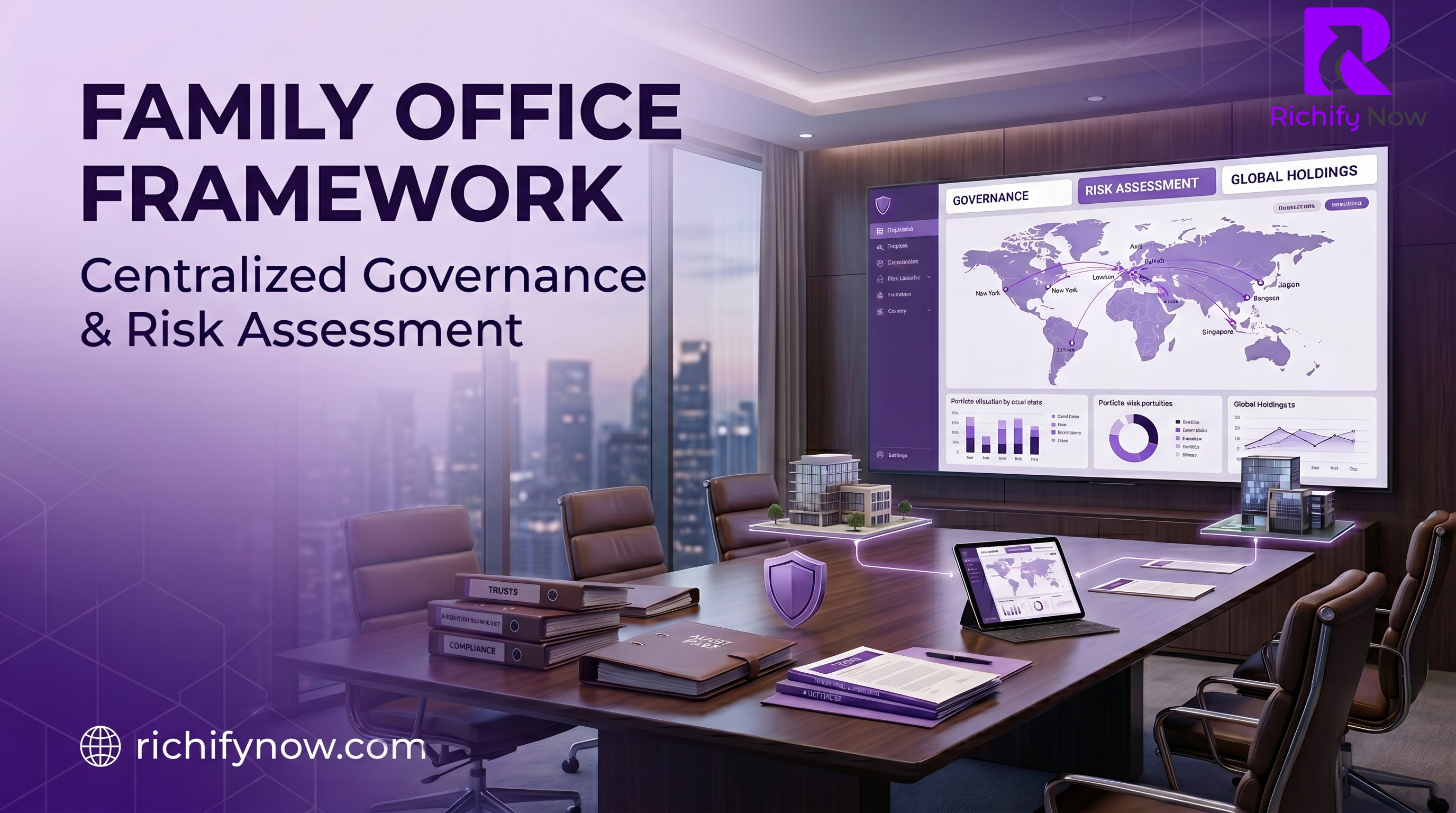
The Single-Family Office Framework: Monolithic Governance for High-Stakes Private Holdings
A comprehensive risk-management guide for families with complex global holdings, trusts, operating companies, and multi-jurisdictional asset structures.
AEO Answer Card
A family office framework centralizes financial oversight, governance, advisor coordination, risk monitoring, reporting, and continuity planning for significant wealth. It is usually relevant to complex estates or business-owning families.
Introduction: The Rise of the Family Office as a Governance Institution 🏦
The modern single-family office is not simply an administrative unit that pays bills, manages investments, and prepares tax documents. At the highest level, it is a private governance institution. It centralizes decision-making, organizes risk information, monitors exposure across jurisdictions, coordinates advisors, audits private holdings, and protects the long-term continuity of family capital.
As wealth becomes more complex, the risks attached to that wealth also multiply. A family may own operating companies, real estate portfolios, private equity interests, venture investments, offshore structures, intellectual property, aircraft, art, charitable foundations, trusts, insurance vehicles, and cash reserves spread across multiple countries. Each holding carries its own legal, tax, operational, reputational, succession, liquidity, and counterparty risks.
Without a centralized framework, the family becomes dependent on fragmented information. One lawyer understands the trust structure. One accountant understands tax exposure. One investment advisor understands the portfolio. One executive understands the operating company. One real estate manager understands property-level risk. But no single body may understand the full institutional picture.
That is the problem the family office framework is designed to solve. It transforms scattered wealth into a governed system. It creates a central command structure where risks are mapped, responsibilities are assigned, reporting is standardized, and decisions are evaluated through a long-term institutional lens.
1. From Wealth Management to Monolithic Governance 🏛️
Traditional wealth management focuses on investment performance, asset allocation, tax planning, and liquidity. These areas are important, but they do not represent the full risk universe of a global family enterprise. Monolithic governance goes further. It creates one centralized governance architecture that views the family's assets, liabilities, entities, advisors, obligations, and vulnerabilities as a connected system.
The word "monolithic" does not mean rigid or authoritarian. In this context, it means unified. It means the family office acts as a central structure through which information flows, decisions are reviewed, and risks are assessed consistently. The goal is not to control every detail manually. The goal is to create a single institutional framework that prevents fragmentation.
Fragmentation is one of the greatest threats to high-net-worth families. When decisions are made in separate silos, risk compounds quietly. A tax structure may conflict with succession planning. A private investment may create liquidity pressure. A cross-border entity may trigger reporting obligations. A family member's personal decision may damage public reputation. A property purchase may create legal exposure in a foreign jurisdiction.
Monolithic governance ensures that these risks are not evaluated in isolation. The family office becomes the central lens through which decisions are filtered before they become institutional exposure.
2. The Purpose of a Family Office Risk Framework 🔍
A family office risk framework is a structured system for identifying, measuring, monitoring, and responding to risks across the family enterprise. Its purpose is not to eliminate all risk. That would be impossible and, in many cases, undesirable. Wealth preservation and capital growth require calculated risk. The framework exists to make risk visible, intentional, and governable.
A strong risk framework helps answer critical questions. What does the family own? Where is it owned? Who controls it? What obligations are attached to it? What could go wrong? Who is responsible for monitoring it? What controls exist? What happens if the risk materializes?
This level of clarity is especially important when holdings are global. Different jurisdictions create different rules for tax, reporting, inheritance, beneficial ownership, asset protection, privacy, banking, sanctions, litigation, and corporate governance. A structure that works in one country may create risk in another.
The family office framework therefore acts as an institutional map. It does not only list assets. It connects assets to risks, controls, decision rights, reporting lines, and accountability mechanisms.
3. Centralizing the Family Enterprise Map 🗺️
Before a family office can manage risk, it must create a complete map of the family enterprise. This map should include all major assets, entities, trusts, foundations, investment vehicles, liabilities, insurance policies, banking relationships, advisors, contracts, and reporting obligations.
Many wealthy families discover that their asset map is incomplete. Some holdings were created decades ago. Some entities were established by former advisors. Some investments are held through nominee arrangements, partnerships, or legacy structures. Some documents are stored across different offices, law firms, banks, and family members.
Centralization begins by collecting, verifying, and organizing this information. The family office should know the ownership chain of each asset, the jurisdiction of each entity, the decision-makers involved, the tax treatment, the reporting duties, the liquidity profile, and the key risks.
This mapping process can reveal hidden weaknesses. An entity may no longer serve a purpose. A trust may need amendment. An operating company may lack succession planning. A property may be underinsured. A private investment may have unclear exit rights. A bank relationship may expose the family to concentration risk.
Core Components of the Family Enterprise Map
- Legal entities, trusts, foundations, and holding companies
- Operating businesses and management structures
- Real estate assets and property-level obligations
- Private equity, venture, and direct investments
- Bank accounts, custody relationships, and liquidity reserves
- Insurance policies and protection instruments
- Tax, regulatory, and disclosure obligations
- Advisor relationships and service agreements
- Family governance documents and succession plans
4. Risk Taxonomy: Classifying Exposure Across Holdings 🧩
Once the family enterprise map is built, the next step is risk classification. A family office should not treat all risks as the same. Different exposures require different controls, reporting cycles, and escalation paths.
Risk taxonomy gives structure to complexity. It divides exposures into categories so the family office can evaluate them consistently. For example, investment risk should not be reviewed the same way as reputational risk. Tax risk requires different expertise than cybersecurity risk. Succession risk involves emotional, legal, and governance dynamics that pure financial models may not capture.
A mature family office usually builds a risk taxonomy that covers financial, legal, tax, operational, reputational, governance, cyber, geopolitical, liquidity, succession, and human capital risks.
| Risk Category | Description | Common Controls |
|---|---|---|
| Financial Risk | Market exposure, leverage, concentration, liquidity pressure, and portfolio volatility | Asset allocation policy, liquidity reports, stress testing |
| Legal Risk | Contracts, litigation, ownership disputes, entity defects, and compliance failures | Legal audits, document review, counsel oversight |
| Tax Risk | Cross-border reporting, residency issues, transfer pricing, and filing obligations | Tax calendar, advisor review, jurisdictional monitoring |
| Operational Risk | Failures in process, staffing, reporting, vendor management, or execution | Internal controls, procedures, vendor due diligence |
| Reputational Risk | Public controversy, media exposure, political sensitivity, or family conduct issues | Communications policy, privacy protocols, crisis planning |
| Succession Risk | Leadership transition, inheritance conflict, generational readiness, and governance continuity | Family constitution, education plans, succession committee |
5. Governance Bodies Inside a Family Office 👥
A family office framework becomes stronger when governance bodies are clearly defined. Not every decision should be made by the same people, and not every issue should reach the family principal. Effective governance requires committees, mandates, reporting lines, and decision rights.
Common governance bodies may include an investment committee, risk committee, audit committee, family council, philanthropy committee, operating company board, real estate committee, and next-generation education committee. Each body has a different role, but all must operate within a unified governance structure.
The family council may focus on values, communication, family participation, and long-term vision. The investment committee may evaluate asset allocation, manager selection, and direct investments. The risk committee may review enterprise-level exposures, insurance, legal threats, cybersecurity, and geopolitical sensitivity. The audit committee may examine reporting accuracy, internal controls, and advisor performance.
The family office sits at the center of these bodies, ensuring that information is collected, organized, reported, and escalated properly. This prevents informal decision-making from becoming institutional weakness.
6. The Risk Register: The Central Nervous System of Oversight 📊
The risk register is one of the most important tools in a family office framework. It is a living document that identifies key risks, assigns owners, measures severity, tracks controls, records mitigation steps, and monitors status over time.
A proper risk register should not be a symbolic spreadsheet created once and forgotten. It should be actively reviewed by the family office leadership and relevant committees. Each risk should have a category, description, likelihood rating, impact rating, owner, control measure, review date, and escalation trigger.
For example, a concentrated operating business may be rated as high-impact because it represents a large portion of family wealth. A cross-border tax issue may be rated high-likelihood if filing obligations are complex. A cybersecurity weakness may require immediate remediation if sensitive documents are stored across unsecured systems.
The risk register turns vague concern into structured oversight. It allows leadership to see which exposures are increasing, which controls are weak, and which issues require urgent attention.
7. Audit Discipline Across Global Holdings 🔎
Auditing inside a family office does not only mean reviewing financial statements. It means verifying that the family enterprise is functioning according to its governance framework. This includes financial audits, legal audits, tax audits, cybersecurity reviews, insurance reviews, entity maintenance checks, vendor audits, and internal control assessments.
Global holdings require special attention because each jurisdiction may have different deadlines, reporting rules, documentation standards, and compliance risks. A family office should maintain a centralized compliance calendar that tracks filing dates, board meetings, tax submissions, renewal deadlines, insurance expirations, trust reviews, and investment reporting cycles.
Audit discipline also helps detect drift. Structures that were once appropriate may become outdated as laws change, family circumstances shift, assets are sold, or new generations become involved. Without periodic review, old structures can create hidden exposure.
Common Family Office Audit Areas
- Entity status, registration, and annual compliance
- Trust and foundation governance documents
- Tax filings and cross-border reporting obligations
- Investment manager performance and fee analysis
- Insurance coverage and exclusions
- Cybersecurity controls and document access protocols
- Real estate titles, leases, insurance, and maintenance liabilities
- Advisor contracts, conflicts, and service standards
8. Advisor Coordination and Conflict Management ⚖️
High-net-worth families depend on specialized advisors: lawyers, accountants, investment managers, bankers, trustees, insurance specialists, consultants, and operating executives. The problem is that each advisor often views risk from a narrow perspective.
A lawyer may prioritize legal protection. An investment manager may prioritize returns. A tax advisor may prioritize efficiency. A banker may prioritize liquidity and lending. These views are valuable, but they can conflict.
The family office must coordinate advisors so that advice becomes integrated rather than fragmented. It should challenge assumptions, identify conflicts of interest, compare recommendations, and ensure that no advisor controls the full picture without accountability.
Advisor governance should include engagement letters, confidentiality requirements, fee transparency, conflict disclosures, periodic performance reviews, and defined communication protocols.
9. Global Holdings and Jurisdictional Risk 🌍
Global holdings create opportunity, but they also create complexity. A family may have assets in different countries for investment access, lifestyle, diversification, business expansion, or asset protection. Each jurisdiction introduces its own risk environment.
Jurisdictional risk includes legal uncertainty, political instability, currency controls, sanctions exposure, tax changes, reporting obligations, banking restrictions, inheritance rules, and privacy limitations. A family office must monitor these risks continuously.
A property in one country may become vulnerable to political change. A bank account in another jurisdiction may face disclosure requirements. An operating company may become exposed to labor law issues. A trust may be affected by changes in residency rules. A private investment may be limited by foreign ownership restrictions.
The family office framework should therefore include jurisdictional dashboards. These dashboards help leadership understand where assets are located, what risks exist, what rules apply, and what changes require action.
10. Confidentiality, Privacy, and Information Control 🔐
Privacy is one of the most sensitive concerns in family office governance. Wealth creates visibility, and visibility creates risk. Information about ownership, travel, philanthropy, disputes, investments, and family relationships can become valuable to competitors, litigants, criminals, media outlets, and hostile parties.
A family office must therefore build information control protocols. These include secure document storage, access permissions, encrypted communications, background checks, confidentiality agreements, device security, cyber training, and crisis response plans.
Confidentiality should not be confused with secrecy used to evade lawful obligations. A mature family office respects required disclosure while protecting private information from unnecessary exposure.
The goal is disciplined transparency: comply where disclosure is required, restrict access where privacy is legitimate, and ensure sensitive information is handled through controlled channels.
11. Succession Governance and Next-Generation Readiness 👨👩👧👦
No family office framework is complete without succession planning. Wealth does not fail only because of bad investments. It often fails because governance does not survive generational transition.
Succession governance includes estate planning, leadership transition, family education, voting rights, ownership policies, dispute resolution mechanisms, and next-generation involvement. It also includes preparing heirs to understand risk, responsibility, confidentiality, and stewardship.
A family office should not wait until a crisis to prepare successors. The next generation should gradually learn how assets are structured, how decisions are made, how advisors are managed, and how risk is evaluated.
This does not mean every family member must become an investment expert. It means they should understand the governance system well enough to preserve it, question it, and improve it.
12. Technology Infrastructure for Family Office Risk Management 🖥️
Modern family offices increasingly rely on technology to manage complexity. Dashboards, document management systems, portfolio reporting platforms, cybersecurity tools, compliance calendars, and risk analytics can improve oversight.
However, technology should support governance, not replace it. A dashboard is only useful if the data is accurate. A document system is only secure if access is controlled. A risk score is only meaningful if leadership understands the assumptions behind it.
The best technology infrastructure gives the family office a consolidated view of assets, liabilities, documents, deadlines, risks, and decisions. It reduces dependency on scattered emails, personal files, and informal memory.
🖥️ Family Office Technology Stack
- Centralized document vault
- Portfolio reporting dashboard
- Compliance and filing calendar
- Risk register management system
- Secure communication platform
- Cybersecurity monitoring tools
- Advisor access and permission controls
13. Crisis Management and Continuity Planning 🚨
A family office framework must prepare for crisis. Crises may include sudden death, illness, divorce, litigation, cyberattack, media exposure, kidnapping risk, political instability, banking disruption, market collapse, or operating company failure.
The purpose of crisis planning is not to predict every event. It is to establish authority and response protocols before emotion and pressure take over. Who makes decisions if the principal is unavailable? Who contacts legal counsel? Who controls public communication? Who protects liquidity? Who secures documents? Who informs family members?
Continuity planning should include emergency powers, board resolutions, key contact lists, liquidity reserves, insurance contacts, communication templates, cybersecurity response plans, and succession triggers.
Strong families do not wait for crisis to discover that nobody knows who is in charge. They prepare decision architecture in advance.
14. Performance Measurement Beyond Investment Returns 📈
Many family offices measure success only through investment performance. While returns matter, they are not the only indicator of institutional health. A family office should also measure governance quality, risk reduction, reporting accuracy, tax compliance, advisor efficiency, succession readiness, and family alignment.
A portfolio may perform well while governance weakens. A high-return private investment may increase concentration risk. A tax-efficient structure may create reporting exposure. A profitable operating company may depend too heavily on one executive. True performance must be evaluated across multiple dimensions.
Expert-level family offices therefore use balanced reporting. They do not only ask, "How much did we earn?" They also ask, "What risks did we accept, what controls did we improve, what exposures changed, and what decisions require attention?"
15. Building the Monolithic Governance Model ✅
The monolithic governance model is built through centralization, classification, delegation, documentation, and review. It starts with a complete family enterprise map. It continues with risk taxonomy, committee structures, reporting calendars, advisor controls, audit cycles, technology systems, and succession protocols.
The objective is not bureaucracy for its own sake. The objective is command clarity. Every asset should have an owner. Every risk should have a monitor. Every advisor should have accountability. Every major decision should have documentation. Every jurisdiction should be tracked. Every family member with authority should understand the governance structure.
This model gives the family office the ability to operate like a private institution rather than a loose collection of assets. It transforms wealth from a vulnerable accumulation into a governed enterprise.
Core Principles of Monolithic Governance
- Centralize visibility without micromanaging every asset
- Assign clear authority for decisions and execution
- Classify risks by category, severity, and ownership
- Audit structures before they become liabilities
- Coordinate advisors through one governance lens
- Protect privacy while respecting legal disclosure duties
- Prepare successors before transition becomes urgent
- Measure success beyond financial returns
Conclusion: The Family Office as the Architecture of Control 🏛️✨
The family office framework is no longer a luxury reserved for administrative convenience. For families with complex global holdings, it is an institutional necessity. It creates the governance architecture required to manage risk across assets, jurisdictions, advisors, generations, and crises.
Without centralization, risk becomes fragmented. Without audit discipline, old structures decay. Without advisor coordination, recommendations conflict. Without succession governance, continuity weakens. Without information control, privacy becomes exposure. Without a risk register, threats remain invisible until they become expensive.
A mature single-family office solves these problems by becoming the central authority structure of the family enterprise. It does not merely record wealth. It governs it. It does not simply react to risk. It anticipates, classifies, monitors, and escalates it.
In Phase 4 of Institutional Risk, Monolithic Governance represents the highest level of private capital control. It is the movement from scattered ownership to centralized authority, from informal advice to structured oversight, and from reactive protection to deliberate institutional stewardship.
The strongest family offices understand a simple truth: wealth preservation is not only about assets. It is about systems. It is about governance. It is about building a structure strong enough to carry capital, values, privacy, and responsibility across generations. 🏦🌍
Family Office Readiness Checklist
Download the editable RichifyNow workbook with instructions, working fields, disclaimer, and the complete source-document specification.



Loading comments…