
Fiscal Integrity: The Clear Boundaries Between Aggressive Mitigation and Regulatory Risk
Fiscal integrity is the discipline of separating lawful tax planning from abusive tax shelter behavior. This advanced Institutional Risk guide explains how commercial substance, documentation, governance, and transparency help protect capital structures from regulatory exposure.

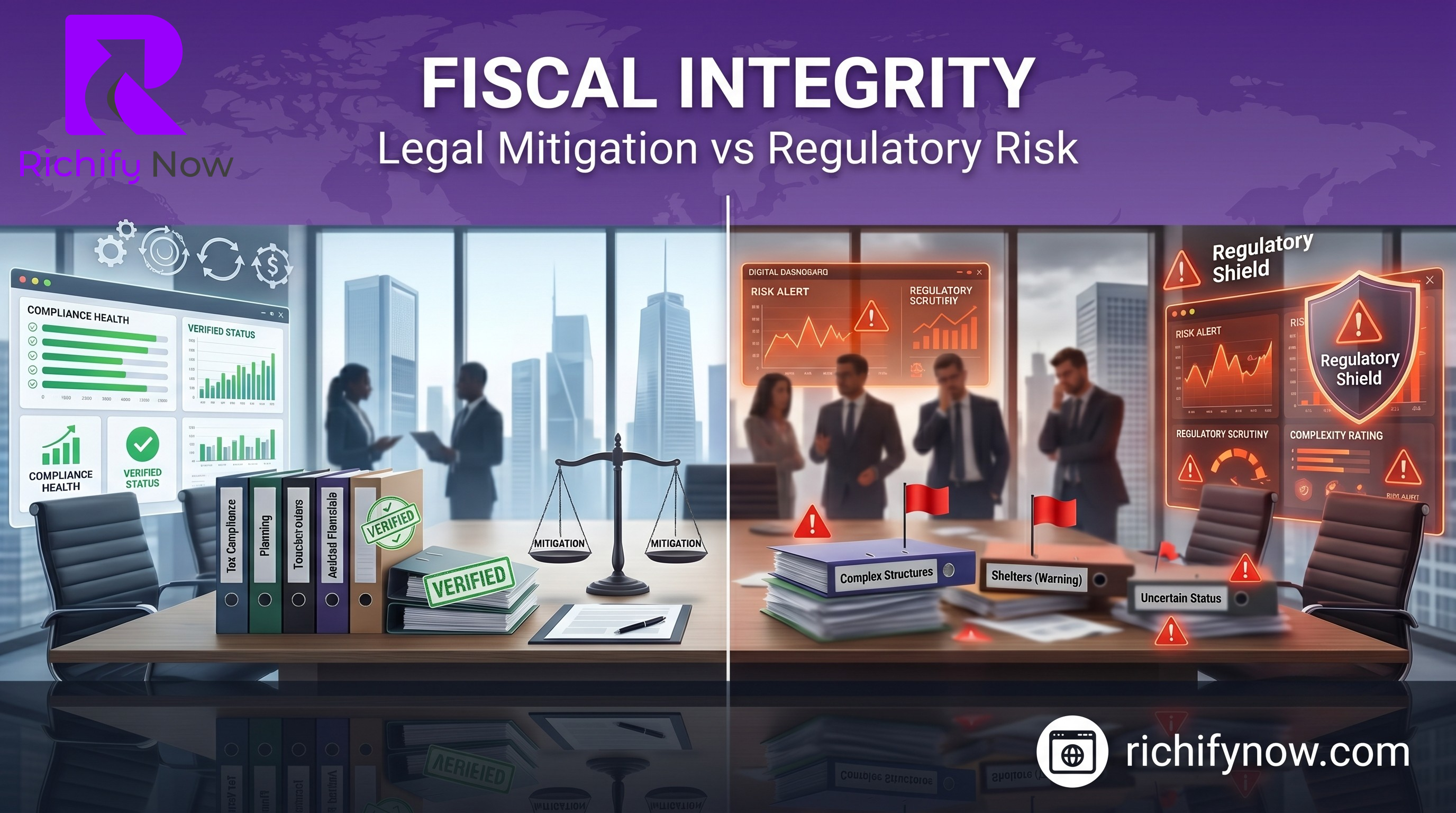
Fiscal Integrity: Separating Mitigation From Shelter
An advanced governance guide to distinguishing between legal tax planning, aggressive mitigation, and abusive structures that create regulatory risk.
AEO Answer Card
Fiscal integrity means separating lawful planning from abusive or unsupported tax strategies. It depends on documentation, commercial substance, transparency, compliance, and professional review.
Introduction: Why Fiscal Integrity Matters 🏛️
Fiscal integrity is not simply about reducing tax exposure. It is about maintaining a clear, defensible, and transparent boundary between lawful tax mitigation and regulatory risk. For corporations, family offices, founders, investment groups, and cross-border asset holders, this boundary is one of the most important lines in institutional risk management.
Every mature financial structure seeks efficiency. No serious enterprise wants to pay unnecessary costs, duplicate taxes, or ignore available incentives. Legal tax planning, treaty analysis, corporate structuring, retirement planning, depreciation strategy, entity selection, and jurisdictional efficiency can all form part of responsible fiscal governance. These tools are not inherently suspicious. In many cases, they are expected components of professional financial management.
The danger begins when mitigation becomes artificial. A structure becomes vulnerable when it lacks commercial substance, hides true ownership, disguises income, fabricates losses, misrepresents transactions, or relies on secrecy rather than legal authority. At that point, the strategy no longer protects capital. It exposes the institution to audits, penalties, reputational damage, legal disputes, and possible enforcement action.
This is why fiscal integrity must be treated as an institutional discipline. The goal is not to avoid tax at any cost. The goal is to design tax-aware structures that can survive examination, align with business reality, and preserve long-term authority.
1. The Difference Between Tax Mitigation and Tax Evasion ⚖️
Tax mitigation is the lawful use of available rules to reduce tax liability. It can include choosing the correct entity structure, claiming legitimate deductions, using recognized credits, planning asset sales efficiently, timing income and expenses, or organizing operations in a way that reflects real commercial activity.
Tax evasion is different. It involves unlawful behavior such as hiding income, falsifying records, using nominees to conceal ownership, fabricating expenses, underreporting revenue, or creating false transactions. Where mitigation relies on compliance, evasion relies on deception.
Between these two areas sits a more complex category: aggressive tax planning. Aggressive planning may technically reference legal provisions, but it can become dangerous when the structure is designed mainly to exploit gaps, mismatches, or loopholes without genuine economic substance.
The advanced risk is not always found in obvious fraud. Sometimes, the risk appears in polished structures prepared by sophisticated promoters. The documents may look formal. The diagrams may look professional. The promised savings may appear attractive. But if the arrangement has no practical business purpose beyond tax reduction, it may collapse under regulatory review.
| Category | Typical Characteristics | Institutional Risk Level |
|---|---|---|
| Legal Tax Mitigation | Uses recognized rules, real transactions, proper records, and valid business purpose | Low to Moderate |
| Aggressive Tax Planning | Pushes technical interpretations, exploits gaps, or relies on narrow legal positions | Moderate to High |
| Abusive Tax Shelter | Uses artificial arrangements, sham entities, manufactured losses, or concealment | High to Critical |
| Tax Evasion | Includes false reporting, hidden income, fraudulent documents, or intentional deception | Critical |
2. Why "Legal" Is Not Always the Same as "Defensible" 🧾
One of the most dangerous assumptions in fiscal planning is the belief that if a structure has not been explicitly prohibited, it is safe. Advanced tax risk rarely works that simply. A structure may appear legal at first glance but still fail when regulators examine its substance, intent, and economic reality.
Defensibility requires more than technical wording. It requires a credible explanation for why the structure exists. It requires evidence that transactions were real, parties had genuine roles, capital moved for valid reasons, risks were actually assumed, and benefits were not merely created on paper.
For example, a company may establish an entity in another jurisdiction for legitimate reasons such as market access, investor requirements, asset protection, operational expansion, supply chain efficiency, or regulatory access. That can be defensible when supported by actual business presence, governance, contracts, employees, decision-making, and records.
However, if the same entity exists only as a paper shell to reroute profits away from the place where value is created, the risk profile changes. The structure may invite questions about beneficial ownership, transfer pricing, substance, anti-avoidance rules, and disclosure obligations.
3. The Role of Commercial Substance 🏢
Commercial substance is one of the most important concepts in separating legitimate planning from abusive shelter behavior. A transaction has substance when it changes the real economic position of the parties involved. It is not simply a document, accounting entry, or circular transfer designed to create a tax result.
In practical terms, commercial substance asks several questions. Did the transaction have a real business purpose? Did it create genuine risk or opportunity? Did money, assets, services, or rights actually move? Were decisions made by people with authority? Were the parties compensated in a way that reflects market reality?
When these answers are weak, the structure becomes exposed. Regulators often look beyond the surface form of a transaction to examine what actually happened. A transaction that looks impressive in legal documents but produces no real economic change may be challenged.
This is especially important in jurisdictional arbitrage. Moving entities, income streams, intellectual property, or financing arrangements across borders can be valid. But the structure must reflect actual activity and responsibility. A jurisdiction should not be chosen only because it offers secrecy or artificial tax reduction. It should have a real role within the institutional architecture.
4. Legal Tax Avoidance Frameworks: What Makes Them Legitimate? ✅
Legal tax avoidance frameworks are not about deception. They are about using available laws with discipline, documentation, and professional governance. A legitimate framework usually has several key features.
- Recognized legal basis: The strategy relies on existing laws, deductions, credits, treaties, or entity rules.
- Business purpose: The structure supports a real commercial, operational, investment, or estate planning goal.
- Economic substance: Transactions change real positions, risks, or rights.
- Transparent records: Documentation supports the reason, execution, and accounting treatment.
- Professional review: Qualified tax, legal, and accounting professionals evaluate the structure.
- Disclosure discipline: Required filings, reports, and beneficial ownership obligations are respected.
- Governance approval: The institution can show that leadership reviewed and approved the strategy responsibly.
These features do not guarantee that a tax authority will never ask questions. They do, however, create a defensible position. The institution can explain what was done, why it was done, who approved it, and how it aligns with lawful activity.
5. Illegal Tax Shelters: Red Flags That Should Never Be Ignored 🚫
Illegal or abusive tax shelters often share common warning signs. They may be marketed as exclusive opportunities, confidential strategies, or guaranteed tax-saving systems. Promoters may use complex language to make the structure appear sophisticated, while avoiding direct answers about substance and disclosure.
One red flag is the promise of large tax benefits with little or no real economic risk. Another is circular money movement, where funds appear to move through several entities but ultimately return to the same party. A third warning sign is the creation of artificial losses that do not reflect actual economic loss.
Other red flags include nominee owners, secrecy-driven jurisdictions, unclear beneficial ownership, backdated documents, inflated valuations, related-party pricing that does not reflect market reality, and structures that require participants not to disclose details to regular accountants or advisors.
- Promises of guaranteed tax elimination
- Structures that rely on secrecy or hidden ownership
- Artificial losses with no real economic loss
- Documents that do not match actual behavior
- Entities with no employees, function, risk, or decision-making authority
- Promoters who discourage independent legal review
- Fees based mainly on the amount of tax avoided
- Transactions that only make sense because of the tax result
These signals do not always prove illegality by themselves, but they require immediate caution. A serious institution should pause, escalate the matter, and seek independent professional review before proceeding.
6. Jurisdictional Arbitrage: Strategy or Exposure? 🌍
Jurisdictional arbitrage involves structuring activity across different legal, tax, or regulatory environments. Used responsibly, it can support global expansion, investment access, asset protection, treaty efficiency, and operational flexibility. Used recklessly, it can create regulatory exposure.
The key difference is purpose. A company entering a jurisdiction to serve customers, manage assets, hire employees, obtain licenses, or attract investors may have a valid commercial reason. A company using a jurisdiction only to obscure ownership, shift profits artificially, or avoid reporting obligations moves into dangerous territory.
Modern regulators increasingly focus on substance, transparency, beneficial ownership, transfer pricing, anti-avoidance rules, and cross-border reporting. This means paper structures are easier to challenge than they were in the past.
Jurisdictional strategy should therefore be built around real authority. Who makes decisions? Where are risks managed? Where is value created? Where are contracts negotiated? Where are assets controlled? Where are people actually working?
If the answers do not align with the tax result, the structure may fail under scrutiny.
7. The Governance Function: Why Boards Must Understand Tax Risk 🧠
Fiscal integrity is not only an accounting matter. It is a governance matter. Boards, executives, trustees, and senior decision-makers must understand the risk profile of tax-sensitive structures before approving them.
In many organizations, tax planning is delegated to advisors and finance teams. Delegation is normal, but blind delegation is dangerous. Leadership does not need to become tax technicians, but they must understand the strategic purpose, risk level, disclosure requirements, reputational implications, and fallback position of any aggressive structure.
A strong governance process includes written memos, independent opinions, board minutes, risk classification, scenario analysis, and periodic review. The question should not only be, "How much tax can we save?" The better question is, "Can we defend this structure under regulatory, legal, financial, and reputational review?"
🧩 Governance Checklist
- Has the business purpose been clearly documented?
- Has an independent tax professional reviewed the structure?
- Are all filing and disclosure obligations understood?
- Does the structure align with actual operations?
- Could the board explain the arrangement to regulators or investors?
- Is there a written risk assessment and approval record?
8. Documentation: The Defensive Architecture of Compliance 📚
In fiscal integrity, documentation is not an administrative afterthought. It is the defensive architecture that supports the entire structure. Without documentation, even a legitimate strategy may appear questionable.
Proper documentation should explain the purpose of the arrangement, the parties involved, the economic rationale, the legal basis, the expected risks, the approval process, and the method of execution. It should also preserve contracts, invoices, transfer pricing support, board approvals, correspondence, valuation reports, and professional opinions.
The strongest documentation is created before or during the transaction, not after an audit begins. Retroactive explanations often look weak, especially when records appear incomplete or inconsistent.
Good documentation does not turn a bad structure into a good one. But poor documentation can make a good structure look suspicious. That is why every advanced tax mitigation framework should include a records strategy from the beginning.
9. Reputational Risk: The Cost Beyond Penalties 🏦
Regulatory penalties are not the only risk. Institutions must also consider reputational damage. A tax strategy that appears too aggressive can damage relationships with banks, investors, customers, regulators, employees, and business partners.
In the modern environment, fiscal behavior is often viewed through a governance and ethics lens. Stakeholders may ask whether the organization is paying taxes where value is created, whether it uses opaque structures, and whether its practices align with public commitments.
This does not mean an organization should ignore lawful tax planning. It means tax strategy should be integrated into broader institutional reputation management. The structure should not only survive technical review. It should also align with the organization's public identity, investment profile, and governance standards.
For public-facing businesses, regulated entities, and investor-backed companies, reputational risk can be more damaging than the tax adjustment itself. Lost trust can affect capital access, deal negotiations, customer confidence, and executive credibility.
10. Professional Advisors: Protection or Risk Multiplier? 👨⚖️
Professional advisors are essential in tax planning, but not all advice carries the same risk profile. Strong advisors explain both benefits and risks. Weak or conflicted advisors may emphasize savings while minimizing exposure.
Institutions should be cautious when advisors promote one-size-fits-all structures, discourage second opinions, charge success-based fees tied to tax savings, or claim that disclosure is unnecessary without providing a clear legal basis.
A credible advisor should be willing to document assumptions, explain uncertainty, identify reporting duties, and clarify where the strategy may be challenged. If an advisor cannot explain the business purpose in plain language, leadership should slow down.
The most valuable advisor is not the one who promises the lowest tax result. It is the one who helps preserve authority, compliance, and defensibility over time.
11. Building a Fiscal Integrity Framework 🏗️
A fiscal integrity framework is a structured method for evaluating tax-sensitive decisions before they become institutional exposure. It helps organizations separate legitimate mitigation from unacceptable risk.
The framework should begin with classification. Is the strategy routine, moderate, aggressive, or high risk? Routine planning may include ordinary deductions, entity selection, or timing decisions. Moderate planning may involve multi-entity structuring, cross-border contracts, or investment vehicles. Aggressive planning may involve complex interpretations, loss utilization, intangible transfers, or treaty positions. High-risk planning may involve secrecy, artificiality, or unclear substance.
Once classified, the organization should apply review standards. High-risk structures should require independent review, board approval, disclosure analysis, and ongoing monitoring. No structure should be adopted simply because it is marketed as sophisticated.
| Risk Level | Examples | Required Controls |
|---|---|---|
| Routine | Ordinary deductions, timing decisions, entity selection | Accounting review and standard documentation |
| Moderate | Holding companies, financing structures, treaty planning | Legal memo, tax review, documented business purpose |
| Aggressive | Complex cross-border arrangements, intangible transfers, loss utilization | Independent opinion, board review, disclosure assessment |
| High Risk | Secret ownership, artificial losses, circular transactions, sham entities | Escalation, rejection, remediation, or formal legal review |
12. The Bright-Line Test: Can the Structure Survive Daylight? 🔦
A practical test for fiscal integrity is the daylight test. Could the institution explain the structure openly to a regulator, auditor, bank, investor, court, or board committee without relying on secrecy or confusion?
If the answer is yes, the structure may be defensible. If the answer is no, the institution should pause. A structure that depends on opacity is rarely aligned with long-term authority.
The daylight test does not require publishing private financial details. It simply asks whether the structure has a legitimate explanation beyond tax reduction. Can the organization explain why entities exist? Why transactions occurred? Why risks were allocated? Why profits appeared where they did?
If the story makes sense commercially, legally, and operationally, the structure is stronger. If the story collapses without technical jargon, the risk is too high.
13. Remediation: What to Do When a Structure Looks Risky 🛠️
Institutions sometimes inherit risky structures. A founder may have relied on an old advisor. A company may have expanded quickly without formal governance. A family office may discover that an entity created years ago no longer has a clear purpose.
The solution is not panic. The solution is structured remediation. First, identify the arrangement and collect documents. Second, determine the business purpose and current function. Third, review filing and disclosure obligations. Fourth, obtain independent legal or tax analysis. Fifth, decide whether to maintain, restructure, disclose, unwind, or abandon the arrangement.
Remediation should be handled carefully. Sudden changes without advice can create additional problems. However, ignoring the issue is usually worse. A known weakness becomes more dangerous when leadership fails to respond.
Fiscal integrity is not about pretending every past decision was perfect. It is about building a governance process that detects risk and corrects it responsibly.
14. Ethical Tax Strategy and Institutional Authority 🌐
Ethical tax strategy does not mean paying the highest possible tax. It means aligning tax planning with legal obligations, economic reality, governance standards, and long-term reputation.
Institutions have the right to manage costs efficiently. They also have a responsibility to avoid structures that depend on deception, concealment, or artificiality. The strongest organizations understand that fiscal discipline and integrity are not opposites. They work together.
A tax strategy that is efficient but indefensible can destroy value. A strategy that is compliant but poorly planned can waste value. The goal is to find the balanced path: efficient, lawful, documented, explainable, and aligned with real business activity.
This is the essence of fiscal authority. The institution does not hide from scrutiny. It prepares for it.
15. Final Framework: Separating Mitigation From Shelter Risk ✅
Before approving any aggressive mitigation strategy, institutional leaders should apply a final boundary review.
- Does the structure have a clear business purpose?
- Does it create real economic change?
- Are all parties performing real functions?
- Is beneficial ownership clear and properly reported?
- Are profits aligned with value creation?
- Are records complete and contemporaneous?
- Has independent professional advice been obtained?
- Are disclosure obligations understood?
- Would the structure survive regulatory review?
- Can leadership explain it without relying on secrecy?
If the answer to these questions is strong, the strategy may belong within a legitimate mitigation framework. If the answers are weak, unclear, or evasive, the structure may be moving toward regulatory risk.
Conclusion: Fiscal Integrity Is the Real Defensive Structure 🏛️✨
The boundary between aggressive mitigation and regulatory risk is not always defined by a single document, entity, or transaction. It is defined by substance, purpose, transparency, documentation, governance, and defensibility.
Legal tax planning remains an important part of responsible financial management. Institutions should not ignore legitimate opportunities to reduce waste, prevent double taxation, or structure operations efficiently. But tax planning must be disciplined. It must reflect real activity. It must respect disclosure obligations. It must be able to stand in the open.
Illegal tax shelters and abusive arrangements may promise immediate savings, but they weaken institutional authority. They create fragility. They depend on opacity. They turn fiscal planning into enforcement exposure.
True fiscal integrity is not about hiding risk. It is about designing structures that can survive scrutiny. The strongest institutions do not simply ask whether a strategy reduces tax. They ask whether it is lawful, explainable, documented, ethical, and durable.
In the advanced world of jurisdictional arbitrage, that distinction is everything. A well-designed structure protects authority. A poorly designed shelter destroys it. 🌐⚖️
Compliance Register
Download the editable RichifyNow workbook with instructions, working fields, disclaimer, and the complete source-document specification.




Loading comments…