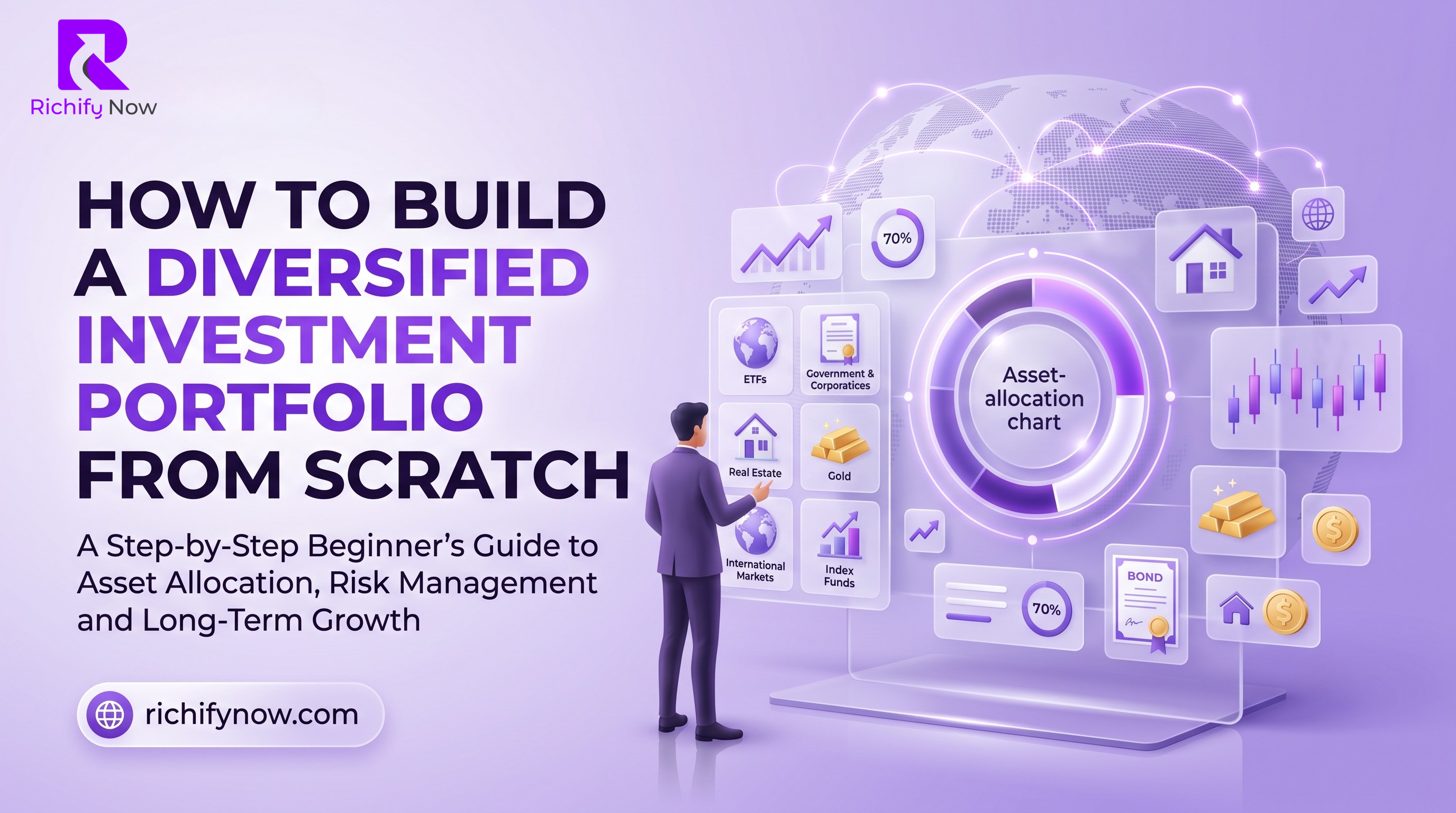
How to Build a Diversified Investment Portfolio From Scratch
Building wealth starts with a well-diversified portfolio Learn how to create an investment portfolio from scratch using stocks, ETFs, bonds, real estate, and other assets while managing risk and maximizing long-term growth

Table of Contents π
Executive Summary π
A diversified investment portfolio spreads money across different asset classes, regions, sectors and individual holdings so that the portfolio does not depend on one company, one industry or one market outcome
The process starts before buying an investment First establish an emergency fund, deal with expensive debt, define the purpose of the portfolio and understand when the money will be needed Those decisions shape the balance between growth assets such as stocks and stabilising assets such as bonds and cash
For many beginners, broad index mutual funds or exchange-traded funds can provide diversification more efficiently than selecting individual securities A simple portfolio may hold a broad domestic stock fund, an international stock fund, a high-quality bond fund and a cash reserve The correct percentages depend on the investorβs goal, timeframe, financial position and ability to tolerate losses
What Diversification Really Means π§Ί
Diversification is often explained as not placing every egg in one basket That explanation is useful, but a complete portfolio requires more than owning several investments If all the holdings depend on the same economic force, the portfolio may appear diversified while remaining highly concentrated
For example, owning ten technology companies provides more company-level diversification than owning one company, but the portfolio is still heavily exposed to one sector A collection of domestic stock funds may also contain many of the same large companies, creating hidden overlap
True diversification generally operates at two levels
Between Asset Classes
Spreading money across stocks, bonds, cash and potentially real estate or other assets that may respond differently to economic conditions
Within Asset Classes
Owning companies from different industries, sizes and countries instead of relying on a few individual securities
Across Risk Drivers
Avoiding excessive dependence on one currency, one country, one interest-rate environment or one source of investment return
Diversification works because different investments do not always rise and fall together When one section of a portfolio struggles, another may hold its value or decline less This does not eliminate volatility, but it can make the overall journey more manageable
Step Zero: Build the Financial Foundation π‘οΈ
Investing should not force you to sell assets at the worst possible time A portfolio becomes fragile when every unexpected bill requires a withdrawal from the market Before investing aggressively, strengthen the financial base supporting the portfolio
π΅ Emergency Reserve
Keep accessible cash for essential expenses and unexpected events The appropriate amount depends on job stability, household responsibilities, insurance and the predictability of income
π³ Expensive Debt
High-interest debt can create a guaranteed financial drag that may outweigh uncertain investment returns Review credit cards and other expensive obligations before increasing market exposure
π Protection
Health, life, disability, property and business insurance can prevent one event from destroying years of investment progress
This foundation separates long-term capital from money needed for near-term survival The result is a greater ability to remain invested during market declines rather than selling because of a cash emergency
Define the Goal and Time Horizon π―
An investment portfolio should be designed for a specific purpose Retirement, education, a future home, financial independence and business expansion may require different levels of growth, liquidity and risk
The time horizon is the period before the money will be needed A long horizon gives volatile growth assets more time to recover from downturns A short horizon usually requires more emphasis on capital stability because a market decline shortly before withdrawal can be damaging
| Time Horizon | Primary Concern | General Portfolio Emphasis | Key Risk |
|---|---|---|---|
| Less than 3 years | Protecting near-term spending money | Cash equivalents and short-duration high-quality instruments | Taking market risk without recovery time |
| 3 to 7 years | Balancing growth and stability | Moderate mix of stocks, bonds and cash | Too much stock exposure close to the goal |
| 7 to 15 years | Long-term growth with managed volatility | Greater equity allocation with meaningful diversification | Abandoning the plan during downturns |
| 15 years or more | Compounding and inflation protection | Higher growth allocation if risk capacity permits | Concentration, excessive fees and emotional trading |
These are educational examples rather than personalised recommendations The correct mix depends on the investorβs full financial circumstances
Understand Risk Tolerance and Risk Capacity π§
Risk tolerance describes how comfortable you feel when investments fall Risk capacity describes how much loss your financial plan can withstand These are related but not identical
A young investor may believe they are emotionally aggressive, but if the money is needed for a home deposit next year, the portfolio has low risk capacity A retiree may be calm during market declines, but a portfolio funding immediate living costs may still require substantial stability
Illustrative Risk Characteristics
Know the Major Asset Classes π§©
Stocks
Stocks represent ownership in companies They offer long-term growth potential through business expansion, earnings and dividends, but prices can fall sharply and remain depressed for extended periods Diversification within stocks can include large and small companies, value and growth styles, multiple industries and domestic and international markets
Bonds
Bonds are debt instruments issued by governments, agencies and companies They may provide interest income and can reduce portfolio volatility, although bonds also face interest-rate, inflation and credit risk High-quality bonds generally play a different role from lower-quality high-yield debt
Cash and Cash Equivalents
Cash supports liquidity and near-term spending needs It usually has lower volatility but may lose purchasing power after inflation A portfolio should distinguish between emergency cash and investment cash reserved for future opportunities or near-term goals
Real Estate Exposure
Real estate investment trusts can provide access to income-producing property without directly buying buildings They may add a different source of return, but publicly traded REITs can still be volatile and sensitive to interest rates
Commodities and Gold
Commodities may behave differently from stocks and bonds in some environments, but they do not always produce income and can be volatile Beginners should avoid treating gold or another commodity as a complete portfolio
Choose an Asset Allocation βοΈ
Asset allocation is the percentage of the portfolio assigned to each major asset class It is one of the most important portfolio decisions because it shapes the balance between expected growth and short-term volatility
There is no universal allocation for everyone A reasonable starting framework considers four questions
β³ When is the money needed
A longer horizon may support more stock exposure while a shorter horizon usually requires greater stability
π How much loss can you absorb
Consider both emotional comfort and the real financial consequences of a major decline
πΌ How stable is your income
Stable employment, diversified income and strong cash reserves may increase risk capacity
π What return is actually required
A goal that is already well funded may not require aggressive risk while an unrealistic goal should be corrected rather than chased with speculation
π Where are your future expenses
Currency and country exposure should make sense in relation to where future spending will occur
π§Ύ Which account holds the assets
Taxes, withdrawal rules and account structure can affect where different investments are most efficiently held
Illustrative Portfolio Models π
These examples show how risk levels can change through allocation They are educational models and should not be copied without considering personal circumstances, local markets and tax rules
Conservative
35% diversified stocks
40% high-quality bonds
15% cash or short-term reserves
10% real estate or other diversifiers
Designed for investors who prioritise stability, have a shorter horizon or expect to withdraw money relatively soon
Balanced
60% diversified stocks
25% high-quality bonds
10% real estate or other diversifiers
5% cash
Designed to pursue long-term growth while maintaining a meaningful stabilising allocation
Aggressive
80% diversified stocks
12% bonds
5% real estate or other diversifiers
3% cash
Designed for long horizons and investors with high risk capacity who can tolerate substantial declines
ETFs, Mutual Funds or Individual Securities? π§Ύ
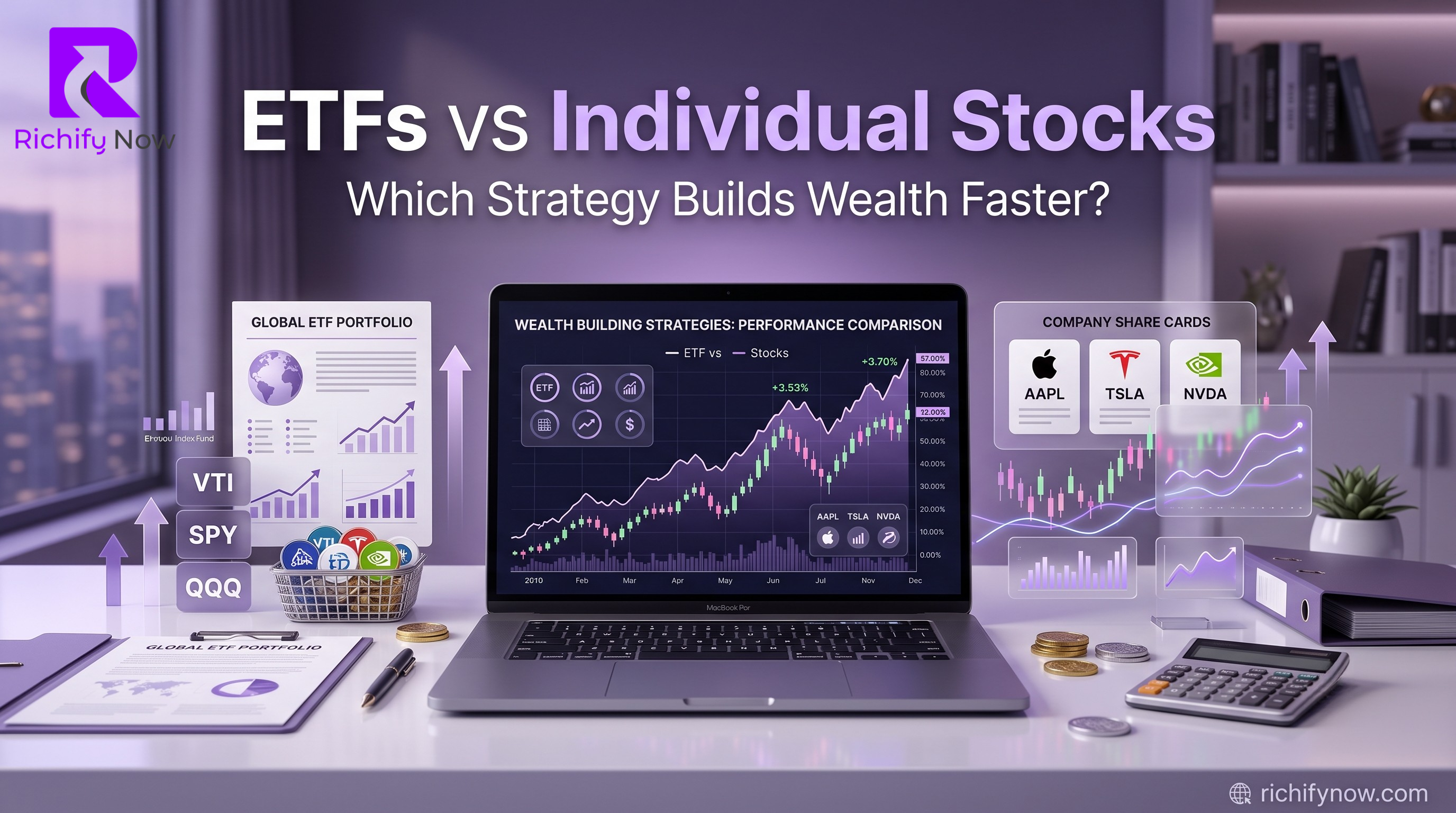
Beginners often assume a diversified portfolio requires dozens of separate purchases Broad funds can make diversification much easier because one fund may hold hundreds or thousands of securities
| Investment Type | Advantages | Limitations | Best Use |
|---|---|---|---|
| Broad Index ETF | Wide diversification, transparent holdings, tradable during the day and often low cost | Brokerage spreads, possible commissions and temptation to overtrade | Building core market exposure |
| Index Mutual Fund | Broad diversification, automatic investment and simple end-of-day transactions | Possible minimums, account restrictions and tax differences by jurisdiction | Regular long-term contributions |
| Actively Managed Fund | Professional security selection and potential specialised exposure | Higher fees, manager risk and inconsistent performance | Selective satellite allocation after due diligence |
| Individual Stocks | Direct ownership, control and potential for concentrated gains | Higher company-specific risk and greater research burden | Small satellite portion for experienced investors |
| Individual Bonds | Known maturity and cash-flow structure if held to maturity and issuer pays | Credit analysis, pricing complexity and difficult diversification with small amounts | Defined income planning for informed investors |
A core-and-satellite approach can balance simplicity with personal choice The core may consist of broad, low-cost stock and bond funds A smaller satellite allocation can hold specialised investments without allowing them to dominate the portfolio
Add International Diversification π
Investing only in the home market creates country concentration A domestic economy may experience weak growth, political disruption, currency pressure or sector-specific problems International diversification spreads exposure across different regions and business cycles
Global investing also provides access to industries and companies that may be underrepresented locally A broad international fund can hold developed and emerging markets, although international investments introduce currency, political, regulatory and liquidity risks
The purpose is not to predict which country will outperform next It is to avoid requiring one national market to deliver every part of the portfolioβs future return
Control Fees, Taxes and Trading Costs πΈ
Costs reduce the money that remains invested and compounds over time Review fund expense ratios, account fees, trading commissions, bid-ask spreads, advisory charges, foreign exchange costs and tax consequences
A fund with a low headline fee may still be inefficient if it creates unnecessary trading or duplicates another holding Two funds that track similar markets may increase complexity without adding meaningful diversification
Tax awareness
Tax treatment differs by country and account type Interest, dividends and capital gains may be taxed differently Tax-advantaged retirement or savings accounts may have contribution limits, withdrawal rules and penalties Because these rules change, confirm the current position with a qualified local professional
Turnover awareness
Frequent buying and selling can create taxes, spreads, commissions and behavioural mistakes A diversified long-term portfolio usually requires less activity than a speculative trading account
How to Build the Portfolio Step by Step ποΈ
Write the Investment Goal
State the purpose, target amount, expected contribution and date when the money may be needed A vague desire to become wealthy is not a complete investment objective
Separate Short-Term and Long-Term Money
Keep emergency and near-term spending funds outside volatile investments This prevents the portfolio from becoming a source of forced withdrawals
Select the Target Allocation
Choose percentages for stocks, bonds, cash and optional diversifiers based on the goal, time horizon and risk capacity Record the percentages before markets influence your emotions
Choose Broad Core Investments
Select diversified funds that provide the required domestic, international and bond exposure Review the benchmark, holdings, fee, liquidity and provider documentation
Check Overlap
Examine whether multiple funds own the same securities or track similar indexes More funds do not necessarily create more diversification
Automate Contributions
Set a regular contribution schedule that fits cash flow Automatic investing can reduce the temptation to delay purchases while waiting for perfect market conditions
Document the Rules
Create a simple investment policy stating the target allocation, contribution method, rebalancing rule, permitted investments and reasons that justify changing the plan
Rebalance Without Chasing the Market π
Market movements cause portfolio weights to drift If stocks rise faster than bonds, a balanced portfolio may gradually become aggressive Rebalancing restores the intended allocation and risk level
Common approaches include
π Calendar Review
Review the portfolio every six or twelve months and rebalance when necessary This is simple and discourages constant tinkering
π Threshold Rule
Rebalance when an asset class moves beyond a predetermined band such as five percentage points from its target
π΅ Cash-Flow Rebalancing
Direct new contributions, dividends or withdrawals toward underweight or overweight areas before selling investments
Rebalancing can trigger taxes or transaction costs in taxable accounts New contributions may restore balance more efficiently than selling Rebalancing should manage risk rather than serve as a disguised attempt to time the market
Common Diversification Mistakes to Avoid β οΈ
| Mistake | Why It Is Dangerous | Better Approach |
|---|---|---|
| Owning too few individual stocks | One company can have an outsized effect on the portfolio | Use broad funds or build adequate diversification with careful research |
| Holding many overlapping funds | The portfolio looks complex but may repeat the same large holdings | Compare indexes and underlying positions |
| Chasing recent winners | Buying after strong performance can increase concentration and valuation risk | Follow a written allocation rather than recent headlines |
| Ignoring international markets | The portfolio depends too heavily on one country and currency | Add global exposure that fits the investorβs circumstances |
| Taking risk with short-term money | A decline may force a sale before recovery | Match the investment to the spending date |
| Never rebalancing | Market drift can quietly change the portfolioβs risk level | Use an annual or threshold-based review |
| Trading too frequently | Costs, taxes and emotions may damage long-term results | Automate contributions and reduce unnecessary activity |
A Simple Beginner Portfolio Blueprint π§±
A beginner with a long-term goal could start by researching a small set of broad funds rather than dozens of specialised products One educational blueprint is
Domestic Equity Core
A broad fund covering a large section of the investorβs home stock market
International Equity Core
A broad fund covering companies outside the home market across multiple countries
High-Quality Bond Core
A diversified government and investment-grade bond allocation appropriate for the investorβs currency and horizon
Cash may be held separately for emergencies and short-term goals Optional real estate or other diversifiers should remain secondary unless the investor fully understands their risks
Frequently Asked Questions β
How many investments are needed for diversification
There is no universal number A single broad market fund may hold hundreds or thousands of securities, while several individual stocks may still leave a portfolio concentrated The important issue is the underlying exposure rather than the number of account positions
Can a portfolio be diversified with only ETFs
Yes Broad stock, bond and international ETFs can create a diversified portfolio ETFs still need to be reviewed for index coverage, costs, overlap, liquidity and tax treatment
Should beginners buy individual stocks
Individual stocks can be included, but they create company-specific risk Many beginners use broad funds as the core and limit individual stocks to a smaller satellite allocation they can afford to lose
How often should a portfolio be rebalanced
Many investors review allocations every six or twelve months Others rebalance when an asset class moves beyond a predetermined threshold Rebalancing too frequently can create costs and taxes
Does diversification prevent losses
No Diversification reduces concentration risk but cannot guarantee profit or protect against every market decline A diversified portfolio can still lose value
Is a 60 percent stock and 40 percent bond portfolio suitable for everyone
No It is a common educational example, not a universal solution The correct allocation depends on goals, time horizon, income, liabilities, taxes and risk capacity
Final Takeaway π
A diversified portfolio is not a collection of random investments It is a deliberate system built around a goal, an asset allocation and clear rules for contribution and rebalancing
Start with a strong financial foundation Choose broad exposures that you understand Keep costs under control Avoid concentration and market chasing Then maintain the portfolio with patience rather than constant prediction
Explore More RichifyNow Investment GuidesStrong References π
- Investor.gov β Beginnersβ Guide to Asset Allocation, Diversification and Rebalancing
- Investor.gov β Asset Allocation and Diversification
- FINRA β Asset Allocation and Diversification
- Vanguard β Portfolio Diversification: What It Is and How It Works
- Vanguard β Rebalancing Your Portfolio
- Investor.gov β Tips for 2026 Investor Bulletin
Editorial disclaimer: This article is for educational purposes only and does not provide personalised investment, legal or tax advice Investments can lose value and diversification does not guarantee profit Consult a qualified professional who understands your country, financial circumstances and goals before acting
Comments