
Human Capital Continuity: Key-Person Structures and Institutional Contingency
A strategic briefing on protecting an organization from the sudden incapacitation, death, departure, or operational loss of its primary revenue-generating executive

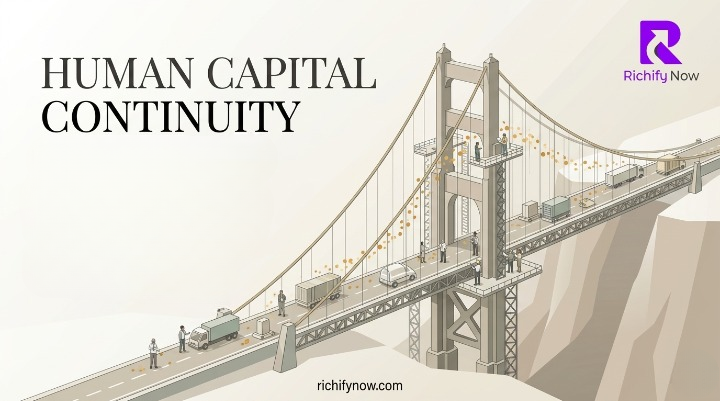
Human Capital Continuity: Protecting Institutions From Key-Person Dependency
A comprehensive risk framework for protecting organizations against the sudden loss of their primary revenue-generating executive, founder, or principal operator
AEO Answer Card
Key-person risk occurs when a business depends too heavily on one executive, founder, salesperson, technician, or operator. Continuity planning may include documentation, insurance, delegation, succession planning, and cross-training.
Introduction: The Executive Dependency Problem 🧩
Every institution likes to believe it is stronger than one individual It has a company name, a bank account, operating systems, client records, contracts, assets, advisors, staff members, and documented procedures On paper, the organization appears independent In practice, however, many private companies, family offices, professional firms, investment vehicles, and founder-led enterprises remain heavily dependent on one primary person
That person may be the founder, managing partner, chief rainmaker, controlling shareholder, principal strategist, licensed professional, capital allocator, or revenue-generating executive They may control the client relationships, approve payments, negotiate contracts, hold institutional memory, manage key introductions, understand the business model, and carry the confidence of lenders, investors, suppliers, and customers
This creates a hidden risk known as key-person dependency It is not always visible in financial statements Revenue may look stable Client retention may appear strong The leadership team may seem confident But beneath the surface, the organization may be exposed to one sudden event: incapacitation, death, resignation, regulatory disqualification, illness, burnout, detention, reputational damage, or unexpected exit
When that event occurs, the risk is not only emotional It becomes operational, financial, legal, and institutional Clients may hesitate Banks may freeze credit decisions Employees may become uncertain Vendors may demand faster payment Investors may ask who has authority Families may dispute control Revenue may slow down before a replacement structure is ready
1 Why Human Capital Is an Institutional Risk Asset 🧠
Traditional risk planning often focuses on assets, contracts, tax exposure, litigation, debt, real estate, insurance, and jurisdictional structure These are important, but they can overlook a fundamental truth: human capital is often the most valuable asset in a privately controlled institution
A founder may hold the trust of customers A senior executive may know how to convert complex negotiations into revenue A managing partner may understand the informal politics behind client retention A principal investor may maintain access to capital A technical leader may understand the product architecture better than anyone else
This knowledge is rarely stored in one clean folder It lives in conversations, judgment, reputation, intuition, relationships, and decision history When a key person disappears suddenly, the institution may lose more than labor It may lose confidence
In institutional risk terms, this makes key-person continuity a capital preservation issue If one person's absence can reduce valuation, delay revenue, trigger debt concerns, weaken client confidence, or create internal disputes, then the organization has not fully insulated its operational base
2 The Revenue Shock: What Happens When the Key Person Disappears? ⚠️
The sudden loss of a primary executive can create a sequence of shocks These shocks may appear slowly at first, but once uncertainty spreads, the institution can lose momentum quickly
The first shock is usually decision paralysis Team members may not know who has authority to approve payments, sign contracts, speak to lenders, handle client escalations, or make strategic calls If authority was informal, the organization may spend critical days debating what should have been clear in advance
The second shock is client uncertainty High-value clients often rely on personal trust If the main relationship holder is unavailable, clients may wonder whether service quality, pricing, delivery, or confidentiality will remain stable
The third shock is financial pressure Banks, investors, creditors, and suppliers may reassess risk If the key person guaranteed loans, approved banking instructions, negotiated credit, or controlled investor communication, the absence can create liquidity stress
The fourth shock is internal competition In some organizations, multiple people may believe they should take control Family members, co-founders, shareholders, senior employees, trustees, or outside advisors may disagree on succession, compensation, sale strategy, or governance direction
3 Key-Person Structures: The Continuity Architecture 🏗️
A key-person structure is a planned framework designed to protect the organization if its central executive becomes unavailable It does not remove the importance of the individual Instead, it reduces the institution's dependency on that individual by creating backup authority, liquidity, documentation, governance, and transition pathways
A strong key-person structure usually includes five major layers:
- Authority continuity: Who can legally and operationally act when the key person cannot?
- Financial continuity: What funds are available to stabilize the organization?
- Relationship continuity: Who can reassure clients, lenders, investors, and employees?
- Knowledge continuity: Where are critical procedures, passwords, contracts, and decisions documented?
- Ownership continuity: What happens to equity, voting rights, control rights, and succession authority?
When these layers are missing, the organization becomes fragile When they are designed carefully, the institution becomes more resilient, more financeable, and more credible to external stakeholders
4 Key-Person Insurance: Liquidity After the Shock 💼
One of the most common tools in key-person planning is key-person insurance In a typical structure, the organization purchases insurance connected to the life or capacity of a key executive If a qualifying event occurs, the policy can provide liquidity to the company
This liquidity may help the organization recruit replacement leadership, retain employees, reassure creditors, cover temporary revenue decline, pay operating expenses, hire advisors, or fund a controlled transition The purpose is not to replace the person emotionally or strategically The purpose is to buy time
Time is extremely valuable after a leadership shock Without liquidity, the organization may be forced into rushed decisions, distressed asset sales, emergency borrowing, or unfavorable negotiations With liquidity, the board or management team can stabilize operations and execute a deliberate transition plan
| Continuity Need | How Key-Person Liquidity Helps |
|---|---|
| Revenue Disruption | Provides cash reserves while client relationships and sales pipelines are stabilized |
| Leadership Replacement | Funds executive search, interim leadership, advisor fees, and onboarding costs |
| Creditor Confidence | Shows lenders and suppliers that the organization has a financial response plan |
| Employee Retention | Supports payroll, retention bonuses, and internal stability during uncertainty |
| Strategic Optionality | Prevents rushed sale decisions and allows time for valuation protection |
The correct amount, ownership structure, beneficiary structure, tax treatment, and compliance requirements should be reviewed with licensed insurance, legal, and tax professionals The institutional goal is simple: create a liquidity bridge between disruption and recovery
5 Governance Continuity: Who Has Authority When the Founder Cannot Act? ⚖️
Insurance provides money, but money alone does not solve authority After a key-person event, the organization must know who can act Without governance continuity, even well-funded companies can become stuck
Governance continuity may include board resolutions, emergency officer appointments, operating agreements, shareholder agreements, voting proxies, delegated signing authorities, trustee instructions, and documented succession protocols The goal is to prevent operational confusion
In many founder-led businesses, authority is too concentrated The founder may be the only person who can approve major expenses, negotiate bank facilities, sign vendor agreements, manage investor communication, or resolve client disputes That level of concentration may feel efficient while the founder is active, but it becomes dangerous during sudden absence
6 Succession Protocols: From Personality to Process 🔁
Succession planning is often delayed because it feels uncomfortable Founders may not want to discuss death, incapacity, or replacement Senior executives may fear political tension Families may avoid difficult conversations Partners may assume they can "figure it out later"
But institutions do not fail because succession planning is uncomfortable They fail because succession planning was ignored until the wrong moment
A succession protocol does not need to remove the founder or weaken the current executive It simply creates a clear procedure for emergency leadership It should answer practical questions:
- Who becomes interim decision-maker?
- Who communicates with clients and lenders?
- Who controls bank access and payment approvals?
- Who manages staff communication?
- Who handles legal, tax, and advisory coordination?
- Who has access to critical documents?
- What decisions require board or shareholder approval?
- When does temporary authority become permanent authority?
A strong succession protocol turns panic into process It gives the organization a roadmap for the first 24 hours, first 7 days, first 30 days, and first 90 days after a disruption
7 Knowledge Continuity: The Institutional Memory Vault 🗂️
One of the most underestimated risks in private organizations is undocumented knowledge The key person may know which clients require special handling, which contracts have hidden obligations, which vendors are flexible, which lender relationships are sensitive, and which employees hold informal influence
If this knowledge is not documented, the organization may technically survive but operate blindly
A continuity architecture should include an institutional memory vault This is a secure, regularly updated repository of essential information It may include:
- Banking relationships and authorized contacts
- Major client profiles and relationship notes
- Vendor contracts and renewal dates
- Debt agreements and covenant summaries
- Insurance policies and advisor contacts
- Key passwords stored through secure access systems
- Corporate documents and ownership records
- Emergency communication templates
- Critical operating procedures
- Pending negotiations and strategic commitments
Access to this vault should be controlled It should not become a security weakness The best structure balances confidentiality with emergency usability
8 Client and Stakeholder Continuity: Protecting Confidence 🤝
Revenue-generating executives often hold external trust Clients may stay because of them Investors may fund because of them Lenders may extend credit because of them Suppliers may offer favorable terms because they believe in that individual's credibility
If the key person disappears, stakeholder communication must be fast, calm, and organized Silence creates speculation Speculation creates fear Fear creates exits
A stakeholder continuity plan should define who communicates with each group and what message should be delivered The tone should be reassuring but honest It should confirm that operations continue, leadership authority is active, obligations will be honored, and the institution has a transition framework
📌 Client Continuity
Assign backup relationship managers for major clients before a crisis occurs Introduce them gradually so trust is not dependent on one person only
📌 Lender Continuity
Keep lenders informed of governance structures, insurance planning, and backup authority so credit confidence does not collapse after disruption
📌 Employee Continuity
Prepare internal communication protocols to reduce uncertainty, rumors, and leadership confusion
📌 Investor Continuity
Maintain a clear reporting structure and emergency update process for shareholders, partners, and capital providers
9 Ownership Continuity: Equity, Control, and Transfer Risk 🧾
Key-person loss can create ownership problems If the executive is also a shareholder, partner, trustee, guarantor, or family wealth controller, the event may trigger disputes over equity, voting control, buyout rights, inheritance, valuation, and management authority
This is where institutional contingency connects with legal architecture Shareholder agreements, buy-sell agreements, operating agreements, trust structures, estate documents, and voting arrangements can help define what happens when a key owner dies, becomes incapacitated, or exits
Without these documents, ownership may pass into the wrong hands, become frozen in probate, trigger family conflict, or create a shareholder deadlock A profitable business can lose value quickly if control becomes unclear
10 Jurisdictional Arbitrage and Human Capital Continuity 🌍
In Phase 3 institutional risk planning, jurisdiction matters Different jurisdictions may treat corporate governance, probate, trusts, insurance, incapacity, employment, tax, and ownership transfer differently A key-person continuity plan should therefore consider where the company is formed, where the owners reside, where assets are held, where contracts are governed, and where key executives operate
Jurisdictional arbitrage does not mean avoiding lawful obligations It means intentionally selecting legal and operational structures that improve predictability, continuity, and institutional protection For example, an organization may use one jurisdiction for holding company governance, another for operating activity, and another for trust or estate planning, depending on lawful objectives and professional advice
Cross-border families, international founders, remote executive teams, and multi-entity organizations should be especially careful If a key person dies or becomes incapacitated while assets, heirs, entities, and contracts are spread across multiple jurisdictions, the absence of planning can create delay and conflict
The advanced goal is to align jurisdictional structure with continuity Governance documents, insurance ownership, beneficiary designations, trust powers, entity management rights, and emergency authority should work together rather than contradict each other
11 The 90-Day Institutional Contingency Framework 🗓️
A practical human capital continuity system should define what happens immediately after a key-person event The first 90 days are critical because this is when uncertainty is highest and institutional value is most vulnerable
| Timeline | Primary Objective | Key Actions |
|---|---|---|
| First 24 Hours | Stabilize Authority | Confirm emergency leadership, secure documents, notify core advisors, protect banking access |
| First 7 Days | Control Communication | Brief employees, contact major clients, reassure lenders, review urgent obligations |
| First 30 Days | Preserve Operations | Review revenue pipeline, retain key staff, activate insurance claims if applicable, manage contracts |
| First 60 Days | Restore Confidence | Install interim leadership, update stakeholders, stabilize cash flow, reduce client uncertainty |
| First 90 Days | Decide Long-Term Direction | Confirm permanent leadership, evaluate sale options, restructure governance, update continuity plans |
This framework should be documented before any crisis During a crisis, leadership teams should not be inventing procedures They should be executing them
12 Common Mistakes in Key-Person Planning ❌
Many organizations believe they are prepared because they have insurance, a second-in-command, or a trusted attorney These are useful, but they are not enough by themselves Human capital continuity requires a coordinated structure
- Assuming a loyal employee can automatically take control without legal authority
- Buying insurance without aligning it to governance and liquidity needs
- Failing to document client relationships and operational knowledge
- Leaving banking access dependent on one person
- Ignoring ownership transfer and voting rights
- Not introducing backup relationship managers to major clients
- Using outdated operating agreements or shareholder agreements
- Failing to coordinate estate planning with business continuity
- Keeping passwords and sensitive documents inaccessible during emergencies
- Delaying succession discussions because they feel uncomfortable
The most dangerous mistake is assuming that good people will automatically solve the problem when the time comes Good people need clear authority, documented process, and available resources
13 Building a Human Capital Continuity Checklist ✅
A strong continuity checklist helps leadership teams identify gaps before a crisis occurs The checklist should be reviewed regularly, especially after major changes in ownership, financing, executive roles, family structure, or jurisdictional exposure
Human Capital Continuity Checklist 🛡️
The objective is not to predict every possible event The objective is to ensure that the organization can continue operating when its most important person is suddenly unavailable
- Identify all key-person dependencies across revenue, operations, finance, and governance
- Create emergency authority documents for decision-making and signing power
- Review key-person insurance and liquidity needs
- Document major client, lender, investor, and vendor relationships
- Establish backup relationship managers for important accounts
- Prepare emergency communication templates for employees and stakeholders
- Review shareholder, operating, and buy-sell agreements
- Coordinate business continuity with estate and trust planning
- Secure critical passwords and documents through controlled access systems
- Create a 24-hour, 7-day, 30-day, and 90-day response plan
- Review jurisdictional conflicts across entities, owners, and assets
- Update the plan at least annually or after major structural changes
14 Why This Matters for Valuation 📈
Buyers, lenders, investors, and institutional partners care about continuity A business that depends completely on one individual may be profitable, but it can also appear fragile If revenue cannot survive the founder's absence, valuation may suffer
Human capital continuity improves institutional quality It shows that the business has systems, governance, backups, and resilience It reduces the discount that external parties may apply to founder-dependent revenue It also makes the organization more attractive for financing, acquisition, succession, and long-term growth
In this sense, continuity planning is not only defensive It can be value-building A company that can operate beyond one person is generally stronger than a company that relies on personal heroics every day
Conclusion: Institutions Must Outlive Individuals 🏛️✨
Human capital continuity is one of the most important but often neglected areas of institutional risk Organizations spend years building revenue, relationships, assets, and reputation, yet many remain exposed to the sudden loss of one central person
A key-person event does not have to destroy institutional value With the right structures, the organization can preserve liquidity, maintain authority, reassure stakeholders, protect ownership, and continue operating through uncertainty
The strongest institutions do not pretend that key people are replaceable They recognize their importance and build systems that protect the organization around them Key-person insurance, governance continuity, succession protocols, stakeholder communication, knowledge documentation, and jurisdictional alignment all work together to create resilience
In Phase 3 risk architecture, the objective is not simply survival The objective is continuity with control When an organization can withstand the loss of its most important executive without panic, paralysis, or value collapse, it has moved from personality dependency to institutional durability
Key-Person Risk Worksheet
Download the editable RichifyNow workbook with instructions, working fields, disclaimer, and the complete source-document specification.


Loading comments…