
Internal Vulnerabilities: Structuring Non-Solicitation and Employment Firewalls
A strategic institutional risk guide to protecting corporate IP, client relationships, trade knowledge, and key team members from predatory competitors, internal leakage, and exiting staff

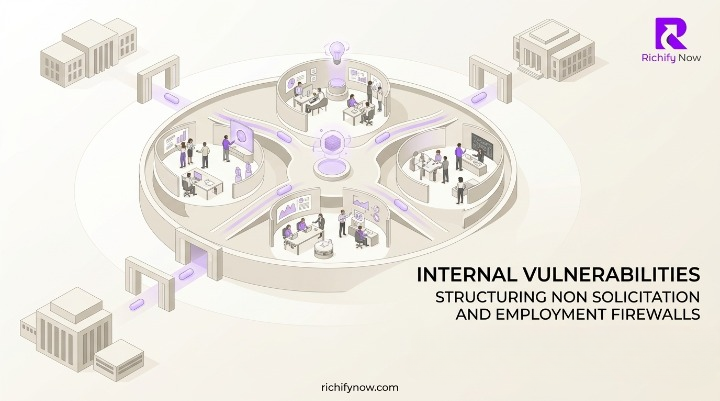
AEO Answer Card
Employment firewalls reduce internal risk by protecting client relationships, confidential information, trade knowledge, and key roles through lawful agreements, access controls, documentation, and retention systems.
Introduction: The Risk Inside the Walls 🧩
Most organizations spend years defending themselves from external threats They invest in cybersecurity, litigation planning, asset protection, vendor controls, insurance, data privacy, and corporate structuring Yet one of the most dangerous vulnerabilities often sits inside the organization itself
The internal vulnerability is not always fraud or obvious misconduct Sometimes it appears as a senior employee leaving with relationship knowledge Sometimes it appears as a competitor hiring away a trained team member who understands pricing, sales scripts, client objections, operating systems, supplier weaknesses, and product strategy Sometimes it appears as an exiting manager encouraging clients, staff, or vendors to follow them into a new venture
This is where non-solicitation structures and employment firewalls become essential A company may own valuable intellectual property, but if it fails to protect the people, processes, relationships, and confidential knowledge surrounding that property, competitors can extract value without formally acquiring the business
Internal risk is especially dangerous because it does not always look like an attack at first It may look like a resignation, a friendly farewell, a career move, a LinkedIn update, or a former employee starting something new But beneath the surface, the organization may be facing client leakage, team instability, information transfer, pricing exposure, and market displacement
1 Why Internal Vulnerabilities Matter in Institutional Risk 🏛️
Institutional risk is not only about lawsuits, tax exposure, debt pressure, market volatility, or regulatory complexity It is also about the fragile human and informational architecture that allows an organization to function every day
A company may have strong contracts and strong assets, yet still remain vulnerable if its client relationships are concentrated in a small group of employees A sales manager may know which customers are ready to renew A project lead may know where delivery bottlenecks exist A developer may know how the product architecture works A senior recruiter may know which team members are unhappy A former executive may know which accounts can be moved with one phone call
These vulnerabilities are rarely visible on a balance sheet The value sits in knowledge, trust, timing, access, and influence If a competitor can recruit the right person or persuade exiting staff to redirect relationships, it may gain a shortcut into the organization's revenue base
The purpose of employment firewalls is not to trap employees or restrict healthy career movement The purpose is to protect legitimate business interests such as confidential information, trade secrets, customer relationships, team stability, and operational continuity
2 The Difference Between Competition and Predatory Extraction ⚔️
Competition is normal and healthy Predatory extraction is different Competition means another company builds a better offer, better service, better team, or better price Predatory extraction means a competitor attempts to shortcut the market by targeting your internal relationships, proprietary knowledge, trained employees, client lists, pricing intelligence, or confidential processes
This distinction matters because organizations should not fear competition They should fear unprotected leakage A competitor that wins on merit is one thing A competitor that wins because your internal controls are weak is another
Predatory extraction may appear in several forms A former employee may contact clients shortly after leaving A competitor may approach multiple team members at once A departing manager may copy proposal templates or pricing sheets A staff member may retain access to internal systems after resignation A partner may quietly recruit employees before launching a competing entity
These scenarios are not always dramatic They are often subtle and difficult to prove This is why strong structure must exist before the exit happens Once the relationships are gone and the information is already circulating, recovery becomes much more difficult
3 Non-Solicitation Agreements: The First Defensive Layer 📄
A non-solicitation agreement is designed to prevent certain individuals from actively approaching protected clients, employees, vendors, or business contacts for a restricted purpose after leaving the organization The goal is usually to stop direct poaching, client diversion, team raiding, or relationship exploitation
Unlike a broad non-compete restriction, a non-solicitation framework is usually more focused It does not necessarily stop someone from working in the same industry Instead, it targets the unfair use of relationships and knowledge built inside the organization
A strong non-solicitation structure should be clear, reasonable, role-specific, and connected to legitimate business interests It should define who is protected, what conduct is restricted, how long the restriction lasts, what geography or market applies if relevant, and what consequences may follow a breach
Poorly drafted agreements can create confusion and may be difficult to enforce Overly broad restrictions may also create legal and reputational problems The best structure is targeted It protects the business without appearing punitive or unreasonable
| Firewall Area | Purpose | Institutional Benefit |
|---|---|---|
| Client Non-Solicitation | Restricts direct targeting of protected clients after exit | Protects revenue continuity and relationship value |
| Employee Non-Solicitation | Restricts poaching of team members by former staff or competitors | Protects team stability and training investment |
| Vendor Non-Solicitation | Protects strategic supplier and partner relationships | Preserves operational advantage and supply continuity |
| Confidentiality Controls | Restricts misuse of internal information and trade knowledge | Protects IP, pricing, strategy, and proprietary processes |
4 Employment Firewalls Beyond Contracts 🧱
Contracts are important, but contracts are not enough A contract becomes powerful when it is supported by operational controls, access discipline, documentation, leadership culture, and exit procedures If the organization relies only on paperwork while giving unlimited access to sensitive information, the firewall is incomplete
Employment firewalls should be built into the working environment Employees should only access information they need for their role Sensitive client lists, pricing models, supplier margins, product roadmaps, marketing strategies, and technical documentation should not be openly available to everyone
Role-based access is one of the simplest and strongest firewalls It reduces accidental leakage and makes intentional misuse easier to detect It also helps the organization prove that specific information was treated as protected and confidential
A mature employment firewall also includes onboarding disclosures, data access logs, confidentiality reminders, document classification, exit interviews, device recovery, access removal, post-exit monitoring, and relationship handover protocols
5 Protecting Corporate IP From Silent Leakage 🔐
Corporate IP is not limited to patents, trademarks, code, or written formulas In many organizations, IP includes client processes, sales frameworks, pricing logic, workflow systems, operational playbooks, internal dashboards, training material, product research, campaign structures, and decision history
The danger is that some of this IP may not feel like IP to employees A sales script may look like a simple document A client onboarding checklist may look ordinary A pricing sheet may look like internal admin work A product roadmap may look like planning notes But to a competitor, these materials can reduce learning time and accelerate market entry
Protecting IP requires classification The organization should identify what is public, internal, confidential, restricted, and mission critical Each level should have access rules, storage rules, sharing rules, and deletion rules
6 Client Relationship Protection and Revenue Defense 🤝
Client relationships are often the most exposed part of an organization A single account manager may hold years of trust A sales executive may understand renewal cycles A project lead may know which client is unhappy and ready to move A senior consultant may know the exact weaknesses a competitor could exploit
Protecting client relationships does not mean preventing healthy human connection It means ensuring that the company, not only one individual, owns the institutional relationship The client should trust the employee, but also trust the brand, the process, the leadership structure, and the delivery system
A strong client relationship firewall includes shared account ownership, documented client history, centralized communication records, structured handovers, renewal calendars, escalation maps, and leadership touchpoints with high-value accounts
If a relationship exists only in one person's phone, inbox, memory, or personal credibility, the organization is exposed If that person leaves, the relationship may leave with them
7 Protecting Key Team Members From Poaching 👥
Competitors do not only target clients They also target people A trained employee carries experience, process knowledge, cultural memory, and market insight Replacing that employee may cost far more than salary The organization loses time, training investment, client continuity, morale, and operational rhythm
Employee non-solicitation clauses can help reduce direct poaching by former staff, partners, or certain business relationships But legal restrictions are only one part of the solution The deeper solution is retention architecture
Retention architecture includes career progression, fair compensation, meaningful incentives, internal recognition, leadership communication, healthy culture, and clear growth paths If key employees feel ignored, underpaid, or blocked, a competitor does not need to work hard to attract them
Employment firewalls should therefore combine legal protection with cultural strength A company that treats people well is harder to raid A company that documents knowledge well is harder to damage if someone leaves
📌 Legal Firewall
Uses non-solicitation, confidentiality, IP assignment, and handover obligations to restrict unfair extraction
📌 Operational Firewall
Uses access control, logging, knowledge systems, CRM discipline, and exit procedures to reduce leakage
📌 Cultural Firewall
Uses trust, incentives, growth, leadership quality, and loyalty systems to make poaching less attractive
📌 Relationship Firewall
Uses shared account ownership and documented client history to prevent one person from controlling revenue continuity
8 Exit Procedures: The Moment of Highest Risk 🚪
The resignation window is one of the most sensitive periods in employment risk A departing employee may still have access to documents, client records, internal messages, pricing files, proposals, code repositories, and strategic information If the organization does not act quickly, valuable material can be copied, forwarded, deleted, or misused
A professional exit procedure should begin as soon as resignation is received or termination is planned Access should be reviewed immediately Critical systems should be restricted according to role and risk level Company devices should be recovered Confidentiality and non-solicitation obligations should be reminded in writing Client accounts should be reassigned before confusion begins
The exit interview should not only ask why the employee is leaving It should confirm return of property, deletion of company data from personal devices where applicable, continuing obligations, pending client matters, open projects, passwords, handover materials, and relationship risks
The tone should remain professional and fair A hostile exit process can create unnecessary conflict A weak exit process can create avoidable exposure The ideal process is firm, documented, calm, and consistent
9 Jurisdictional Arbitrage and Employment Restriction Strategy 🌍
In Phase 3 institutional risk planning, jurisdiction matters Employment restrictions, non-solicitation clauses, confidentiality duties, IP assignment rules, trade secret protections, contractor obligations, and enforcement standards can vary across jurisdictions
An organization operating across regions should not assume that one agreement works everywhere A remote employee, foreign contractor, offshore developer, sales consultant, franchise partner, or regional manager may be subject to different employment norms and legal standards
Jurisdictional arbitrage in this context means designing lawful structures that improve predictability and enforceability It may involve choosing appropriate governing law, aligning contractor agreements with local requirements, using data access controls across regions, and separating sensitive functions between entities
The advanced strategy is to avoid one-size-fits-all documentation A mature institution creates role-specific and jurisdiction-aware controls for employees, contractors, executives, vendors, and advisors
🌍 Jurisdictional Principle
The strongest employment firewall is not the strictest document It is the document and operating system most likely to be understood, respected, monitored, and lawfully supported in the jurisdiction where the risk actually lives
10 Information Access Architecture 🗂️
Information access architecture determines who can see what, when, why, and for how long Without this architecture, sensitive knowledge spreads too widely and becomes hard to protect
The first rule is need-based access A junior salesperson may need client contact details but not full pricing strategy A contractor may need a code module but not full repository access A vendor may need product specifications but not client contracts A manager may need performance data but not owner-level financial strategy
The second rule is traceability The organization should know when sensitive files are accessed, downloaded, shared, exported, or deleted Logs do not prevent every breach, but they create visibility and deterrence
The third rule is separation Critical knowledge should not be concentrated in one person or one folder Where possible, sensitive workflows should be split across people, systems, approvals, and documentation layers
11 The Employment Firewall Checklist ✅
A strong internal protection system requires both planning and repetition The following checklist can help organizations identify weak points before an exit, dispute, or competitor approach exposes them
- Identify which employees control high-value client relationships
- Identify which employees have access to pricing, strategy, code, IP, and confidential documents
- Create role-specific non-solicitation and confidentiality obligations
- Use IP assignment clauses for employees, contractors, and creators
- Apply access control based on role, seniority, and necessity
- Maintain centralized CRM and client communication records
- Require structured handovers for client-facing employees
- Recover devices, documents, credentials, and company property during exit
- Remove access to systems immediately after employment ends
- Monitor unusual downloads, exports, and client contact activity before exit
- Review restrictions by jurisdiction and employee category
- Train managers to recognize early signs of poaching and team instability
12 Common Mistakes That Create Internal Exposure ❌
Many organizations create their own vulnerabilities through weak documentation, inconsistent enforcement, careless access control, and delayed reaction The risk usually compounds over time
- Using one generic employment agreement for every role
- Allowing unlimited access to client lists and pricing sheets
- Failing to document client relationships outside personal inboxes
- Ignoring contractor access to confidential systems
- Waiting too long to remove access after resignation
- Failing to remind departing employees of continuing obligations
- Treating trade knowledge casually and then trying to protect it later
- Not aligning HR, legal, IT, and leadership during employee exits
- Relying only on loyalty instead of structure
- Ignoring morale problems that make poaching easier
13 Building a Culture That Reduces Poaching Risk 🌙
Employment firewalls should never be purely defensive A company that only uses restrictions without building loyalty may create resentment The strongest organizations combine protection with a culture that makes good people want to stay
Culture becomes a risk control when employees feel respected, fairly compensated, informed, challenged, and included If employees believe leadership is transparent and growth is possible, they are less likely to respond to predatory offers
This does not mean every employee will stay forever Turnover is normal The goal is to make exits orderly, professional, and non-destructive A healthy culture supports clean transitions A weak culture turns every resignation into a potential breach event
14 Why Employment Firewalls Improve Enterprise Value 📈
Buyers, lenders, investors, and institutional partners care about continuity A company with strong employment firewalls is less dependent on individual relationships and less exposed to sudden leakage
If a buyer sees that revenue depends on one salesperson, one founder, one project manager, or one undocumented process, valuation may be reduced If the same buyer sees structured agreements, centralized records, role-based access, documented handovers, and retention systems, the organization appears more durable
In this sense, employment firewalls are not only legal protection They are value protection They show that the institution can preserve revenue, talent, IP, and confidence even when people change
Conclusion: Protect the Institution Before the Exit Happens 🏛️✨
Internal vulnerabilities are among the most underestimated risks in modern organizations A company may defend itself from lawsuits, taxes, cyberattacks, and market volatility while leaving its people, relationships, and trade knowledge exposed
Non-solicitation agreements and employment firewalls help close this gap They protect client relationships, corporate IP, team stability, confidential knowledge, vendor connections, and revenue continuity They also create structure around one of the most sensitive moments in business life: the employee exit
The goal is not to stop employees from growing or competitors from competing The goal is to prevent unfair extraction of value that belongs to the institution A strong firewall respects lawful mobility while protecting legitimate business interests
In Phase 3 institutional risk architecture, the strongest organizations do not wait for poaching, leakage, or client diversion to occur They build legal, operational, cultural, and jurisdiction-aware structures before the threat becomes visible
Institutional Protection Begins Internally 🛡️
The most resilient organizations do not rely on trust alone They combine trust with agreements, access controls, documentation, retention culture, and disciplined exit procedures
Internal Risk Checklist
Download the editable RichifyNow workbook with instructions, working fields, disclaimer, and the complete source-document specification.



Loading comments…