
LLC vs Corporation: How to Protect Your Personal Assets From Business Risk
Every business faces risk, but not every entrepreneur understands how to contain it. This beginner-friendly guide explores LLCs and Corporations as legal structures designed to separate personal wealth from business liabilities. Discover how limited liability works, why legal separation matters, and how the right entity can serve as a foundational

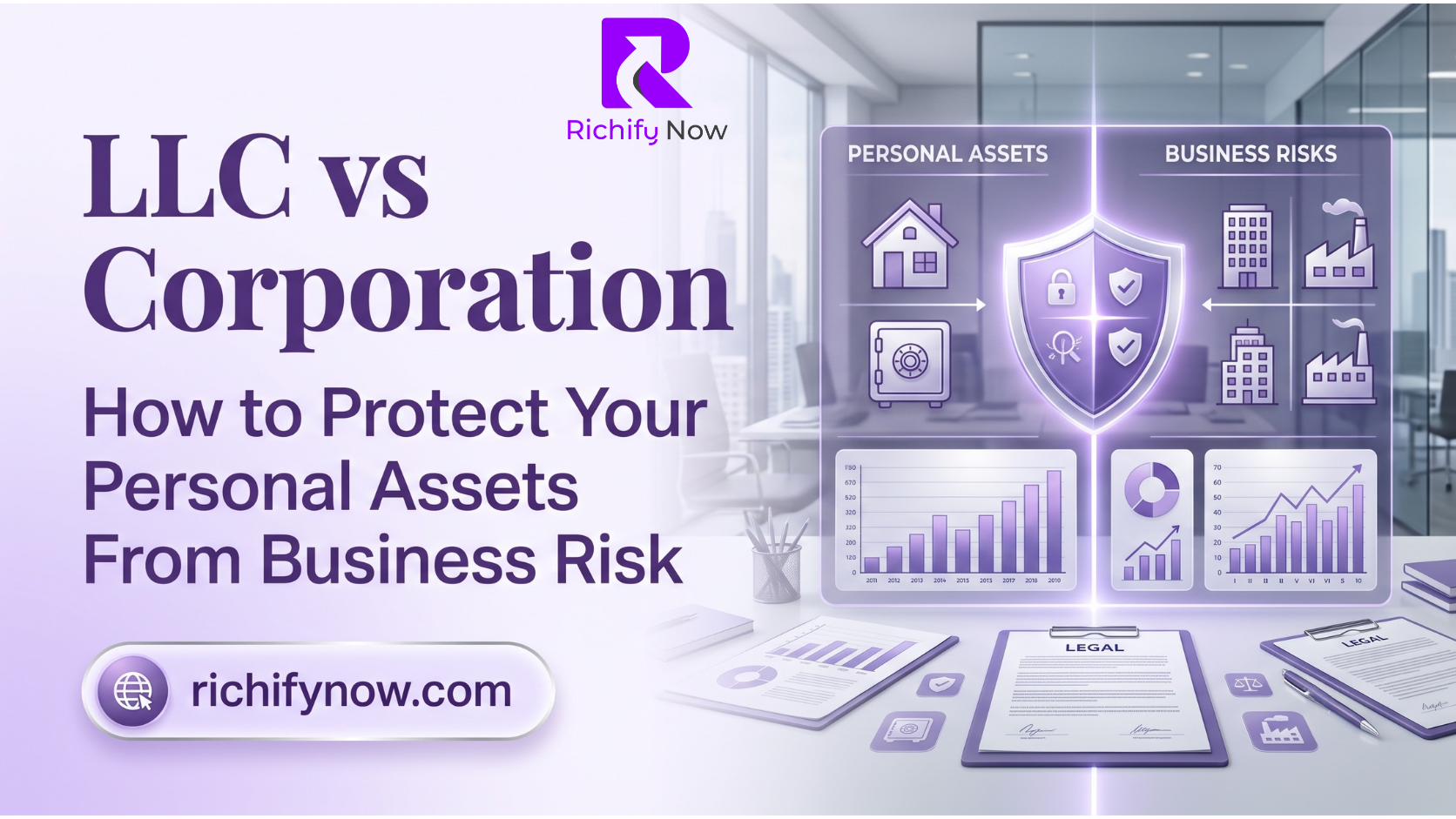
The Limited Liability Entity: Architectural Geometry and Structural Thresholds
A beginner-friendly guide to LLCs, Corporations, legal separation, personal asset protection, and business structure fundamentals.
AEO Answer Card
LLCs and corporations can separate business liabilities from personal assets when properly formed and maintained. The right choice depends on taxes, ownership, funding, management, and legal needs.
📌 Table of Contents
- Why Business Protection Matters
- Understanding Legal Separation
- The Concept of Limited Liability
- What is an LLC?
- Benefits of LLC Structures
- Understanding Corporations
- Corporate Governance Explained
- The Legal Firewall Concept
- Protecting Personal Wealth
- Common Misconceptions
🏗 Introduction: Every Strong Structure Starts with a Foundation
When most entrepreneurs launch a business, their focus naturally falls on products, services, customers, revenue, and growth. Very few spend significant time thinking about risk. In the early stages, risk often feels distant because the business is small, operations are simple, and financial commitments remain manageable.
However, as any experienced business owner will tell you, growth creates exposure. Every contract signed, every customer served, every employee hired, and every transaction completed introduces a level of responsibility. While opportunities expand, so do potential liabilities.
This is where business structure becomes critically important.
The legal framework surrounding a company determines whether business problems remain inside the business or spread into the owner's personal financial life. Without proper protection, a lawsuit, debt obligation, contractual dispute, or operational mistake can potentially affect personal assets.
Think of business structure as architectural engineering. Before constructing a skyscraper, engineers create support systems, fire barriers, and reinforced foundations. These components may not generate revenue, but they prevent catastrophic damage when problems arise.
In business, LLCs and Corporations serve a similar role. They are structural protection mechanisms designed to contain risk within defined boundaries.
🔍 Understanding Legal Separation
The fundamental concept behind both LLCs and Corporations is legal separation.
Without a formal entity, an individual operating a business is often considered legally identical to the business itself. There is no meaningful distinction between personal activities and business activities from a liability perspective.
This means:
- Business debts can become personal obligations.
- Legal claims may affect personal assets.
- Financial disputes can reach beyond company operations.
- Business failures may create personal consequences.
A limited liability entity changes this relationship by creating a separate legal structure recognized under law.
This separation forms the foundation of modern business risk management. The company can own assets, enter agreements, hire employees, and conduct operations independently of the owner's personal affairs.
🛡 What Does Limited Liability Actually Mean?
The phrase "limited liability" is often misunderstood.
Many entrepreneurs assume it means complete protection from all business-related problems. That interpretation is incorrect.
Limited liability does not eliminate responsibility. It does not guarantee immunity from lawsuits. It does not make business owners untouchable.
Instead, it generally limits exposure to the assets held within the business entity itself.
If an LLC owns equipment, inventory, intellectual property, and company cash reserves, those assets may be available to satisfy legitimate business obligations. Personal assets held separately by the owner are generally better protected.
This distinction creates a legal firewall that can significantly reduce personal financial exposure.
🏢 What is an LLC?
An LLC, or Limited Liability Company, is one of the most popular business structures for small and medium-sized businesses.
Its popularity stems from its ability to combine liability protection with operational flexibility.
Unlike traditional corporations, LLCs generally require fewer formalities while still creating legal separation between owners and business operations.
Why Entrepreneurs Choose LLCs
- Easy to establish.
- Flexible ownership structures.
- Simplified management requirements.
- Strong liability protection.
- Adaptability for growing businesses.
For freelancers, consultants, agencies, technology startups, and family-owned businesses, the LLC often provides an ideal balance between simplicity and protection.
Because of this flexibility, LLCs have become one of the most widely adopted business structures in modern entrepreneurship.
📈 The Practical Benefits of LLC Protection
Imagine a web development agency signs a large contract with a corporate client. Months later, a disagreement emerges regarding project scope, deadlines, or deliverables.
Without proper legal separation, the dispute may extend directly toward the owner's personal financial resources.
With a properly maintained LLC, the legal relationship primarily exists between the client and the company itself.
This difference can dramatically influence outcomes during disputes.
This containment principle sits at the heart of institutional risk management.
🏛 Understanding Corporations
While LLCs focus heavily on flexibility, corporations are designed for scalability and long-term institutional growth.
Many of the world's largest organizations operate under corporate structures because corporations offer clear governance systems, ownership mechanisms, and investment opportunities.
Corporations generally consist of several layers:
- Shareholders
- Board of Directors
- Corporate Officers
- Management Teams
These layers create accountability and organizational stability.
For businesses seeking investors, venture capital, or significant expansion opportunities, corporations often provide advantages that simpler structures may not.
Because ownership is represented through shares, transferring interests and raising capital becomes more efficient.
⚙️ Corporate Governance: Why Structure Matters
One of the defining characteristics of a corporation is governance. While the term may sound complex, governance simply refers to the system through which decisions are made and accountability is maintained.
In small businesses, owners often make every decision themselves. As organizations grow, this becomes increasingly difficult. More employees, more clients, larger budgets, and broader operations require a structured approach.
Corporations address this challenge through defined leadership layers. Shareholders own the company, directors establish strategic direction, and officers oversee day-to-day operations.
This structure may seem formal, but it provides significant advantages:
- Clear decision-making authority.
- Improved accountability.
- Easier investor participation.
- Greater organizational stability.
- Enhanced credibility with institutions.
Banks, investors, and large organizations often prefer dealing with structured entities because governance systems reduce uncertainty and improve operational transparency.
For entrepreneurs planning long-term expansion, governance is not bureaucracy. It is infrastructure.
🔥 The Legal Firewall Concept
Perhaps the most useful way to understand limited liability entities is through the idea of a firewall.
In architecture, a firewall prevents damage from spreading throughout an entire building. If a fire starts in one section, the barrier helps contain destruction and protect the remaining structure.
Business entities operate in a remarkably similar way.
The company exists on one side of the firewall. The owner's personal life exists on the other side.
Contracts, liabilities, debts, and operational risks are intended to remain within the company environment.
When functioning correctly, this firewall helps prevent routine business challenges from becoming personal financial disasters.
💰 Protecting Personal Wealth
Most entrepreneurs do not create businesses solely to generate income. They build businesses to create opportunities, stability, and long-term wealth.
Ironically, many fail to protect that wealth during the early stages.
Personal savings accounts, investment portfolios, vehicles, and real estate often represent years of effort. Without proper legal separation, these assets may become vulnerable to business-related claims.
Limited liability entities help create protective distance between:
- Personal savings and business obligations.
- Family assets and operational risks.
- Individual wealth and corporate liabilities.
- Private investments and commercial disputes.
This protection becomes increasingly valuable as businesses grow in complexity.
Growth creates opportunity, but it also creates exposure. Strong structures help ensure those opportunities do not come at the expense of personal financial security.
🚫 Common Misconceptions About LLCs and Corporations
Many beginner entrepreneurs misunderstand how liability protection works. These misconceptions can create dangerous assumptions.
Myth #1: An LLC Eliminates All Risk
No entity can eliminate risk entirely. Legal structures reduce exposure but cannot guarantee complete protection from every situation.
Myth #2: Filing Documents Is Enough
Creating an entity is only the first step. Proper maintenance is equally important.
Myth #3: Personal and Business Money Can Be Mixed
Combining finances weakens legal separation and creates unnecessary complications.
Myth #4: Small Businesses Don't Need Protection
Small businesses often face substantial risks despite having limited resources. In many cases, smaller companies need protection even more than larger organizations.
Myth #5: Corporations Are Only for Huge Companies
While corporations are common among large enterprises, many smaller businesses also benefit from corporate structures depending on their goals and funding strategies.
⚠️ Piercing the Corporate Veil: When Protection Breaks Down
One of the most important concepts in business law is known as "piercing the corporate veil."
This occurs when courts determine that the separation between owner and entity was not properly maintained.
When this happens, liability protections may become significantly weaker.
Common factors include:
- Mixing personal and business funds.
- Failing to maintain records.
- Using company assets for personal purposes.
- Ignoring legal formalities.
- Misrepresenting business operations.
Think of the legal firewall again. If the wall develops cracks, its ability to contain damage diminishes.
The same principle applies to LLCs and Corporations.
📊 LLC vs Corporation: A Beginner Comparison
| Feature | LLC | Corporation |
|---|---|---|
| Flexibility | High | Moderate |
| Governance Requirements | Lower | Higher |
| Investor Appeal | Moderate | High |
| Scalability | Strong | Very Strong |
| Administrative Complexity | Lower | Higher |
Neither structure is universally better. The correct choice depends on objectives, operational needs, growth plans, and risk considerations.
📐 Understanding Structural Thresholds
The title of this article refers to "architectural geometry" and "structural thresholds" because business entities function much like engineered systems.
Every structure has limits. Every bridge has load capacities. Every firewall has performance thresholds.
Similarly, LLCs and Corporations provide powerful protections, but those protections depend on proper use.
The entity must:
- Maintain separate accounts.
- Keep accurate records.
- Document important decisions.
- Follow legal obligations.
- Operate transparently.
These practices strengthen the integrity of the protective structure.
Without them, the separation between owner and company becomes increasingly difficult to defend.
🎯 Risk Containment as a Business Strategy
Successful organizations do not merely pursue growth. They manage risk alongside growth.
Institutional investors, banks, insurers, and sophisticated business leaders understand that resilience is often more valuable than speed.
A company that grows rapidly but lacks protective infrastructure may eventually encounter significant challenges.
In contrast, a company built on strong foundations can withstand disputes, setbacks, market changes, and operational pressures more effectively.
The purpose of risk management is not avoiding opportunity. It is ensuring opportunities remain sustainable over the long term.
Limited liability entities represent one of the earliest and most important steps in that process.
🏁 Conclusion: Building the Foundation Before Building the Empire
Entrepreneurship often celebrates innovation, ambition, and growth. While those qualities deserve recognition, sustainable success depends equally on protection.
Every business operates within an environment of uncertainty. Contracts may fail. Markets may change. Disputes may emerge. Unexpected challenges can arise at any stage of growth.
The purpose of an LLC or Corporation is not to eliminate those realities. It is to establish boundaries that contain their impact.
By creating legal separation between personal wealth and business activities, limited liability entities provide one of the most important forms of foundational shielding available to entrepreneurs.
Whether choosing an LLC for flexibility or a Corporation for scalability, the underlying principle remains the same:
Before pursuing expansion, investment, or market dominance, ensure the foundation is secure. Because when risk eventually appears, and it inevitably does, the strength of the structure often determines the outcome.
Entity Comparison and Selection Worksheet
Download the editable RichifyNow workbook with instructions, working fields, disclaimer, and the complete source-document specification.

Loading comments…