
Why Personal Asset Ownership Can Put Your Wealth at Risk
Personal asset ownership may seem simple, but it can expose your wealth to unnecessary risk. Discover why protecting assets is a critical part of long-term financial security and resilience.

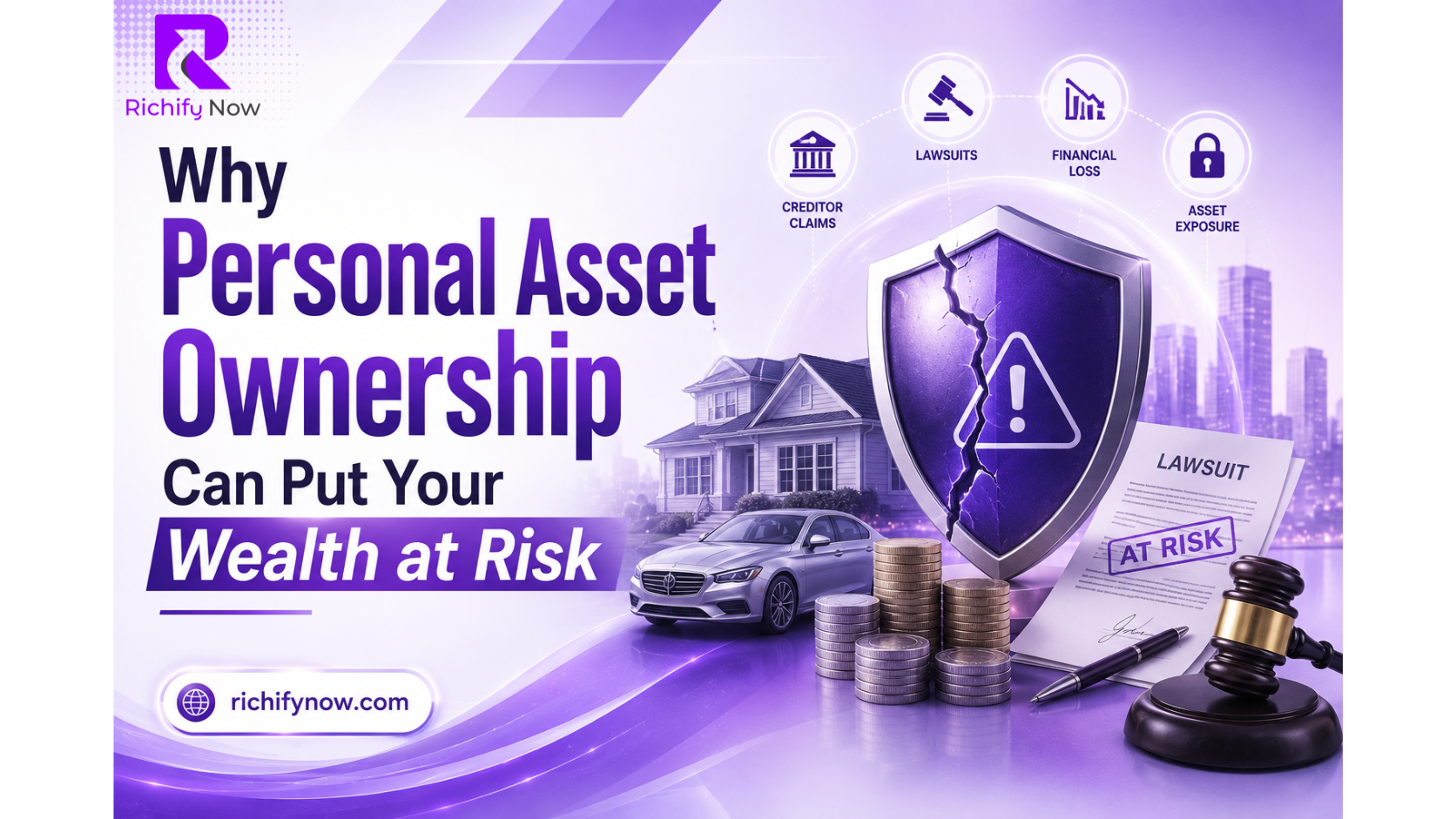
📖 Introduction: The Ownership Illusion Nobody Questions
For generations, financial success has followed a familiar script. Work hard. Earn more money. Buy a house. Purchase vehicles. Build savings. Invest for the future. Accumulate assets.
Most people never stop to question one critical detail: Who should actually own those assets?
The default answer is almost always the same. People place everything under their own personal name. Their home, investment properties, vehicles, cash reserves, investment portfolios, and sometimes even business assets all become attached to a single legal identity.
At first glance, this appears perfectly normal. After all, if you purchased an asset, why shouldn't you own it personally?
The problem is that ownership and exposure are inseparable. The moment an asset sits under your personal name, it becomes directly connected to your legal, financial, and personal liabilities.
Most individuals spend years learning how to create wealth, but very little time learning how to protect it. This creates a dangerous imbalance. People become increasingly successful while simultaneously becoming increasingly vulnerable.
Institutional investors rarely make this mistake. Large corporations, investment groups, family offices, and sophisticated wealth holders understand that asset acquisition is only half of the equation. The other half is protection.
In fact, many institutions spend just as much effort designing ownership structures as they do acquiring assets themselves.
The average individual, however, often concentrates everything under one legal identity. This creates a hidden risk that remains invisible until a dispute, lawsuit, accident, creditor issue, inheritance conflict, or financial crisis suddenly exposes it.
This article explores why personal asset ownership may be one of the most overlooked financial vulnerabilities in modern wealth building and why de-risking the individual has become an increasingly important part of long-term financial resilience.
AEO Answer Card
Personally owning assets can expose them to certain lawsuits, debts, public visibility, or operational risks. Risk-aware ownership planning can involve insurance, entities, trusts, contracts, and professional guidance.
⚠️ Understanding Concentration Risk
When people hear the phrase concentration risk, they usually think about investing. For example, placing all savings into a single stock would create significant risk because one negative event could impact the entire portfolio.
The same concept applies to asset ownership.
Imagine an individual who owns:
- 🏡 A primary residence
- 🏢 Two rental properties
- 🚗 Three vehicles
- 💰 Significant cash reserves
- 📈 Investment portfolios
- 💼 Business interests
On paper, this person appears financially secure.
However, from a risk perspective, all those assets are connected to the same legal identity. That identity becomes a single point of exposure.
If legal, financial, or personal complications emerge, multiple asset classes may become connected to the resulting dispute.
The problem isn't wealth. The problem is concentration.
Many individuals unknowingly create an ownership structure that resembles placing every valuable possession into one large container and hoping nothing ever happens to it.
Hope is not a risk management strategy.
🏡 Real Estate: A Wealth Builder with Hidden Exposure
Real estate remains one of the most effective wealth-building tools available. Properties can appreciate over time, generate rental income, provide inflation protection, and create long-term financial stability.
Because of these benefits, many investors focus heavily on acquiring additional properties.
Yet very few focus on ownership risk.
Every property carries potential liabilities.
- 🔨 Contractor disputes
- 🚪 Tenant conflicts
- ⚖️ Regulatory issues
- 💧 Property damage claims
- 🚧 Safety incidents
- 🏘️ Neighbor disputes
- 📋 Compliance concerns
A single property issue may seem isolated, but when multiple properties are personally owned, the exposure becomes interconnected.
This creates a situation where one problematic asset can create stress across an individual's broader financial landscape.
Institutional investors understand this dynamic. That is why large-scale property ownership is rarely structured under a single personal identity.
The lesson is simple: ownership matters just as much as acquisition.
🚗 Vehicles: Everyday Assets with Extraordinary Liability
Vehicles are often viewed as ordinary possessions. Most people see them as transportation tools, not risk-generating assets.
However, every time a vehicle enters a public roadway, it creates potential exposure.
Even the safest driver cannot fully control weather conditions, road hazards, mechanical failures, or the actions of other drivers.
An incident involving a vehicle can quickly evolve beyond repair costs. Questions regarding liability, responsibility, damages, and financial consequences often follow.
For individuals holding significant wealth under their personal name, vehicle-related disputes may create concerns extending far beyond the vehicle itself.
The important lesson here is that asset value and risk value are not always equal.
A vehicle worth a relatively small amount can sometimes generate liabilities far exceeding its market price.
This is one reason institutions treat liability-generating assets differently from wealth-preserving assets.
💰 Why Cash Is Not Automatically Safe
Many people believe cash is the safest asset class. Unlike real estate, it requires little maintenance. Unlike investments, it does not fluctuate dramatically in value.
Cash provides flexibility, liquidity, and immediate accessibility.
Yet liquidity and protection are not the same thing.
Cash held directly under personal ownership remains connected to the individual's broader financial profile.
Large cash balances often represent years of discipline, sacrifice, and strategic decision-making.
Unfortunately, many people spend years accumulating cash while spending almost no time considering how that cash should be protected.
Building wealth and preserving wealth are different disciplines.
Accumulation creates value. Protection helps ensure that value survives future uncertainty.
Without protection, wealth creation remains incomplete.
💡 Key Insight
"The greatest financial risk is often not the asset itself, but the way the asset is owned."
⚖️ The Lawsuit Scenario Most People Never Prepare For
Most individuals assume lawsuits are events that happen to large corporations, celebrities, or extremely wealthy investors. In reality, legal disputes occur every day and often begin with ordinary situations.
A visitor slips on a property. A business contract becomes disputed. A vehicle accident creates questions of liability. A tenant raises legal concerns. A partnership disagreement escalates. An employee files a claim.
None of these situations require criminal behavior or intentional wrongdoing. Sometimes all it takes is a disagreement combined with financial consequences.
The issue is not merely whether someone wins or loses a legal dispute. The issue is understanding how much of their financial world becomes exposed during the process.
When substantial assets are concentrated under personal ownership, those assets become part of a larger financial picture that may receive scrutiny during legal proceedings.
Legal expenses alone can become significant. Court costs, professional fees, settlement negotiations, document preparation, and prolonged disputes often create financial pressure before any final outcome is reached.
Institutional organizations recognize this risk and design protective structures before disputes arise. Individuals frequently wait until after a problem appears, when options are often more limited.
Protection is most effective when implemented during periods of stability, not during moments of crisis.
👨👩👧👦 Family Wealth Is More Fragile Than Most People Realize
One of the biggest misconceptions in financial planning is the belief that accumulating assets automatically protects future generations.
Creating wealth is important, but preserving wealth across generations requires an entirely different skill set.
Many families spend decades building successful businesses, purchasing properties, growing investments, and creating financial security. Yet they often spend very little time considering what happens if unexpected events interrupt those plans.
Common challenges include:
- 📜 Inheritance disputes
- ⚖️ Estate administration complications
- 👥 Family disagreements
- 💼 Business succession issues
- 🏠 Property ownership conflicts
- 💰 Asset distribution disagreements
As wealth increases, these challenges often become more complex.
A poorly structured ownership model can create confusion, delays, and disputes during periods when families are already dealing with difficult circumstances.
Institutional wealth planning focuses heavily on continuity. The goal is not simply creating wealth today but ensuring that wealth remains functional and protected tomorrow.
Individuals can learn an important lesson from this approach: long-term financial security depends on both growth and preservation.
🏛️ Why Institutions Rarely Own Assets Like Individuals Do
Perhaps the clearest evidence of personal ownership risk comes from observing how institutions manage valuable assets.
Large corporations, investment funds, family offices, and professional investors rarely place all assets under a single ownership identity.
Instead, they focus on:
- 🛡️ Risk segregation
- 📊 Liability isolation
- 🏗️ Ownership structuring
- 📈 Asset compartmentalization
- 🔒 Wealth preservation
- 📋 Long-term continuity planning
Their objective is not complexity for the sake of complexity.
Their objective is resilience.
They understand that every asset carries a unique risk profile. Some assets generate income. Some generate liabilities. Some create operational exposure. Others create legal exposure.
Treating all assets as if they belong in one ownership basket ignores these differences.
Think of a modern ship.
Ships are designed with multiple watertight compartments. If one section becomes damaged, the entire vessel does not immediately sink because the damage remains contained.
Institutional ownership structures follow a similar philosophy.
The objective is containment.
When everything is personally owned, financial compartmentalization disappears and concentration risk increases.
🧠 The Psychological Trap of Personal Ownership
One reason personal ownership remains so common is because it feels familiar.
Most people simply follow what they observe around them.
Parents own homes personally. Friends own vehicles personally. Colleagues purchase investments personally. Business owners often begin by holding everything under their own name.
As a result, personal ownership becomes the default choice.
Very few people stop to ask whether the default option is actually the safest option.
This creates an interesting contradiction.
People spend months researching investment opportunities, comparing mortgage rates, evaluating property locations, and analyzing vehicle purchases.
Yet they may spend only minutes considering how those assets should be owned.
The asset receives all the attention.
The ownership structure receives almost none.
From a risk-management perspective, ownership may be just as important as acquisition.
A strong asset combined with weak protection can still create vulnerability.
⏳ The Hidden Cost of Waiting
One of the most expensive mistakes in risk management is assuming protection can always be addressed later.
Many individuals delay planning because everything appears stable.
The investments are growing.
The properties are producing income.
The business is successful.
The bank accounts are healthy.
Because no immediate problem exists, protection feels unnecessary.
However, risk planning is not designed for normal conditions.
Risk planning exists for abnormal conditions.
The most effective protection strategies are often implemented years before they become necessary.
Waiting until a dispute, lawsuit, financial crisis, or creditor issue emerges may significantly reduce available options.
This is why institutions consistently plan ahead.
They understand that resilience is built before disruption occurs.
The strongest defensive position is usually established long before anyone realizes it will be needed.
📈 Wealth Creation vs Wealth Preservation
Most financial education focuses on creating wealth.
People are encouraged to earn more income, invest more capital, purchase more assets, and increase net worth.
These are valuable goals.
However, creating wealth and preserving wealth are not the same discipline.
Building wealth involves:
- 💼 Increasing income
- 📊 Investing capital
- 🏡 Acquiring assets
- 🚀 Expanding opportunities
Preserving wealth involves:
- 🛡️ Managing risk
- ⚖️ Reducing exposure
- 🏛️ Structuring ownership
- 🔒 Protecting accumulated value
Many individuals become highly skilled at wealth creation while remaining inexperienced in wealth preservation.
The result is a growing asset base supported by a relatively weak protection framework.
Institutional investors understand that true financial strength requires both disciplines working together.
Growth without protection creates fragility.
Growth combined with protection creates resilience.
🚀 Key Lessons From Institutional Thinking
- ✅ Ownership structure matters as much as asset acquisition.
- ✅ Concentrating assets under one legal identity increases exposure.
- ✅ Real estate, vehicles, and cash all carry unique risk profiles.
- ✅ Wealth creation and wealth preservation are separate disciplines.
- ✅ Institutions prioritize protection long before problems arise.
- ✅ Resilience is built through planning, not reaction.
- ✅ The goal is not fear; the goal is preparedness.
🎯 Conclusion: The Individual Should Not Be the Weakest Link
Modern wealth creation has never been easier. Individuals have access to global investments, digital businesses, real estate opportunities, and financial tools that previous generations could only imagine.
Yet despite these advancements, many people continue to use ownership strategies that expose them to unnecessary risk.
The greatest vulnerability is often not a market crash, economic downturn, or investment mistake.
The greatest vulnerability may be an ownership structure that concentrates everything under a single legal identity.
Institutional investors learned long ago that protection is not a luxury. It is a requirement.
They understand that wealth should be designed to withstand uncertainty, not merely perform during favorable conditions.
Individuals can apply the same principle.
The objective is not to avoid success. The objective is to ensure success remains protected.
Financial resilience is created when growth and protection evolve together.
Because building wealth is important.
But keeping it may be even more important.
As personal wealth grows, one question becomes increasingly valuable:
"Are my assets working for me, or am I unknowingly exposing them through the way they are owned?"
The answer to that question often determines whether wealth remains secure for years to come.
🛡️ Institutional Risk Series – Phase 1: Foundational Shielding
Understanding the hidden vulnerabilities that threaten long-term wealth preservation and learning how sophisticated investors think about protection before problems occur.
Asset Protection Questions
Download the editable RichifyNow workbook with instructions, working fields, disclaimer, and the complete source-document specification.


Loading comments…