CRM, ERP, or Project Management? Choosing the Right Software for Growth
Choosing between CRM, ERP, and project management software can shape how a business grows. This guide explains the difference between each system, when to use them, and how companies can select the right software to improve sales, operations, execution, and long term scalability.

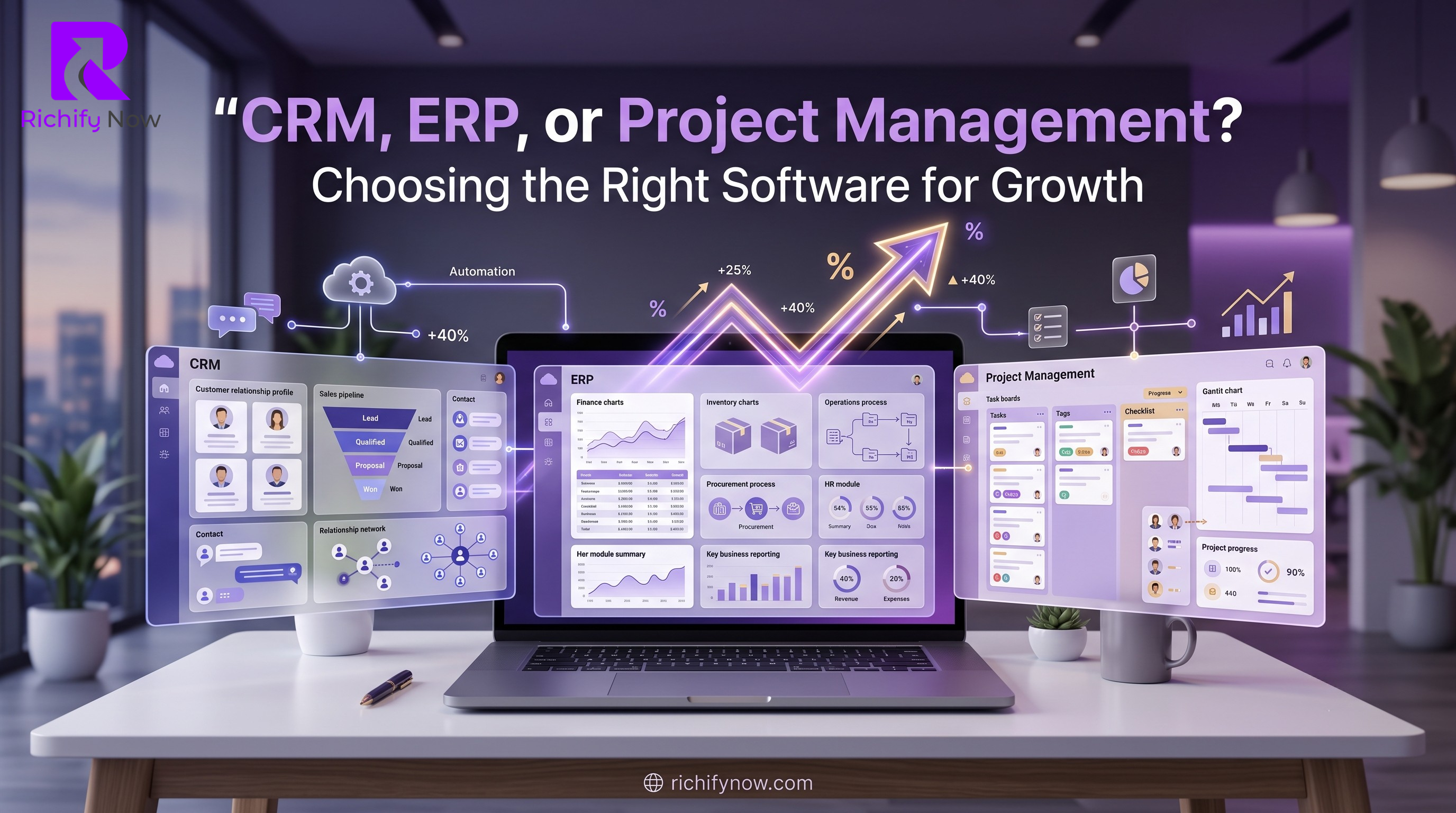
CRM, ERP, and project management software solve different problems. A CRM manages customers and sales, an ERP connects core business operations, and project management software organizes tasks, timelines, and team execution. The right choice depends on your biggest operational bottleneck.
Introduction 🧠
Growth creates opportunity
It also creates confusion
A small business can often survive with spreadsheets, inboxes, WhatsApp messages, scattered notes, and manual reminders
But as customers increase, orders expand, projects multiply, team members join, invoices pile up, and decisions become faster, the old system starts breaking quietly
Leads get missed
Tasks get delayed
Inventory becomes unclear
Customer history gets lost
Managers ask for reports that nobody can generate quickly
Employees spend more time searching for information than doing meaningful work
This is the point where many companies begin asking a serious question
Do we need CRM, ERP, or project management software?
The answer depends on what kind of problem is limiting your growth
A CRM helps you manage customers and sales relationships
An ERP helps you manage internal business operations such as finance, inventory, procurement, HR, supply chain, and reporting
A project management system helps teams plan, assign, track, and complete work on time
The mistake many businesses make is buying software based on popularity instead of business need
This guide explains the difference between CRM, ERP, and project management software in a simple RichifyNow style so founders, operators, and growing teams can choose the right system before software becomes another expensive problem
Quick Business Note ⚠️
This article is for educational and strategic planning purposes only
The right software depends on your company size, budget, workflows, team maturity, data quality, industry needs, integration requirements, and implementation capacity
Before purchasing any platform, review your process gaps, compare vendors, calculate total cost, and test the software with real users
What Is CRM Software? 🤝
CRM stands for customer relationship management
Salesforce describes CRM as a system for managing a company's interactions with current and potential customers, which makes it especially important for sales, marketing, service, and relationship driven growth
In simple language, CRM software is the place where your customer conversations, leads, follow ups, deals, contacts, tasks, notes, proposals, and pipeline activity become organized
A CRM helps a business answer questions like
Who contacted us
Which lead is ready for a follow up
Which salesperson owns this opportunity
What stage is this deal in
Which customers need support
Which campaigns generated the best leads
Which accounts are most valuable
Without a CRM, growing sales teams often depend on memory, scattered spreadsheets, inbox searches, and personal notes
That may work in the early stage, but it becomes risky when leads increase and more people touch the customer journey
A CRM is not only a contact list
It becomes the memory system of the customer side of the business
CRM Is Best When Your Growth Problem Looks Like This 💡
- Leads are coming in but follow ups are inconsistent
- Salespeople are using separate spreadsheets
- Customer communication history is hard to find
- Deals are getting stuck without clear ownership
- Marketing campaigns are not connected to sales outcomes
- Support teams cannot see the full customer context
- Management wants better sales pipeline visibility
What Is ERP Software? 🏢
ERP stands for enterprise resource planning
Oracle explains ERP as software used by organizations to manage core business areas such as finance, accounting, HR, manufacturing, supply chain, and other company operations
In simple language, ERP software helps a business control the operational engine behind revenue
If CRM manages the customer facing side, ERP manages the internal business system
ERP becomes important when a company needs one connected source for inventory, purchasing, accounting, payroll, production, orders, billing, compliance, reporting, and resource planning
For example, an ecommerce company may need ERP when sales, warehouse stock, supplier orders, returns, invoicing, and financial reporting become too complex for separate tools
A manufacturer may need ERP when production planning, material availability, vendor purchasing, labor tracking, and cost control need to work together
A service company may need ERP when finance, contracts, procurement, HR, project costs, and reporting require stronger control
ERP is usually a bigger decision than CRM because it touches more departments and changes how the company operates
That is why ERP selection needs serious planning
Gartner notes that ERP strategy should support flexibility and accommodate innovations such as generative AI, which shows that ERP is not only back office software but a foundation for future operational change
ERP Is Best When Your Growth Problem Looks Like This ⚙️
- Finance and operations are not aligned
- Inventory data is unreliable
- Departments are using disconnected systems
- Reports take too long to prepare
- Procurement and supplier management are messy
- Order processing depends on too much manual work
- Management needs a clearer view of company performance
What Is Project Management Software? 📋
Project management software helps teams plan, assign, track, organize, and complete work
Atlassian describes project management as the use of skills, tools, and techniques to plan, execute, monitor, and complete projects within timeframes
In simple language, project management software answers the daily execution questions
What needs to be done
Who is responsible
When is it due
What is blocked
What is completed
What is delayed
Which task comes next
This software is especially useful for agencies, SaaS teams, content teams, construction teams, product teams, marketing departments, software development teams, and operations teams that manage recurring work or deadline driven projects
Project management tools do not replace CRM or ERP
They improve execution visibility
A business may have many customers in CRM and strong accounting in ERP, but still fail because internal work is not managed properly
That is why project management software is often the first software a growing service business adopts
Project Management Software Is Best When Your Growth Problem Looks Like This 🚦
- Tasks are forgotten or duplicated
- Deadlines are missed without warning
- Team members are unclear about ownership
- Managers need project visibility without asking everyone manually
- Clients keep asking for updates
- Work is moving through too many chats and emails
- Projects need checklists, approvals, documents, and timelines
CRM vs ERP vs Project Management At A Glance 🔍
Which Software Should A Growing Business Choose First? 🧭
The right answer depends on the bottleneck
If the bottleneck is sales visibility, choose CRM first
If the bottleneck is operational control, choose ERP first
If the bottleneck is team execution, choose project management first
A company should not buy ERP just because it sounds more serious
A company should not buy CRM just because every sales expert recommends it
A company should not buy project management software just because tasks feel messy for one week
The smartest buying decision begins with process diagnosis
Where is money leaking
Where are delays happening
Where is data unreliable
Where are customers getting ignored
Where are employees repeating manual work
Where does leadership lack visibility
When you know the real bottleneck, the software decision becomes clearer
RichifyNow Growth Framework 💜
Think of software growth in three layers
The customer layer is CRM
The operating layer is ERP
The execution layer is project management
If your business cannot capture and convert demand, fix the customer layer first
If your business cannot control resources, costs, inventory, or reporting, fix the operating layer first
If your business cannot deliver work on time, fix the execution layer first
The best software is not the one with the longest feature list
The best software is the one that removes the strongest growth barrier
When CRM Should Come First 🚀
CRM should usually come first when revenue is being lost because customer relationships are not managed properly
This often happens in service businesses, agencies, consultants, real estate firms, B2B companies, ecommerce brands, and subscription businesses
If leads are arriving from ads, SEO, referrals, email, WhatsApp, social media, and website forms, but nobody knows which leads are hot, CRM becomes urgent
A CRM can help assign leads, track communication, schedule follow ups, record notes, create deal stages, monitor win rates, and show which channels bring serious opportunities
This gives management a clearer view of revenue health
CRM also supports customer retention
A business that only focuses on new leads may forget existing customers
CRM helps teams identify inactive accounts, upsell opportunities, service issues, renewal dates, and customer satisfaction signals
For growth, this matters because keeping customers is often cheaper than constantly replacing them
Choose CRM first if the biggest weakness is lead handling, sales process, customer follow up, or relationship history
When ERP Should Come First 🏗️
ERP should come first when the business is struggling with internal complexity
This is common when a company has physical inventory, multiple departments, purchasing cycles, stock movement, accounting pressure, payroll complexity, supplier coordination, production planning, or multi location operations
If sales are growing but operations are becoming chaotic, ERP may be the smarter foundation
For example, a company may receive more orders but not know whether stock is available
It may sell products at healthy revenue levels but lose money because cost tracking is poor
It may have strong demand but weak procurement control
It may close deals but struggle to invoice accurately
ERP helps reduce these problems by connecting operational data
However, ERP should not be adopted casually
ERP projects can be expensive, time consuming, and disruptive if processes are unclear
A business should document workflows before implementation
It should also train users properly, clean data, define ownership, and avoid unnecessary customization in the early phase
Choose ERP first if the biggest weakness is finance control, inventory accuracy, operational visibility, supply chain coordination, or enterprise reporting
When Project Management Software Should Come First 📌
Project management software should come first when work is delayed because tasks are unclear
This is common in agencies, software teams, marketing teams, design teams, remote teams, startups, and client service companies
If your team says we discussed it but nobody did it, you likely need better project management
If every update requires a long meeting, you likely need clearer task visibility
If clients are unhappy because delivery timelines keep changing, you need a better execution system
Project management software gives structure to daily work
It allows teams to create tasks, assign owners, set deadlines, attach files, comment in context, track status, and create repeatable workflows
It also reduces dependency on memory
This is important because growing teams cannot rely on informal coordination forever
The more people involved in delivery, the more important task visibility becomes
Choose project management software first if the biggest weakness is execution clarity, team accountability, deadline management, or client delivery
Can A Business Need All Three? 🔗
Yes, many growing companies eventually need all three systems
But needing all three eventually does not mean buying all three immediately
The danger of buying too much software too early is adoption failure
Teams become overwhelmed
Data gets duplicated
Processes become more confusing
Managers pay for features nobody uses
Instead, a better approach is staged software adoption
Start with the strongest bottleneck
Build usage discipline
Connect the next system only when the first one is stable
For example, a B2B agency may start with CRM to manage leads, then add project management to deliver client work, then add ERP or accounting integrations when finance becomes complex
An ecommerce brand may start with ERP or inventory tools, then connect CRM for customer retention, then add project management for marketing and operational campaigns
A SaaS startup may start with project management for product execution, then add CRM for sales, then add ERP style finance systems as the company scales
The Cost Mistake Companies Make 💸
Many companies compare software only by monthly subscription price
This is a mistake
The real cost includes setup, training, migration, customization, integrations, reporting, support, process redesign, user resistance, and lost productivity during transition
A cheap tool that nobody uses is expensive
An expensive tool that improves revenue control or operational efficiency may be valuable
Before choosing software, calculate total cost of ownership
Ask how many users need access
Ask whether implementation help is required
Ask whether your current data is clean enough
Ask whether the tool connects with your website, email, payment system, accounting platform, warehouse tool, or communication system
Ask whether reporting can answer leadership questions without manual exporting
Growth software should reduce friction, not create another administrative burden
A Simple Decision Checklist ✅
Choose CRM If
- Your lead pipeline is unclear
- Sales follow up is inconsistent
- Customer history is scattered
- Marketing and sales are disconnected
- Customer retention needs structure
Choose ERP If
- Inventory, finance, HR, procurement, or operations are hard to control
- Departments use disconnected systems
- Reports are slow or unreliable
- Manual data entry creates errors
- Operational complexity is limiting scale
Choose Project Management If
- Tasks are unclear
- Deadlines are missed
- Team accountability is weak
- Client delivery needs more structure
- Work is trapped in chats, emails, and meetings
Common Mistakes To Avoid 🚫
The first mistake is buying software before documenting your workflow
If your process is unclear, software will only digitize confusion
The second mistake is choosing the biggest platform because it looks impressive
Large platforms can be powerful, but they can also overwhelm smaller teams
The third mistake is ignoring user adoption
A system only works when employees actually use it correctly
The fourth mistake is customizing too early
Too much customization can make implementation slower and harder to maintain
The fifth mistake is failing to assign system ownership
Every important platform needs an owner who manages data quality, usage discipline, reporting, and process improvement
The sixth mistake is treating software as the strategy
Software supports strategy
It does not replace leadership, process design, team training, or decision making
Internal Reading Path For RichifyNow Readers 🔗
FAQs ❓
What is the main difference between CRM and ERP?
CRM focuses on customers, sales, leads, communication, and relationships, while ERP focuses on internal operations such as finance, inventory, HR, procurement, supply chain, and reporting
Is project management software the same as CRM?
No, project management software tracks tasks, timelines, owners, and delivery workflows, while CRM tracks customer relationships, sales pipelines, and communication history
Which software should a small business choose first?
A small business should choose the software that solves its strongest bottleneck, CRM for missed leads, ERP for operational control, and project management for delivery execution
Can CRM, ERP, and project management software work together?
Yes, many growing companies eventually connect these systems so customer data, operational data, and project activity can support better decisions across the business
Is ERP only for large enterprises?
No, ERP is not only for large enterprises, but it is usually more useful when a company has enough operational complexity to justify the cost, setup, training, and process discipline
What is the biggest risk when choosing business software?
The biggest risk is buying software without understanding the process problem, because the wrong platform can increase confusion, waste money, and reduce team adoption
Final Verdict 💜
CRM, ERP, and project management software all support growth, but they solve different business problems
CRM helps a company manage demand, relationships, sales pipelines, and customer retention
ERP helps a company manage resources, operations, finance, inventory, procurement, and reporting
Project management software helps teams manage execution, tasks, deadlines, collaboration, and delivery quality
The right choice depends on where growth is getting blocked
If revenue opportunities are being missed, start with CRM
If operations are becoming difficult to control, start with ERP
If delivery is becoming messy, start with project management software
The smartest companies do not buy software because it is trendy
They buy software because it removes a measurable bottleneck
At RichifyNow, the growth lesson is simple
Software should not make your business look bigger
Software should help your business operate better 🌟
RichifyNow Insight 🚀
CRM protects customer growth, ERP protects operational growth, and project management protects execution growth, the right choice is the one that strengthens the weakest layer of your business
Continue Learning SaaSReferences 📚
- Salesforce, What Is CRM
- Salesforce, What Is CRM Software
- Oracle, What Is ERP
- Oracle, Enterprise Resource Planning ERP overview
- Atlassian, What Is Project Management
- Gartner, Enterprise Resource Planning insights
CRM vs ERP vs Project Management Decision Tool
Download the editable RichifyNow workbook with instructions, working fields, disclaimer, and the complete source-document specification.
Loading comments…