
ETFs vs Individual Stocks: Which Strategy Builds Wealth Faster?
ETFs and individual stocks both offer powerful paths to wealth building, but they work in very different ways. This guide explains which strategy may grow faster, which one carries more risk, and how investors can use both to build a smarter long term portfolio.

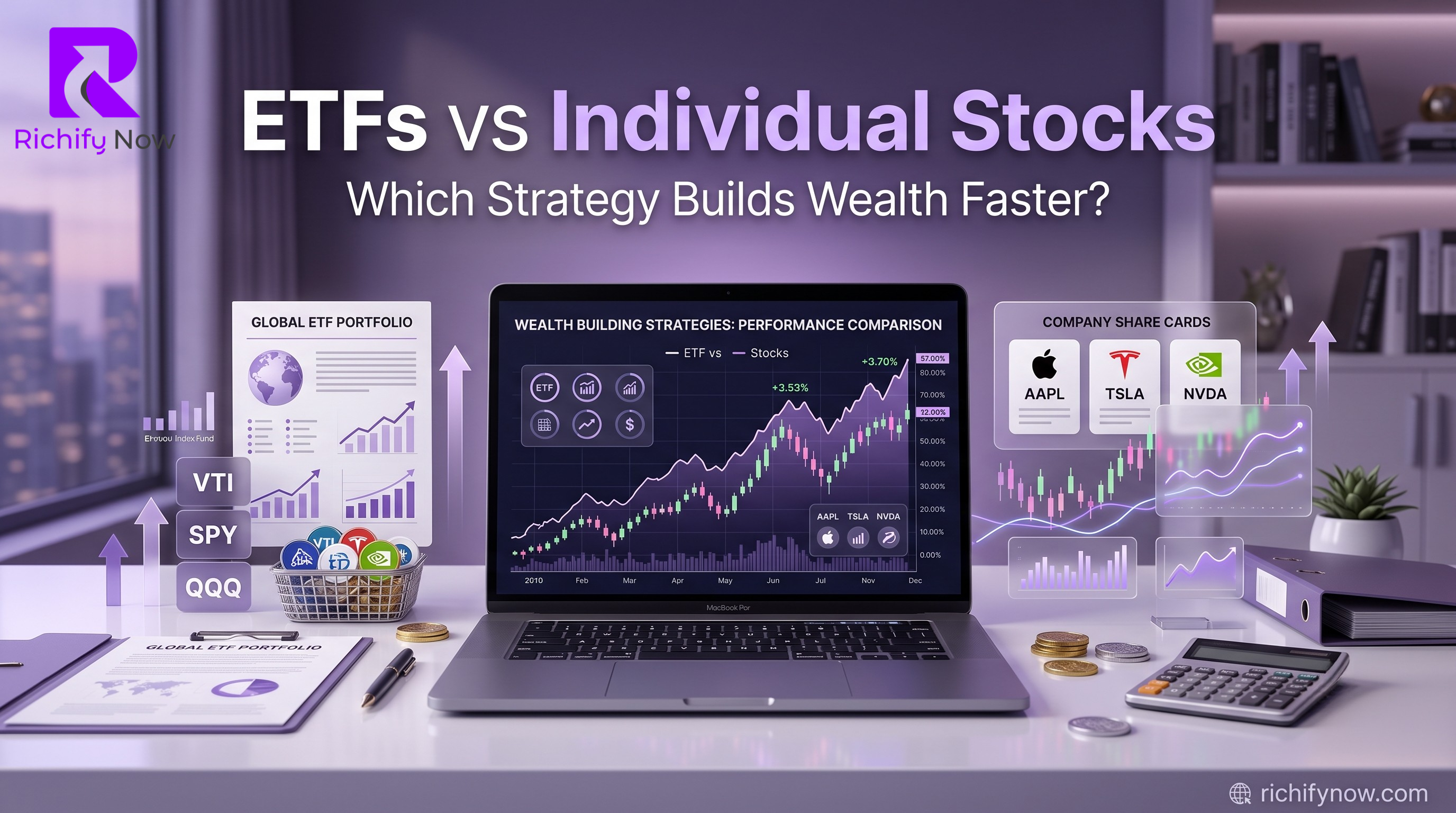
ETFs offer diversified exposure through one fund, while individual stocks require selecting and monitoring specific companies. ETFs are often simpler for beginners, while individual stocks offer more control and more concentrated risk. The better option depends on knowledge, time, risk tolerance, and goals.
Introduction 🧠
Every investor wants the same result
More wealth, less regret, and a strategy that can survive real market pressure
That is why the debate between ETFs and individual stocks is so important
Some investors believe ETFs are the smarter path because they spread risk across many companies, reduce emotional decision making, and allow people to build wealth steadily over time
Other investors believe individual stocks build wealth faster because one excellent company can grow far more than a broad market fund
Both views contain truth
ETFs can be powerful because they make diversification simple, while individual stocks can be powerful because they allow focused exposure to specific companies with higher growth potential
The real question is not which one sounds more exciting
The real question is which one matches your knowledge, risk tolerance, time horizon, income stability, patience, and ability to stay consistent when markets become uncomfortable
This guide explains both strategies in a simple RichifyNow style so beginners and growing investors can understand how each option works, where each one wins, where each one fails, and how to build a smart investment plan without blindly following hype
Important Investor Note ⚠️
This article is for education only and should not be treated as personal financial advice
Investing involves risk, market prices can fall, and past performance does not guarantee future results
Before investing, review your goals, emergency fund, debt position, time horizon, and risk capacity
What Is an ETF? 📦
An ETF, or exchange traded fund, is an investment fund that usually holds a basket of assets such as stocks, bonds, sectors, commodities, or market indexes
Many ETFs trade on stock exchanges like normal shares, which means investors can buy or sell them during market hours
The main attraction of ETFs is simple diversification
Instead of buying one company, an investor can buy one ETF that gives exposure to dozens, hundreds, or even thousands of holdings
For example, a broad market ETF may give exposure to large companies across technology, healthcare, finance, consumer goods, industrials, and other sectors
This does not remove risk, but it reduces the danger that one company failure can damage the entire portfolio
Investor gov explains that many ETFs invest across a range of companies and industries rather than one specific stock, which can help lower risk if one company fails
ETFs can be passive or active
A passive ETF usually tracks an index, while an active ETF is managed with a specific strategy
Some ETFs are broad and beginner friendly, while others are narrow, leveraged, inverse, thematic, or single stock based, which can make them much riskier
ETF Strengths 💪
- Easy diversification across many companies
- Lower company specific risk compared with owning one stock
- Simple for beginners to understand
- Useful for long term monthly investing
- Often lower cost than many active funds
- Can be used for broad markets, sectors, bonds, dividends, and themes
What Are Individual Stocks? 🏢
Individual stocks represent ownership in one company
When you buy a stock, your result depends heavily on how that company performs, how investors value it, how its industry changes, how management executes, and how the market reacts to risk
Individual stocks can create faster wealth when an investor owns strong companies early and holds them through years of growth
A single winning stock can outperform a broad ETF by a large margin
That is the dream that attracts many investors to stock picking
However, the opposite is also true
A single weak stock can fall sharply, stay down for years, or even lose most of its value
This is why individual stock investing requires research, patience, valuation discipline, emotional control, and risk management
FINRA describes concentration risk as the risk of amplified losses when a large portion of holdings is tied to one investment, asset class, or market segment
Individual Stock Strengths 🌟
- Higher potential upside from outstanding companies
- More control over what you own
- Ability to avoid companies or sectors you dislike
- Potential for dividend growth from selected businesses
- Useful for investors who enjoy deep research
- Can help experienced investors build concentrated conviction portfolios
Which Strategy Builds Wealth Faster? ⚡
The honest answer is this
Individual stocks can build wealth faster if you choose the right companies, buy at reasonable prices, hold through volatility, and avoid major mistakes
ETFs often build wealth more reliably because they reduce the need to predict the next winning company
Faster does not always mean better
A strategy that grows quickly but collapses during stress may not be a good wealth building system
A strategy that grows steadily, keeps you invested, and prevents emotional decisions may create better long term results for many people
This is especially true for investors who have limited time, limited research skill, or a tendency to panic during market declines
The SEC investor education material explains that asset allocation depends on time horizon and ability to tolerate risk, which means the best investment mix is personal rather than universal
So the better question becomes this
Which strategy can you follow consistently for ten years or longer?
Why ETFs Often Win For Most Investors 🛡️
ETFs often win for everyday investors because they reduce the number of decisions required
Most people do not fail in investing because they lack access to ideas
They fail because they switch strategies, chase hot trends, panic during declines, overtrade, or put too much money into one exciting stock
A broad ETF strategy can protect investors from themselves
When an investor buys a diversified ETF every month, the focus shifts from predicting tomorrow to building ownership over time
This simple process can be powerful
It removes the need to know which company will dominate next year
It also allows investors to benefit from broad economic growth, corporate earnings, innovation, dividends, and long term market participation
Another reason ETFs work well is that they fit real life
Most people are busy with jobs, businesses, families, and daily responsibilities
They may not have time to read annual reports, track margins, study balance sheets, review competitors, understand valuation, and monitor company news
For these investors, ETF investing can be a smarter system because it is easier to maintain
A strategy you can repeat during good markets and bad markets is often better than a strategy that only looks good during excitement
Why Individual Stocks Can Build Wealth Faster 🚀
Individual stocks can build wealth faster because they allow concentration
When you own a broad ETF, your money is spread across winners, average companies, and weaker companies
This reduces risk, but it also limits the impact of any one superstar business
When you own individual stocks, your portfolio can benefit more directly from exceptional companies
If a company grows revenue, improves profits, expands globally, builds a strong brand, creates pricing power, and keeps winning market share, its stock may deliver strong long term returns
This is why some investors prefer owning selected businesses instead of owning the whole market
The advantage is control
You decide what to own, how much to own, when to add, and when to exit
You can build a portfolio around your highest conviction ideas
But this advantage becomes dangerous when confidence becomes overconfidence
Many investors believe they can pick winners, but they may actually be reacting to headlines, influencers, recent price movement, or emotional excitement
Stock picking can work, but it demands a serious process
A Strong Stock Picking Process Should Include 🔍
- Clear understanding of the business model
- Revenue and profit quality review
- Debt and cash flow analysis
- Competitive advantage assessment
- Valuation discipline
- Position sizing rules
- Exit rules for broken investment cases
- Patience during normal volatility
The Hidden Risk In Stock Picking 🎭
The hidden risk in individual stocks is not only losing money
The hidden risk is believing you are investing when you are actually speculating
Buying a stock because it is trending online is not a strategy
Buying because the price already went up is not research
Buying because someone said it could double is not risk management
Real investing requires a reasoned thesis
You should know why the company can grow, what could go wrong, what price makes sense, and how much of your portfolio you are willing to risk
Without that discipline, individual stocks can become emotional gambling with professional looking language
This is where ETFs protect beginners
They may feel less exciting, but they remove the pressure to make perfect decisions company by company
The Hidden Risk In ETFs 🧩
ETFs also have risks
Not every ETF is safe, diversified, or suitable for beginners
Some ETFs focus on one sector, one theme, one country, one commodity, or leveraged daily performance
These can behave very differently from broad market ETFs
FINRA notes that most exchange traded products are ETFs, but some products are not registered under the same investment company structure, and leveraged, inverse, and single stock products can carry different risk profiles
The SEC has also warned that single stock leveraged and inverse ETFs eliminate the diversification benefit because they track one stock instead of an index
This matters because many beginners hear the word ETF and assume it automatically means safe
That is not always true
A broad total market ETF and a leveraged single stock ETF are not the same type of risk
Before buying any ETF, investors should check what it holds, what index or strategy it follows, what fees it charges, how concentrated it is, and whether it matches long term goals
ETFs vs Stocks For Different Investor Types 👥
If you are a beginner, ETFs are usually the cleaner starting point
They allow you to learn investing while staying diversified
You can begin with a simple portfolio and gradually study individual companies without putting your full wealth at risk
If you are a busy professional, ETFs can help you invest without turning portfolio management into a second job
If you are an experienced investor, individual stocks can make sense for a portion of your portfolio if you have a repeatable research process
If you are emotional with price swings, ETFs may help you avoid panic decisions
If you love research and can accept underperformance, individual stocks may give you more control and upside potential
If you are investing for retirement, education, or long term family wealth, a diversified core may be more important than chasing speed
If you are young and building skills, a small satellite stock portfolio can help you learn without risking your full financial future
RichifyNow Wealth Framework 💜
For many investors, the smartest answer is not ETFs or stocks
The smarter answer is core and satellite
The core is built with diversified ETFs that carry most of the portfolio
The satellite is a smaller portion used for individual stocks, sector ideas, or higher conviction opportunities
This structure allows investors to seek upside without putting the entire portfolio under stock picking pressure
A simple example could be eighty percent diversified ETFs and twenty percent selected stocks
A more conservative investor may choose ninety percent ETFs and ten percent stocks
A more experienced investor may choose seventy percent ETFs and thirty percent stocks
The exact mix depends on risk tolerance, knowledge, goals, and time horizon
How To Choose Between ETFs And Stocks 🧭
Start by asking how much time you can give to investing each week
If the answer is almost none, broad ETFs may be a better fit
If you can study businesses consistently, individual stocks may deserve a small role
Next, ask how you react when prices fall
If a ten percent decline makes you panic, concentrated stock picking may be too stressful
If you can stay calm and review facts, you may be able to handle selected stocks
Then ask what your goal is
If you want reliable long term compounding, ETFs may serve you well
If you want higher potential returns and accept higher risk, individual stocks may be useful
Finally, ask whether you have an investment process
If you cannot explain why you own a stock, when you would add, and when you would sell, you may not be ready for serious stock picking
A Practical Beginner Plan 📅
Month one should focus on education
Learn what ETFs are, how indexes work, what expense ratios mean, and why diversification matters
Month two should focus on building a simple investment policy
Write down your goal, monthly contribution amount, risk level, preferred asset mix, and rules for buying
Month three should focus on action
Start with a small amount you can afford, use a consistent schedule, and avoid checking prices every hour
Month four and beyond should focus on improvement
Review your portfolio quarterly, not emotionally every day
If you want to add individual stocks, create a separate research watchlist
Study one company at a time
Do not buy ten random stocks because you saw ten exciting headlines
Build slowly, learn patiently, and protect your future self from present excitement
Common Mistakes To Avoid 🚫
The first mistake is chasing speed without understanding risk
Many investors ask what builds wealth faster, but they ignore what can destroy wealth faster
The second mistake is buying too many individual stocks without knowing them well
Owning twenty random stocks is not the same as owning a researched portfolio
The third mistake is assuming every ETF is diversified
Some ETFs are concentrated, thematic, leveraged, or designed for short term trading
The fourth mistake is changing strategy every few months
Wealth building needs consistency
The fifth mistake is investing money needed for emergencies
Market investments should not replace an emergency fund
The sixth mistake is copying influencers without understanding your own financial position
A strategy that suits someone else may be unsuitable for your income, goals, country, tax situation, or risk tolerance
Internal Reading Path For RichifyNow Readers 🔗
FAQs ❓
Are ETFs safer than individual stocks?
Broad diversified ETFs are usually less risky than owning one individual stock because the money is spread across many holdings, but ETFs can still lose value and not every ETF is diversified
Can individual stocks make me richer faster?
Yes, individual stocks can build wealth faster when selected well, but they can also create larger losses if the company performs poorly or the investor buys at an inflated price
Should beginners start with ETFs or stocks?
Many beginners may find ETFs easier because they provide diversification and require less company by company research, while stocks may be added later after learning analysis and risk control
Is a mix of ETFs and stocks a good idea?
A core and satellite approach can work well for many investors, with ETFs forming the stable core and individual stocks forming a smaller opportunity focused portion
How many stocks should I own if I choose individual stocks?
There is no perfect number, but the goal should be enough diversification to avoid one company controlling your financial future, while still owning only companies you understand
Do ETFs guarantee profit?
No, ETFs do not guarantee profit, even broad market ETFs can decline during market downturns, so investors still need patience, time horizon, and proper risk planning
Final Verdict 💜
So which strategy builds wealth faster?
Individual stocks can build wealth faster when an investor has skill, discipline, patience, and the ability to identify strong companies before the market fully rewards them
ETFs often build wealth more reliably because they reduce concentration risk, simplify the process, and help investors stay consistent
For most everyday investors, ETFs may be the stronger foundation
For skilled investors, individual stocks may become a useful growth accelerator
The best strategy may not be choosing only one
The best strategy may be building a diversified ETF core and using a smaller stock portfolio for researched opportunities
Wealth is not only built by chasing the fastest path
Wealth is built by surviving mistakes, staying invested, controlling risk, and allowing time to reward intelligent consistency
At RichifyNow, the smarter question is not only how fast can your money grow
The smarter question is how strong is the system that helps your money keep growing 🌟
RichifyNow Insight 🚀
ETFs are the engine of consistency, individual stocks are the engine of conviction, and long term wealth often comes from knowing how much of each engine your financial life can safely handle
Continue Learning InvestingReferences 📚
- Investor gov, Exchange Traded Funds guide
- Investor gov, Beginner guide to asset allocation and diversification
- SEC, Asset allocation and diversification investor publication
- FINRA, Exchange traded funds and products investor education
- FINRA, Concentration risk investor insight
- SEC Investor Bulletin, Leveraged and inverse ETFs
Beginner Investing Readiness Checklist
Download the editable RichifyNow workbook with instructions, working fields, disclaimer, and the complete source-document specification.
Loading comments…