The Beginner's Investment Blueprint: Where to Put Your First $1,000 in 2026
Starting with your first $1,000 can feel confusing, but it can become the foundation of long term wealth This beginner investment blueprint explains smart places to put your money in 2026 based on safety, debt, growth, skills, and income potential

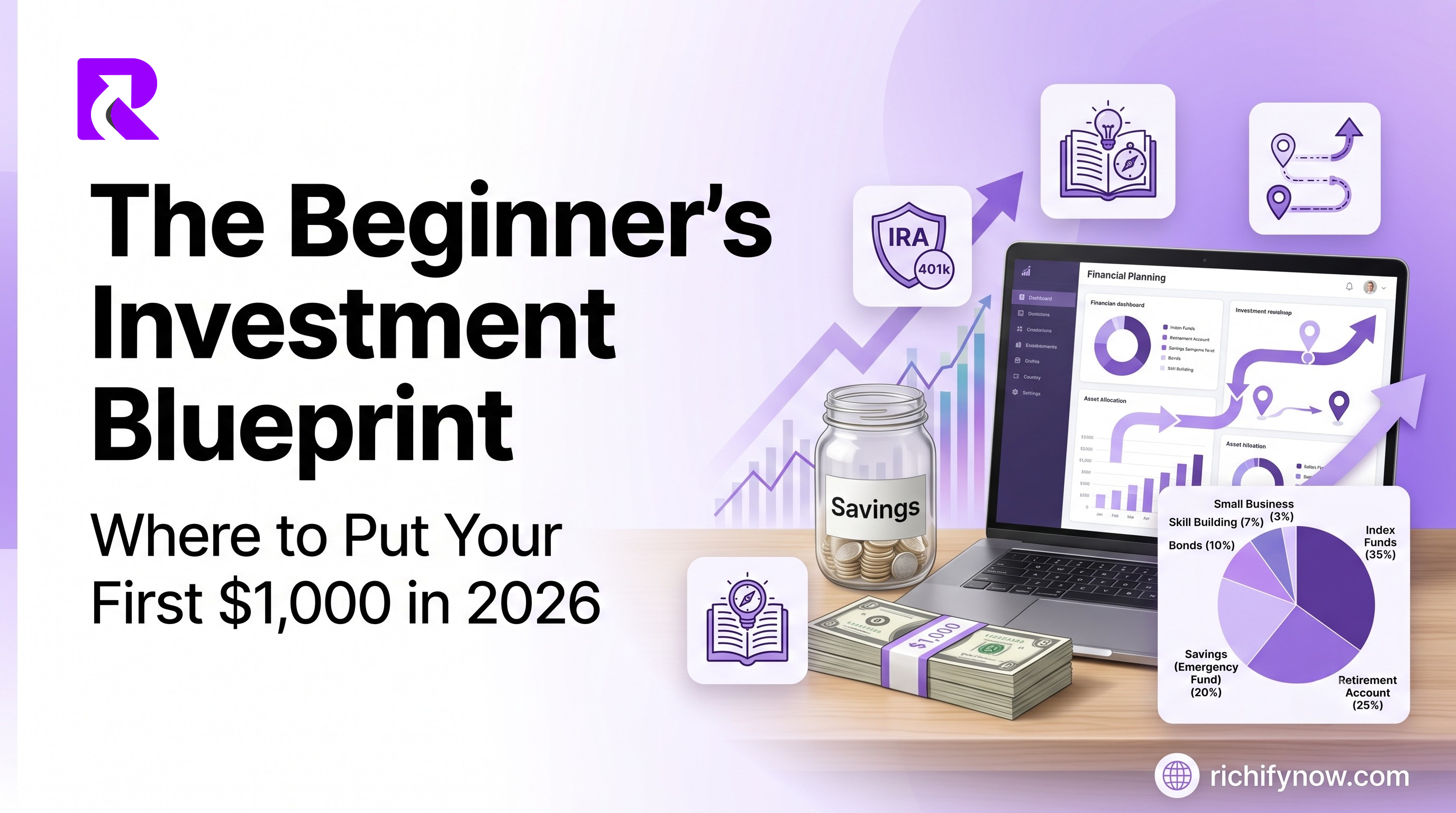
Before investing your first $1,000, consider emergency savings, high-interest debt, financial goals, time horizon, risk tolerance, and skills. The best first step may be savings, debt reduction, diversified investing, or education depending on your situation.
Introduction:
Starting your investment journey can feel confusing when every platform, influencer, app, and financial expert seems to recommend something different. One person says buy index funds. Another says start a side hustle. Someone else says keep cash safe. Then there are crypto coins, dividend stocks, high yield savings accounts, bonds, real estate funds, retirement accounts, and digital assets.
If you only have your first $1,000 to invest, the question becomes even more important. You cannot afford to treat that money carelessly. At the same time, you should not be so afraid of risk that you never start.
This beginner friendly blueprint explains how to think about your first $1,000 in 2026, where it can go, what mistakes to avoid, and how to turn a small amount of money into a foundation for long term financial growth.
Important Note Before You Invest ⚠️
This article is for educational purposes only and should not be treated as personal financial advice. Every investor has a different income level, age, location, tax situation, debt position, family responsibility, and risk tolerance. Before making a major investment decision, consider speaking with a qualified financial professional.
Why Your First $1,000 Matters More Than You Think 🌱
Many beginners believe that $1,000 is too small to matter. They think real investing starts when they have $10,000, $50,000, or even $100,000. This mindset keeps people waiting for the perfect moment, and that perfect moment often never comes.
The truth is that your first $1,000 matters because it teaches behavior. It teaches discipline, patience, planning, risk management, and decision making. The first $1,000 is not only about financial return. It is about building the identity of someone who saves, invests, learns, and thinks long term.
A beginner who learns how to manage $1,000 wisely can later manage $10,000 with more confidence. A person who wastes the first $1,000 chasing hype may repeat the same mistake with larger amounts in the future.
Your first investment should not be built around excitement alone. It should be built around stability, learning, and repeatable progress.
The Beginner Rule: Do Not Invest Money You May Need Immediately 🧠
Before deciding where to put your first $1,000, ask one simple question. Will you need this money for rent, bills, food, transport, emergency medical costs, or debt payments within the next few months?
If the answer is yes, your first priority should not be stocks, crypto, or risky investments. Your first priority should be financial safety. Investing is powerful, but it becomes dangerous when you invest money you may need tomorrow.
Markets can rise and fall. Stocks can drop. Funds can lose value in the short term. Some investments may take time to sell. If you invest your emergency money and then need it during a bad market week, you may be forced to sell at a loss.
That is why beginners should separate emergency cash from growth money. Emergency cash protects your life. Investment money builds your future.
Step 1: Build A Mini Emergency Fund First 🛡️
If you have no savings at all, the smartest use of your first $1,000 may be to create a mini emergency fund. This may not sound exciting, but it is one of the most important financial moves a beginner can make.
A mini emergency fund helps you avoid panic when life becomes expensive. A car repair, medical bill, broken phone, delayed salary, family emergency, or urgent travel cost can appear suddenly. Without savings, many people use credit cards, borrow from friends, take payday loans, or sell assets quickly.
An emergency fund gives you breathing room. It protects you from making desperate financial decisions.
In 2026, where costs can change quickly and many households feel pressure from inflation, having even $500 to $1,000 in accessible cash can create emotional and financial stability.
A good place for emergency cash is a safe and liquid account, such as a high yield savings account, money market account, or another secure savings option available in your country. The goal is not maximum return. The goal is access, safety, and peace of mind.
Step 2: Pay Down Toxic Debt Before Chasing Returns 💳
Not all debt is the same. Some debt may be manageable, such as a low interest mortgage or student loan. But high interest debt can quietly destroy your financial progress.
If you have credit card debt, payday loans, personal loans with very high interest, or overdue balances, paying down that debt may be one of the best uses of your first $1,000.
Why? Because paying off high interest debt gives you a guaranteed benefit. If your credit card charges a high interest rate, reducing that balance can save you money immediately. Trying to beat that interest rate through investing is difficult and risky.
Many beginners want to invest while ignoring debt because investing feels more exciting. But building wealth is not only about buying assets. It is also about removing financial leaks.
If your money is flowing out through interest payments every month, your first investment may be to stop that leak.
Step 3: Use Retirement Accounts If They Fit Your Situation 🏦
For many beginners, a retirement account can be one of the smartest places to invest the first $1,000. In the United States, examples include Roth IRAs, traditional IRAs, and workplace retirement plans such as a 401k.
The benefit of retirement accounts is that they may offer tax advantages. A Roth IRA, for example, is funded with after tax money and may allow tax free qualified withdrawals in retirement. A traditional IRA may offer tax benefits depending on your income and situation.
If your employer offers a retirement plan with a matching contribution, that match can be extremely valuable. For example, if your employer matches part of your contribution, not contributing enough to receive the match may mean leaving free money on the table.
Your first $1,000 may not fill a retirement account limit, but it can start the habit. Even a small amount invested early can grow over time through compounding.
The key is to understand account rules, contribution limits, withdrawal restrictions, and tax treatment before investing. Retirement accounts are powerful, but they are designed for long term money, not emergency spending.
Step 4: Consider Low Cost Index Funds Or ETFs 📈
For beginners who are ready to invest for the long term, low cost index funds or exchange traded funds can be a simple and practical option.
An index fund is designed to track a group of investments, such as a broad stock market index. Instead of trying to pick one winning company, you own small pieces of many companies through one fund.
This matters because beginners often make the mistake of trying to find the next big stock. They hear about a trending company, buy it at a high price, and then panic when the price falls.
A broad index fund reduces the pressure of picking individual winners. It spreads risk across many companies and sectors. This does not remove risk completely, but it can make investing more stable and easier to manage.
With $1,000, a beginner may choose to invest gradually instead of all at once. For example, they may invest $250 per month over four months. This method is called dollar cost averaging. It reduces the emotional stress of trying to choose the perfect day to invest.
Index investing works best when you have patience. It is not designed for quick profits. It is designed for long term wealth building.
Step 5: Keep A Portion In Safe Cash Or Bonds 💼
Beginners often think investing means putting all money into stocks. But a balanced investment plan may include cash or bonds too.
Cash gives flexibility. Bonds can provide more stability than stocks in some situations. Savings products such as certificates of deposit, treasury bills, money market funds, or government savings bonds may also fit certain goals.
The right choice depends on your country, time horizon, and risk tolerance. If you need the money in one year, risky investments may not be suitable. If you are investing for retirement decades away, you may be able to accept more market movement.
For a first $1,000 portfolio, safety can matter as much as growth. A beginner who sees their entire account drop quickly may panic and quit investing. Keeping a portion in safer assets can make the journey emotionally easier.
This is especially useful if you are still learning. There is no shame in moving slowly. Good investing is not a race. It is a system.
Step 6: Invest In Skills That Increase Your Income 🛠️
One of the most underrated places to put your first $1,000 is into yourself.
Traditional investing grows money through markets. Skill investing grows money through your earning power. For beginners, increasing income can sometimes create a larger return than a small stock portfolio.
For example, $1,000 could be used for a professional course, certification, portfolio website, business tools, design software, marketing training, coding skills, sales training, financial education, or equipment that helps you earn more.
The goal is not to buy random courses. The goal is to choose a skill with real market demand. If a skill can help you get a better job, freelance clients, consulting income, or a small online business, it can become a powerful investment.
In 2026, many people are looking for ways to create additional income streams. Skills such as digital marketing, graphic design, web development, copywriting, data analysis, video editing, automation, AI tool usage, and sales can help beginners build income faster than passive investing alone.
If you invest $1,000 into a skill that helps you earn an extra $300 per month, the long term impact can be much bigger than waiting for market returns on $1,000.
Step 7: Try A Small Business Or Digital Asset Carefully 💻
Another smart option is using part of your first $1,000 to build a small income asset. This does not mean gambling on a risky business idea. It means testing something small, controlled, and measurable.
A beginner might use a portion of the money to start a simple service website, create a digital product, test a content website, launch a newsletter, buy tools for freelancing, or run a small marketing experiment.
This approach is different from passive investing. It requires effort. But it can teach business skills and possibly create income.
The danger is overspending before proof. Many beginners spend money on logos, themes, tools, and branding before they know whether the idea can generate revenue.
A better approach is to test demand first. Can you get one client? Can you sell one product? Can you get email subscribers? Can you create content that attracts readers? Can you solve a real problem?
If the answer is yes, you can reinvest profits. If the answer is no, you learn without losing too much.
A Practical $1,000 Blueprint For Beginners 🧾
There is no perfect allocation for everyone, but a beginner can use a simple framework based on their financial situation.
Option 1: The Safety First Plan 🛡️
- $700 into emergency savings
- $200 toward high interest debt
- $100 into financial education or a beginner investment account
This plan is best for someone with no savings, unstable income, or debt pressure.
Option 2: The Balanced Beginner Plan ⚖️
- $400 into emergency savings
- $400 into a low cost diversified fund through a suitable account
- $200 into skill development or business tools
This plan is best for someone with some stability who wants both protection and growth.
Option 3: The Growth Focused Plan 🚀
- $600 into diversified long term investments
- $250 into a high income skill or business test
- $150 kept as cash for flexibility
This plan is best for someone with an emergency fund already in place and a long term mindset.
What Not To Do With Your First $1,000 ❌
Knowing what to avoid is just as important as knowing where to invest.
Do not put your entire $1,000 into a single hype stock because someone on social media said it will explode. Do not invest everything into crypto without understanding the risk. Do not buy expensive courses from people promising guaranteed wealth. Do not trade options if you do not understand how they work. Do not borrow more money to invest because you feel behind.
Most beginner losses come from impatience. People want fast results, so they chase shortcuts. They buy at emotional highs, sell during fear, and jump between trends without a plan.
Your first $1,000 should be used to build confidence, not stress.
Avoid anything that promises guaranteed returns, secret systems, risk free profits, or overnight wealth. Real investing involves uncertainty. Anyone who hides that uncertainty is not being honest.
How To Choose The Right Investment For Your Personality 🧭
A good investment is not only about numbers. It also has to fit your personality.
If you panic easily when prices fall, putting all your money into volatile assets may not be wise. If you enjoy learning and building, a small business experiment may fit you better. If you are busy and want simplicity, automated contributions into a diversified fund may be easier.
Ask yourself these questions before investing:
- Do I need this money within the next 12 months?
- Do I have emergency savings?
- Do I have high interest debt?
- Can I handle seeing my investment drop temporarily?
- Do I want passive growth or active income building?
- Am I willing to learn before taking risk?
The right answer depends on your situation. A 22 year old with no debt and stable income may choose differently from a parent with bills and no emergency fund. A freelancer with irregular income may need more cash safety than an employee with predictable salary.
The Power Of Compounding Over Time ⏳
Compounding is one of the most important ideas in investing. It means your money can earn returns, and those returns can later earn more returns.
At first, compounding feels slow. A small portfolio may not grow dramatically in the first few months. But over many years, consistent investing can create meaningful results.
This is why starting with $1,000 matters. The amount may be small, but the habit can become powerful. If you invest once and stop, the impact is limited. But if your first $1,000 becomes the beginning of monthly investing, the results can grow over time.
The goal is not to turn $1,000 into wealth overnight. The goal is to turn $1,000 into a system. Add more whenever possible. Reinvest gains. Keep learning. Avoid emotional decisions. Stay consistent.
A Simple 30 Day Action Plan 📅
Day 1 To 3: Review Your Money
List your income, expenses, debts, savings, and upcoming financial responsibilities. Before investing, you need a clear picture of your current money situation.
Day 4 To 7: Decide Your Priority
Choose whether your first $1,000 should go toward emergency savings, debt reduction, retirement investing, index funds, skill building, or a small business test.
Day 8 To 14: Learn The Basics
Study risk, diversification, asset allocation, fees, taxes, and account types. Beginners do not need to become experts, but they should understand what they are buying.
Day 15 To 21: Choose Your Account Or Tool
Open the right account, compare fees, check security, and avoid platforms that feel unclear or overly promotional.
Day 22 To 30: Invest Or Allocate Gradually
Move your money according to your plan. You can invest all at once or divide it into smaller amounts. The important thing is to act with discipline, not emotion.
Beginner Investment Mistakes To Avoid In 2026 🚫
The investment world in 2026 is full of opportunity, but also full of noise. Artificial intelligence stocks, crypto trends, digital businesses, side hustles, high yield products, and trading platforms all compete for attention.
Beginners must be careful. Opportunity is good, but confusion can be costly.
Avoid investing without a goal. Avoid buying something only because it is trending. Avoid ignoring fees. Avoid thinking short term with long term investments. Avoid checking your portfolio every hour. Avoid copying strangers online. Avoid putting money into something you cannot explain in simple language.
A strong beginner investor is not the person who finds the most exciting opportunity. It is the person who builds a plan and follows it with patience.
Frequently Asked Questions ❓
Is $1,000 enough to start investing?
Yes, $1,000 is enough to start. It may not make you rich quickly, but it can help you build habits, open accounts, buy diversified funds, reduce debt, create safety, or invest in skills.
Should beginners invest all $1,000 at once?
Some beginners invest all at once, while others divide the amount over several weeks or months. Gradual investing can reduce emotional stress and help beginners learn as they go.
What is the safest place for the first $1,000?
If you have no emergency fund, a safe and accessible savings account may be the best place. If you already have savings, diversified long term investments may be suitable depending on your goals and risk tolerance.
Should I invest in crypto with my first $1,000?
Crypto can be highly volatile. Beginners should be very careful and should not put emergency money or their entire first investment into a risky asset they do not fully understand.
Is investing in skills better than stocks?
It depends on your situation. If a skill can increase your income, it may create a strong return. For many beginners, combining skill development with long term investing can be a smart approach.
Final Thoughts: Your First $1,000 Is The Start Of A Wealth System 💜
Your first $1,000 is more than money. It is a test of your financial mindset.
You can use it to create safety, remove debt, start investing, build skills, test a business idea, or begin a long term wealth plan. The best choice depends on your current situation, but the principle remains the same. Use the money in a way that makes your financial life stronger.
Do not chase hype. Do not compare your beginning to someone else's success. Do not wait until you feel rich to start acting wisely with money.
The beginner who invests carefully, learns consistently, and avoids emotional decisions is already ahead of the person waiting for the perfect time.
In 2026, the smartest investment blueprint is not about finding one magical asset. It is about building a system: protect your cash, reduce bad debt, invest for the long term, grow your skills, and keep improving your earning power.
Start with $1,000. Build the habit. Repeat the system. That is how small money becomes serious financial momentum 🚀
📋 Start your investment journey with clarity and confidence
First $1,000 Decision Checklist
Download the editable RichifyNow workbook with instructions, working fields, disclaimer, and the complete source-document specification.
Loading comments…