
Business Insurance Basics: How to Protect Your Company From Financial Shocks
Commercial insurance is often viewed as a compliance requirement, but its true value lies in protecting the financial foundation of a business. This beginner-friendly guide explains the difference between general liability and capital preservation, explores essential insurance coverages, and demonstrates how a baseline insurance protocol can help o

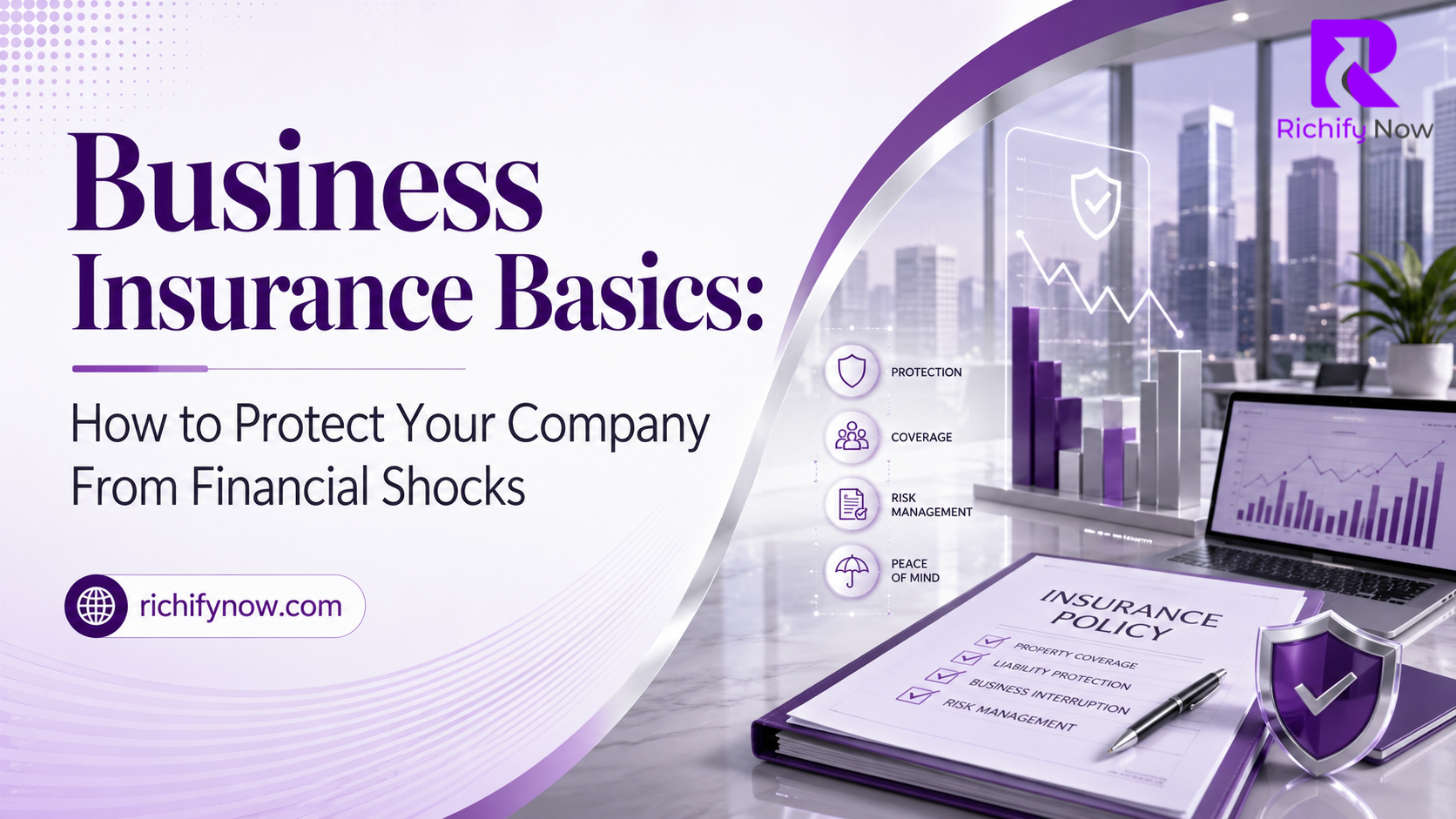
Business Insurance Basics: How to Protect Your Company From Financial Shocks
A beginner-friendly guide to understanding liability coverage, capital preservation, and the insurance policies that help protect your business from unexpected disruption.
🛡 Phase
Foundational Shielding
⏱ Reading Time
10–12 Minutes
AEO Answer Card
Business insurance can help transfer financial risk from lawsuits, property loss, errors, cyber incidents, workers, or interruptions. The right coverage depends on business type, location, contracts, and risk profile.
🏗 Introduction: Insurance Is More Than a Compliance Requirement
Ask most new business owners why they purchase insurance and the answer is usually straightforward.
Because someone told them they need it.
Perhaps a landlord required proof of coverage. Maybe a client demanded a certificate of insurance before signing a contract. In some industries, regulations make certain policies mandatory.
As a result, many entrepreneurs view insurance as little more than a checkbox.
Something to buy. Something to file away. Something to forget until renewal season arrives.
While this approach is common, it often misses the larger purpose of commercial insurance.
Insurance is not merely a compliance tool.
It is a capital preservation strategy.
A single lawsuit, accident, property loss, or operational disruption can erase years of hard work if adequate protections are not in place.
This is why sophisticated organizations approach insurance differently.
Rather than asking, "What policy do we need?" they ask, "What assets are we trying to protect?"
That shift in perspective changes everything.
🛡 Understanding the Difference Between Liability and Capital Preservation
Before discussing specific policies, it helps to understand two concepts that are often confused.
General Liability
General liability focuses on protecting a business from claims involving bodily injury, property damage, and certain legal disputes.
Its purpose is defensive.
It helps absorb financial consequences when incidents occur.
Capital Preservation
Capital preservation focuses on protecting the financial resources that allow a business to operate and grow.
Its purpose is strategic.
Rather than focusing solely on compliance, capital preservation asks how risks can be prevented from destroying organizational stability.
Compliance asks whether insurance exists. Capital preservation asks whether insurance is sufficient to protect the business when something goes wrong.
This distinction forms the foundation of a strong insurance strategy.
🏢 Why Every Business Faces Risk
Many entrepreneurs underestimate risk because nothing significant has happened yet.
Operations seem stable. Customers are satisfied. Revenue is increasing. The future appears predictable.
Unfortunately, risk does not require permission.
Unexpected events occur regardless of preparation.
- Customers can file lawsuits.
- Visitors can suffer injuries.
- Property can be damaged.
- Equipment can fail.
- Employees can make mistakes.
- Cyber incidents can occur.
- Natural disasters can disrupt operations.
The probability of each event may be relatively low.
However, the financial impact can be substantial.
Insurance exists because even unlikely events deserve planning.
📋 The Most Common Insurance Mistake
One of the most common mistakes among small businesses is purchasing insurance solely because it is required.
A contractor secures coverage because a project requires it.
A retailer purchases a policy because a lease agreement demands it.
A consultant obtains insurance because a client requests proof of coverage.
In each case, the decision is reactive.
The policy exists because someone else required it.
The business never evaluates whether coverage actually aligns with operational risk.
The cheapest policy is not always the safest policy. Inadequate coverage can create a false sense of security.
A certificate of insurance may satisfy a contract requirement while still leaving significant vulnerabilities exposed.
📌 What General Liability Insurance Actually Covers
General liability insurance serves as the foundation of many commercial insurance programs.
Although policy details vary, general liability coverage often addresses situations involving:
- Third-party bodily injury claims.
- Property damage claims.
- Legal defense expenses.
- Certain advertising-related disputes.
- Customer accidents occurring on business premises.
Imagine a customer visiting an office.
They slip, fall, and sustain an injury.
Medical expenses emerge. A legal claim follows. Costs begin accumulating.
General liability insurance may help address these expenses depending on policy terms and circumstances.
This protection can be invaluable because legal costs often escalate quickly regardless of fault.
💰 Why Liability Protection Alone Is Not Enough
General liability coverage is important.
However, it does not protect every aspect of a business.
Many entrepreneurs mistakenly assume a single policy protects them from every operational threat.
In reality, risks often extend beyond liability claims.
- Property losses.
- Equipment damage.
- Business interruption.
- Cyber incidents.
- Professional mistakes.
- Employee-related exposures.
This is where capital preservation becomes important.
The goal is not simply preventing lawsuits.
The goal is preserving the organization's ability to continue operating after unexpected events occur.
🏠 Property Insurance: Protecting Physical Assets
For many businesses, physical assets represent a significant portion of organizational value.
Computers, servers, office furniture, equipment, inventory, production tools, and specialized machinery often require years of investment to acquire.
A fire, flood, theft incident, or unexpected disaster can damage these assets within hours.
Property insurance exists to help businesses recover from these losses.
Without property coverage, replacing damaged assets may require substantial capital that could otherwise be invested in growth initiatives.
The objective is not simply replacing assets. The objective is preventing asset replacement costs from destabilizing the business.
Property coverage becomes increasingly important as organizations accumulate infrastructure, technology, and inventory.
👨💼 Professional Liability Insurance: Protecting Expertise
Many modern businesses sell knowledge rather than products.
Consultants, designers, agencies, accountants, developers, marketers, architects, and advisors generate value through expertise.
When expertise becomes the product, different risks emerge.
Clients may claim:
- Professional negligence.
- Missed deadlines.
- Financial losses.
- Errors in deliverables.
- Incomplete work.
Even if a business ultimately prevails, legal defense costs can become significant.
Professional liability insurance helps address risks associated with professional services and advice.
For service-based organizations, this coverage often becomes one of the most important components of a baseline insurance strategy.
💻 Cyber Insurance: A Modern Necessity
A decade ago, cyber insurance was often viewed as optional.
Today, digital risk affects businesses of every size.
Customer records, payment information, operational data, intellectual property, and internal communications are increasingly stored digitally.
This creates opportunities but also vulnerabilities.
- Data breaches.
- Ransomware attacks.
- Unauthorized access.
- Operational disruptions.
- Privacy-related claims.
The financial consequences of cyber incidents often extend beyond technical recovery.
Notification requirements, legal obligations, reputational concerns, and customer trust issues can create additional challenges.
Cyber insurance helps organizations manage these modern exposures and is becoming a fundamental component of institutional risk management.
⏳ Business Interruption Coverage: Protecting Revenue Streams
Many entrepreneurs focus on protecting assets but overlook another critical resource.
Revenue.
A business can survive equipment damage if operations continue.
A business can survive property loss if customers remain active.
The greater threat often emerges when operations stop completely.
Business interruption coverage is designed to address this challenge.
When qualifying events disrupt normal operations, this coverage may help replace lost income and support ongoing obligations.
This distinction is important because organizations frequently underestimate how quickly cash flow problems can develop during unexpected interruptions.
Many businesses fail not because assets were damaged but because revenue stopped while expenses continued.
📊 Building a Baseline Insurance Protocol
A baseline insurance protocol is not about purchasing every available policy.
Instead, it involves identifying the most significant threats facing the organization and creating reasonable protections against them.
For beginners, this process often includes evaluating four key areas:
- Liability exposure.
- Property exposure.
- Operational exposure.
- Digital exposure.
By analyzing these categories, businesses can prioritize coverage according to actual risk rather than assumptions.
The result is a more strategic approach to insurance planning.
🧱 Insurance Layering: Thinking Like an Institution
Large organizations rarely rely on a single policy.
Instead, they create layered protection systems.
Each layer addresses a different category of risk.
Think of insurance as architectural engineering.
Buildings rely on multiple systems simultaneously:
- Foundations.
- Structural supports.
- Fire suppression systems.
- Security controls.
- Emergency procedures.
Insurance functions similarly.
General liability protects one category of risk. Property insurance addresses another. Cyber coverage addresses a different threat. Business interruption coverage protects revenue continuity.
Together, these layers create a more resilient organizational structure.
Risk management is strongest when multiple protections work together rather than relying on a single solution.
🚫 Common Insurance Mistakes Beginners Make
Many businesses unintentionally weaken their protection through avoidable mistakes.
1. Buying Coverage Solely for Compliance
Meeting contractual requirements is important, but compliance should not be the only objective.
2. Choosing Policies Based Only on Price
Low-cost coverage may create significant protection gaps.
3. Ignoring Emerging Risks
Cyber threats, digital assets, and remote operations create exposures that many older insurance plans never considered.
4. Failing to Review Coverage Regularly
Business growth changes risk profiles. Insurance should evolve alongside operations.
5. Assuming One Policy Covers Everything
No single policy addresses every potential threat.
📈 Insurance as a Growth Tool
Insurance is often viewed as a defensive expense.
However, sophisticated organizations recognize another benefit.
Insurance creates confidence.
Confidence enables expansion.
When leaders understand that critical risks are managed appropriately, they can focus more effectively on growth initiatives, partnerships, hiring, and investment opportunities.
In this sense, insurance supports growth indirectly by reducing uncertainty.
The goal is not fear.
The goal is preparedness.
❓ Frequently Asked Questions
Do all businesses need general liability insurance?
Most businesses benefit from liability protection because accidents, claims, and legal disputes can occur in nearly every industry.
Is insurance only important for large companies?
No. Smaller businesses often have fewer financial resources available to absorb unexpected losses, making protection especially important.
What is the most important insurance policy?
There is no universal answer. The most important coverage depends on the organization's specific risks and operations.
How often should coverage be reviewed?
Annual reviews are common, though significant business changes may justify more frequent evaluations.
Can insurance eliminate all risk?
No. Insurance transfers certain financial risks but cannot eliminate uncertainty entirely.
🏁 Conclusion: Protecting the Entity Before Protecting Growth
Every business begins with ambition.
Entrepreneurs focus on customers, products, revenue, marketing, and expansion.
These priorities are understandable.
Growth creates opportunity.
However, sustainable growth requires protection.
The purpose of commercial insurance is not merely satisfying regulations or obtaining certificates for clients.
Its deeper purpose is preserving the entity itself.
When unexpected events occur, insurance helps prevent operational setbacks from becoming existential threats.
General liability coverage forms an important starting point.
But true capital preservation requires broader thinking.
Property protection, professional liability, cyber coverage, and business interruption planning all contribute to a stronger risk-management foundation.
Organizations that understand this distinction often approach insurance differently.
They stop asking what is required.
They start asking what is worth protecting.
🏛 Richify Insight
Insurance should never be viewed solely as a regulatory requirement. The strongest organizations treat insurance as a strategic tool designed to preserve capital, protect operational continuity, and strengthen long-term resilience.
🚀 Final Thought
Foundational shielding begins with legal structure, but it becomes stronger when supported by thoughtful insurance planning. Protecting the baseline entity today creates the stability needed to pursue tomorrow's opportunities with confidence.
Insurance Review Checklist
Download the editable RichifyNow workbook with instructions, working fields, disclaimer, and the complete source-document specification.

Loading comments…