
The Immutable Fortress: Constructing a Monolithic Institutional Risk Protocol
The final master level synthesis of entity selection operational privacy asset trusts and sovereign banking into one lawful governance system built to preserve authority capital continuity and institutional control

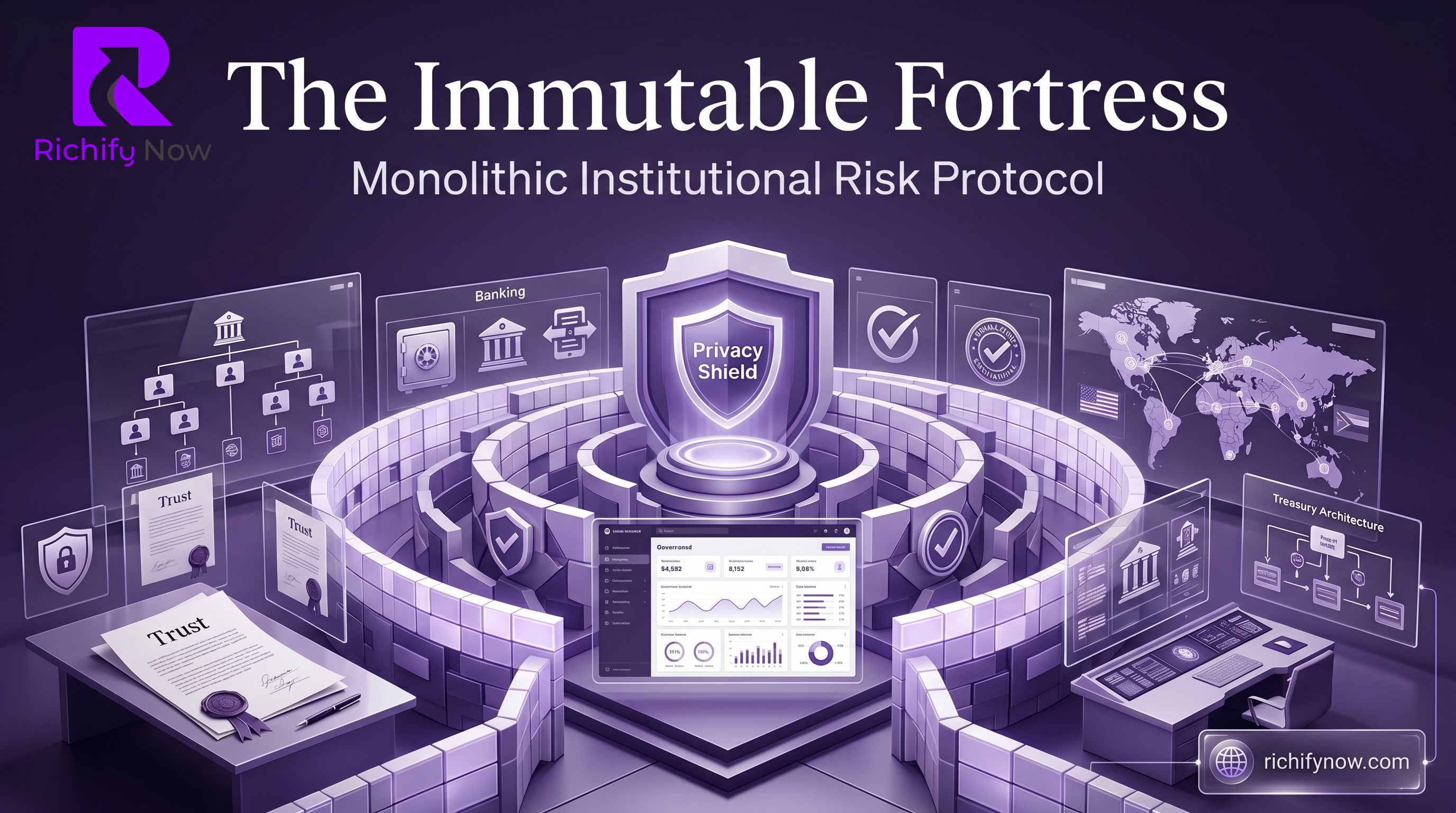
The Immutable Fortress: Constructing a Monolithic Institutional Risk Protocol
Expert institutional risk framework integrating entity selection, operational privacy, asset trusts, sovereign banking, and governance command into one lawful, defensible system
An institutional risk protocol is a structured system for identifying, reducing, documenting, and monitoring threats to capital, operations, privacy, governance, and continuity. It should be designed around lawful structures, transparency, and professional guidance.
🏰 Introduction: The Fortress Is Not One Wall
The strongest institutional risk system is never built from one document one entity one bank account one trust or one advisor It is built from alignment Each layer supports the next layer until the entire asset ecosystem becomes harder to fracture harder to confuse and harder to destabilize
In complex wealth structures the greatest danger is not always a lawsuit market crash tax event banking restriction family dispute or political shock The deeper danger is fragmentation Fragmentation occurs when entities are selected without purpose trusts are drafted without operational coordination privacy is treated as secrecy banking is concentrated in one jurisdiction and governance authority is scattered across people who do not share one command system
The immutable fortress is the answer to this fragmentation It is not a promise that risk disappears Risk never disappears It is a protocol that makes risk visible organized contained and governed
A monolithic institutional risk protocol is designed to answer one master question How can an asset ecosystem preserve control continuity liquidity privacy and lawful authority when pressure comes from many directions at once
🧩 Why Monolithic Governance Requires Integration
Many institutions fail because they build protection in isolated parts They may create a holding company yet leave assets exposed through personal guarantees They may create a trust yet fail to coordinate entity ownership They may open foreign accounts yet ignore reporting duties They may speak about privacy yet maintain messy documents and inconsistent records
True governance requires integration Entity selection must match asset risk Trust design must match succession goals banking structure must match liquidity needs operational privacy must match lawful disclosure duties tax planning must match commercial substance and family governance must match long-term control
The point is not to create complexity for its own sake Complexity without purpose becomes expensive confusion The point is to create a structure where every layer has a job and every job supports institutional continuity
“The master risk protocol does not ask how to hide wealth It asks how to govern wealth so clearly that pressure cannot easily break it”
🏛️ Layer One: Entity Selection as the Structural Foundation
Entity selection is the first architectural decision It determines how assets are owned how liabilities are contained how decisions are made how income flows and how control can continue beyond one individual
A weak structure often uses entities as labels A strong structure uses entities as risk chambers Each entity should exist for a reason such as holding real estate operating a business managing intellectual property isolating investment exposure controlling family ownership or separating high risk activity from low risk assets
The choice between a company partnership foundation trust related vehicle or holding entity should not be made only for convenience It should be made after reviewing liability exposure tax treatment governance rights reporting duties financing needs and succession objectives
Core Entity Design Questions
- Which assets require liability separation
- Which activities create operational risk
- Which assets should never be directly exposed to business creditors
- Which entity will control voting power
- Which entity will receive income
- Which documents define transfer restrictions and decision authority
- Which structure remains workable during death incapacity dispute or litigation
🔐 Layer Two: Operational Privacy Without Illegality
Operational privacy is often misunderstood It is not secrecy It is disciplined information control A serious institution does not hide from lawful obligations It reduces unnecessary exposure while remaining compliant with reporting tax banking and regulatory requirements
Privacy becomes important because information can become a weapon Public asset visibility may attract opportunistic claims targeted litigation predatory negotiations fraud attempts social pressure and family interference Excessive disclosure can weaken bargaining power and expose sensitive relationships
However privacy that ignores compliance becomes risk The immutable fortress therefore separates lawful confidentiality from unlawful concealment The structure should maintain accurate records beneficial ownership disclosures tax filings banking transparency and internal documentation while limiting casual public exposure
Operational Privacy Controls
- Use clean internal records for all entities and trusts
- Limit public facing information to what is necessary
- Separate personal identity from operational vendor relationships where lawful
- Use professional addresses and administrative systems where appropriate
- Control who can access financial documents
- Maintain secure communication channels with advisors
- Follow all beneficial ownership tax and banking disclosure duties
The goal is not to disappear The goal is to reduce unnecessary vulnerability while keeping the structure defensible under legal review
🛡️ Layer Three: Asset Trusts and Capital Continuity
Asset trusts can become powerful governance tools when designed with purpose They may support succession privacy asset protection beneficiary control charitable objectives or long-term stewardship But a trust is not magic It must be funded administered documented and aligned with the rest of the structure
A poorly used trust can create more confusion than protection If assets are never transferred properly the trust may not control them If trustee powers are unclear beneficiaries may challenge decisions If distribution standards are vague conflict may grow If the trust conflicts with entity agreements the structure may become unstable
In the immutable fortress trusts act as continuity engines They separate beneficial enjoyment from direct control They appoint fiduciaries to manage transition They reduce probate dependence They help preserve core assets from fragmentation and they allow governance rules to survive beyond the founder
💜 Stewardship
Trusts can guide how wealth is used across generations
🧾 Documentation
Trust records create evidence of intent authority and administration
🛡️ Containment
Trusts can reduce direct exposure when lawfully structured
👑 Continuity
Trustee authority can preserve control during transition events
🌍 Layer Four: Sovereign Banking and Jurisdictional Resilience
Sovereign banking does not mean avoiding law It means reducing concentration risk by ensuring that institutional liquidity is not entirely dependent on one bank one currency one jurisdiction or one political environment
A serious asset ecosystem must consider what happens if a bank freezes activity a currency weakens a local market becomes unstable a payment corridor slows or credit conditions tighten Liquidity is not useful only because it exists It is useful because it can be accessed when needed
Sovereign banking resilience may include diversified banking relationships multi currency planning qualified custodians regulated financial institutions documented source of funds and clear treasury controls Every account should serve a lawful purpose and every cross border structure should satisfy reporting requirements
Banking Resilience Questions
- Are core reserves concentrated in one institution
- Can emergency liquidity be accessed during local disruption
- Are accounts aligned with entity purpose and tax reporting
- Are signatories documented and succession ready
- Are treasury controls strong enough to prevent misuse
- Are funds held with reputable compliant institutions
- Is there a lawful plan for currency and jurisdiction diversification
📊 The Monolithic Risk Protocol Map
| Protocol Layer | Purpose | Risk Reduced |
|---|---|---|
| Entity Selection | Separates ownership activity and liability | Contagion creditor exposure and operational confusion |
| Operational Privacy | Controls unnecessary information exposure | Predatory claims public pressure and negotiation weakness |
| Asset Trusts | Preserves continuity and beneficiary governance | Probate delays succession conflict and asset fragmentation |
| Sovereign Banking | Diversifies liquidity access and treasury channels | Bank concentration currency pressure and local disruption |
| Governance Command | Centralizes decision authority and reporting | Leadership paralysis inconsistent decisions and advisor conflict |
🧠 Layer Five: Governance Command and Decision Authority
The final layer is command Without command the structure becomes a collection of expensive parts With command the structure becomes an institution
Governance command defines who can act what they can approve when they must report and how decisions are reviewed It also defines emergency powers succession authority advisor roles investment limits liquidity rules and dispute procedures
A founder controlled structure may work while the founder is active But the immutable fortress must remain functional when the founder is unavailable deceased incapacitated challenged or intentionally retired from daily control This requires written authority not informal memory
Governance Command Elements
- Board or council authority
- Trustee and protector powers
- Investment committee rules
- Emergency liquidity approval process
- Entity manager succession plan
- Advisor accountability framework
- Beneficiary communication policy
- Document review calendar
Command should not be authoritarian without accountability It should be clear disciplined reviewable and legally grounded
⚖️ Compliance as the Load Bearing Wall
Any institutional risk protocol that ignores compliance is not a fortress It is a liability Modern asset structures face tax rules banking due diligence beneficial ownership registers anti money laundering laws sanctions screening exchange controls and fiduciary duties
A strong protocol does not try to outrun these obligations It builds them into the architecture Entity records are maintained tax filings are coordinated beneficial ownership is disclosed where required banking documents are accurate source of funds is documented advisor decisions are recorded and trustees act within their powers
“The safest fortress is not the one hidden from law It is the one strong enough to withstand lawful inspection”
Compliance strengthens privacy because it makes the structure defensible It strengthens banking because institutions trust organized records It strengthens succession because fiduciaries can act confidently and it strengthens asset protection because courts are less likely to respect structures that look artificial abusive or deceptive
🔁 Stress Testing the Fortress
A protocol is only useful if it works under pressure Stress testing allows leadership to identify weak points before a real crisis exposes them
The institution should test legal financial operational family and banking scenarios What happens if a lawsuit appears What happens if a bank requests enhanced due diligence What happens if a key founder dies What happens if a beneficiary disputes control What happens if a local currency weakens What happens if an operating company fails What happens if advisors disagree
These questions convert theory into preparation The result should be a living risk manual with responsibilities timelines document locations emergency contacts and decision triggers
Stress Test Areas
- Litigation pressure and creditor claims
- Liquidity freeze and treasury access
- Trust administration conflict
- Entity manager incapacity
- Family dispute escalation
- Tax audit readiness
- Banking due diligence review
- Document loss or cyber breach
🏦 Treasury Architecture and Capital Movement
The movement of capital must be as disciplined as the ownership of capital Many institutions create legal structures but fail to design treasury rules Money moves informally between entities loans are undocumented expenses are paid from the wrong accounts personal and business funds are mixed and advisors later struggle to defend the purpose of transactions
The immutable fortress requires treasury architecture Every account should have a purpose Every transfer should have documentation Every intercompany loan should have terms Every distribution should follow authority Every reserve should have a policy and every emergency payment should be approved through a defined process
Treasury discipline supports tax clarity creditor defense trustee confidence banking trust and internal accountability It also reduces the chance that one careless transaction weakens years of planning
👨👩👧 Beneficiary Governance and Human Risk
Institutional risk is not only about laws banks and entities It is also about people Beneficiaries can become risk sources when they do not understand the purpose of the structure or when expectations are shaped by entitlement emotion or outside influence
A monolithic protocol should include beneficiary governance This may involve education distribution standards family councils communication rules confidentiality expectations and conflict resolution channels
The goal is not to silence beneficiaries The goal is to prevent confusion from becoming conflict Beneficiaries should understand that wealth preservation requires stewardship patience accountability and respect for the governance system
🧾 Documentation as Defensive Memory
Documents are the memory of the institution When founders advisors trustees or managers change the records explain why decisions were made and how authority should operate
Poor documentation creates openings for disputes Strong documentation creates continuity The fortress should maintain trust documents entity agreements meeting minutes resolutions banking files tax records insurance policies valuation reports loan agreements transfer records and advisor correspondence
Documentation should be organized secured backed up and accessible to authorized decision makers A crisis is not the time to search for documents The protocol should already know where they are who controls them and when they must be updated
✅ Master Checklist for the Immutable Fortress
- Map every asset liability entity trust account and advisor relationship
- Separate operating risk from passive wealth holdings
- Review every entity for purpose governance and compliance
- Coordinate trust ownership with entity agreements
- Maintain lawful privacy without hiding required information
- Diversify banking relationships where commercially justified
- Document source of funds and capital movement
- Create treasury rules for transfers reserves and distributions
- Define trustee protector manager and board authority
- Prepare succession plans for key decision makers
- Use beneficiary education and family governance documents
- Stress test litigation liquidity tax banking and family scenarios
- Review documents after law changes asset sales death divorce relocation or new business activity
- Maintain a central risk manual with updated responsibilities and contacts
Master Business Risk Register
Download the editable RichifyNow workbook with instructions, working fields, disclaimer, and the complete source-document specification.

Loading comments…