
What Interest Rate Changes Really Mean for Entrepreneurs and Investors
Interest rate changes affect far more than bank loans. They influence business expansion, customer demand, startup funding, stock valuations, bond prices, real estate affordability, and investor risk appetite. This guide explains what rate hikes and cuts really mean for entrepreneurs and investors

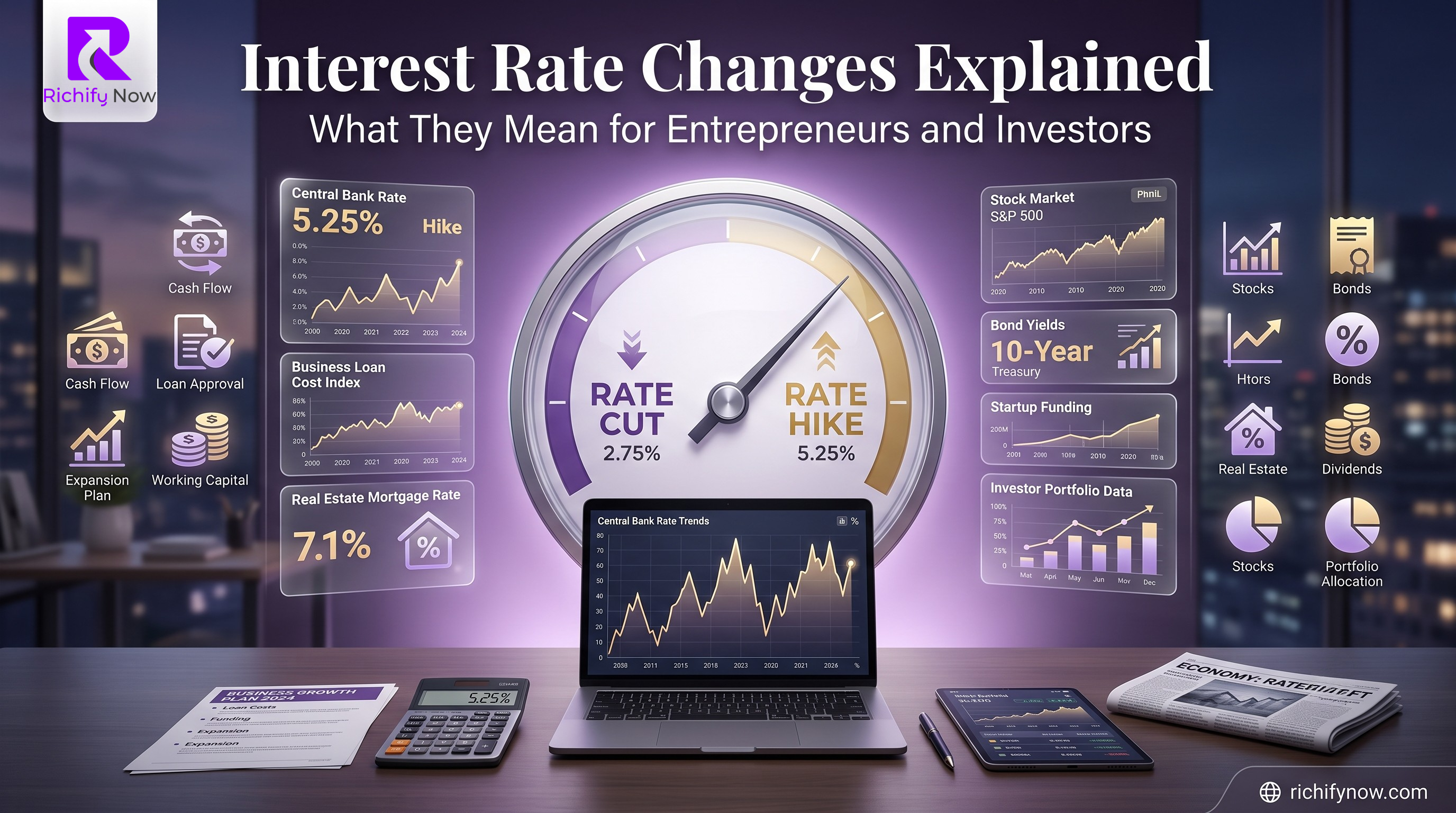
Economic Analysis 💜 RichifyNow
Interest Rate Changes Explained: What They Really Mean for Entrepreneurs and Investors
A practical guide to understanding how rate hikes and rate cuts affect borrowing costs, business expansion, startup funding, real estate, stock valuations, cash flow, and investment strategy 📊
AEO Answer Card
Interest rates affect everything from business loans and startup valuations to stock prices bonds real estate and consumer spending Entrepreneurs should protect cash flow while investors should review debt duration and liquidity
Introduction 🧠
Interest rates are not just numbers announced by central banks
They are signals that move through the entire economy
They affect how expensive it is to borrow, how attractive it is to save, how investors value future profits, how customers spend, how businesses price risk, and how entrepreneurs decide whether to expand or wait
For entrepreneurs, interest rate changes can decide whether a new branch, warehouse, marketing campaign, machine, vehicle, software system, or inventory purchase feels affordable or dangerous
For investors, interest rate changes can reshape stock valuations, bond prices, real estate demand, startup valuations, dividend expectations, currency movements, and portfolio risk
This matters even more in 2026 because policy rates remain a central issue across major economies
The Federal Reserve’s target range was reported at 3.50% to 3.75% in early July 2026, the Bank of England listed Bank Rate at 3.75% in June 2026, and the European Central Bank listed its deposit facility rate at 2.25% with effect from 17 June 2026
The lesson is simple
Entrepreneurs and investors do not need to predict every central bank decision
They need to understand what rate changes do to cash flow, valuation, debt, consumer demand, and opportunity cost
Important Economic Note ⚠️
This blog is for educational and economic analysis purposes only
Interest rates, inflation, business lending, mortgage rates, and asset prices change frequently
Entrepreneurs should verify current borrowing terms with lenders and investors should review their personal risk tolerance, time horizon, liquidity needs, tax position, and financial goals before making decisions
What Interest Rates Really Are 💸
An interest rate is the price of money over time
When you borrow, the interest rate is the cost you pay for using someone else’s capital
When you save or lend, the interest rate is the return you receive for delaying consumption and taking credit risk
Central banks influence short-term interest rates to manage inflation, employment, financial stability, and overall economic demand
The Federal Reserve explains that open market operations and the federal funds rate are central tools in monetary policy implementation, while the Bank of England explains that Bank Rate affects lending and savings rates across the economy
When rates rise, borrowing generally becomes more expensive and saving becomes more attractive
When rates fall, borrowing generally becomes cheaper and saving becomes less rewarding
The Bank of England explains that higher rates tend to discourage consumer and business spending, while lower rates can encourage spending by reducing loan payments and making borrowing cheaper
Graph 1: Current Policy Rate Snapshot 🌍
The chart below compares selected major policy rates as of mid-2026
These rates are not identical instruments, so the purpose is not to say one economy is stronger than another
The purpose is to show that entrepreneurs and investors are operating in a world where the cost of money remains meaningful across major markets
Selected Policy Rates In 2026
Bank of England Bank Rate 3.75%
Federal Reserve target midpoint 3.625%
China one-year LPR 3.00%
ECB deposit facility rate 2.25%
Chart note: Fed figure uses the midpoint of the reported 3.50% to 3.75% target range, while China’s one-year LPR was reported at 3.00% in June 2026
Why Entrepreneurs Should Care First 🏢
Entrepreneurs feel rate changes through cash flow before they feel them through economic theory
A higher interest rate can raise monthly payments on working capital loans, equipment financing, commercial mortgages, credit cards, inventory lines, and floating-rate debt
A lower interest rate can reduce financing pressure and make expansion easier, but it can also attract more competitors because capital becomes easier to access
Rate changes also affect customers
When households pay more on mortgages, auto loans, credit cards, and personal debt, they may reduce spending on restaurants, retail, subscriptions, travel, renovation, entertainment, and nonessential services
When financing becomes cheaper, customers may feel more comfortable spending, borrowing, upgrading, and investing in bigger purchases
This is why interest rates are not only a finance issue
They are a demand issue, pricing issue, margin issue, hiring issue, and timing issue
How Rate Hikes Affect Entrepreneurs 📈
A rate hike means the cost of capital usually rises
For entrepreneurs, this creates pressure in five areas
Small business credit conditions are especially sensitive because entrepreneurs often rely on bank loans, credit cards, private lenders, or short-term working capital
Reuters reported from the Federal Reserve’s Senior Loan Officer Opinion Survey that business loan demand improved in late 2025, but demand from small firms was flat and banks expected higher delinquencies and charge-offs for small-business loans in 2026
Separately, business line of credit APRs were reported to have ranged around 6.5% to 7.5% in the fourth quarter of 2025 based on Kansas City Fed data cited by WSJ Buy Side, showing why credit quality and lender selection matter for borrowers
Graph 2: How A Rate Increase Hits Business Debt 💳
This simple example shows the annual interest cost on $100,000 of business debt at different rates
It is an illustration, not a loan offer
Annual Interest Cost On $100,000 Debt
5% interest rate $5,000 per year
7% interest rate $7,000 per year
9% interest rate $9,000 per year
12% interest rate $12,000 per year
Chart note: author calculation using simple annual interest, excluding fees, compounding, amortization, penalties, and taxes
How Rate Cuts Affect Entrepreneurs 📉
A rate cut usually reduces the cost of borrowing over time, especially for variable-rate credit and new debt
This can help entrepreneurs finance equipment, real estate, marketing, technology, staff, inventory, and expansion
But rate cuts are not automatically good news
Sometimes central banks cut rates because the economy is weakening
In that case, cheaper debt may arrive at the same time as weaker demand, tighter lender standards, and cautious customers
The smart entrepreneur reads rate cuts through two questions
First, are borrowing costs falling because inflation is under control and growth is stable
Second, or are borrowing costs falling because demand is slowing and policymakers are trying to protect the economy
The difference matters because one environment may reward expansion while the other rewards liquidity and caution
What Interest Rates Mean For Startup Funding 🚀
Startups are highly sensitive to interest rates because startup valuations depend heavily on future growth
When rates are low, investors may be more willing to pay high prices for profits expected far in the future
When rates rise, future profits are discounted more heavily and investors often demand a clearer path to profitability
This is why high-rate environments can punish startups that burn cash without showing strong margins, retention, pricing power, or operating discipline
For founders, the practical message is clear
Do not build a company that only survives when capital is cheap
Build a company with a stronger gross margin, lower customer acquisition waste, faster payback period, disciplined hiring, and enough cash runway to survive funding delays
Why Investors Care About Discount Rates 📊
Investors value assets by comparing today’s price with expected future cash flows
When interest rates rise, the discount rate used to value future cash flows usually rises too
That makes distant profits less valuable today
This is one reason long-duration growth stocks, speculative tech companies, unprofitable startups, and high-multiple assets can struggle when rates move higher
When rates fall, the opposite can happen because future profits become more valuable in present-value terms
Graph 3: Why Higher Rates Reduce Present Value 🧮
This chart shows the present value of $100,000 received five years from now at different discount rates
The higher the discount rate, the lower the value today
Present Value Of $100,000 In Five Years
4% discount rate $82,193 today
8% discount rate $68,058 today
12% discount rate $56,742 today
Chart note: author calculation using present value formula PV = FV ÷ 1 + r raised to n, rounded to nearest dollar
Interest Rates And The Stock Market 📈
Interest rates influence stocks through earnings, discount rates, investor psychology, and competition from safer assets
When rates rise, companies with debt may pay more interest, which can reduce profits
Investors may also demand higher expected returns from stocks because cash, money-market funds, bonds, and savings products become more attractive
When rates fall, borrowing can become cheaper and risk assets may become more attractive, especially if economic growth remains healthy
But rate cuts do not guarantee a stock market rally
If rates are falling because recession risk is increasing, earnings expectations may decline at the same time
For investors, the real question is not simply whether rates are rising or falling
The real question is why rates are moving
Interest Rates And Bonds 🧾
Bonds have one of the clearest relationships with interest rates
When market interest rates rise, existing bond prices generally fall because older bonds with lower coupons become less attractive
When market interest rates fall, existing bond prices generally rise because their coupons become more attractive
This effect is stronger for longer-duration bonds
For investors, higher rates can create better future income opportunities, but they can also create short-term price losses in existing bond holdings
This is why bond investors should understand duration, credit quality, maturity, reinvestment risk, and whether they plan to hold to maturity or trade before maturity
Interest Rates And Real Estate 🏠
Real estate is deeply rate-sensitive because most buyers use financing
Higher mortgage rates reduce affordability, which can reduce demand and slow transactions
Lower mortgage rates can improve affordability and bring buyers back into the market, but only if home prices, income, employment, and credit conditions also cooperate
In early July 2026, the average US 30-year fixed mortgage rate fell to 6.43% according to Freddie Mac data reported by AP, while the same report noted that existing-home sales remained near a 4-million annual pace compared with a historical average of 5.2 million
For real estate investors, this means rates are not only a borrowing-cost issue
They are also a cap-rate issue, rental-yield issue, affordability issue, and exit-liquidity issue
Interest Rates And Currency Movement 🌐
Interest rates can also affect currencies
When one country offers higher rates than another, global capital may become more attracted to that country’s currency, especially if investors believe the economy and institutions are stable
A stronger currency can make imports cheaper but exports less competitive
A weaker currency can support exporters but increase the cost of imported goods, fuel, technology, raw materials, and foreign debt
This matters for entrepreneurs who import inventory, buy software in foreign currency, pay overseas suppliers, export products, or borrow in a foreign currency
It also matters for investors who own international stocks, foreign bonds, commodities, or dollar-denominated assets
The Entrepreneur Rate-Change Playbook 🧭
Entrepreneurs should not react emotionally to every central bank announcement
They should build a decision system
Use The D E B T Framework
D — Debt map: Separate fixed-rate debt, variable-rate debt, short-term debt, credit cards, supplier credit, leases, and balloon payments
E — Expense pressure: Estimate how much each rate change adds to monthly cash outflow
B — Business demand: Watch whether customers are delaying purchases, trading down, or requiring payment plans
T — Timing discipline: Approve expansion only when expected return is stronger than the new cost of capital
This framework helps entrepreneurs avoid two common mistakes
The first mistake is expanding aggressively just because rates fell
The second mistake is freezing completely just because rates rose
The better approach is to match debt decisions with real cash flow, customer demand, and margin strength
The Investor Rate-Change Playbook 💼
Investors also need a rate-change system
In a higher-rate environment, cash and bonds may become more competitive, heavily indebted companies may face pressure, and long-duration growth assets may become more sensitive to valuation compression
In a lower-rate environment, risk assets may benefit, but investors should still check whether lower rates are coming from healthy disinflation or from economic weakness
RichifyNow Investor Checklist 💜
- Check how much of your portfolio depends on cheap money
- Review bond duration before assuming bonds are safe
- Study company debt levels and interest coverage
- Compare dividend yield with risk-free alternatives
- Be careful with highly valued growth stocks when discount rates rise
- Review real estate leverage and refinancing risk
- Keep enough liquidity so forced selling does not control your decisions
Rate Hikes Vs Rate Cuts: What They Usually Signal 🔄
Common Mistakes Entrepreneurs Make 🚫
The first mistake is borrowing based only on today’s payment
If the loan is variable-rate, the payment can change
The second mistake is assuming rate cuts will immediately reduce every loan cost
Lenders price credit using risk, collateral, borrower history, loan term, and market conditions, not central bank rates alone
The third mistake is funding long-term assets with short-term debt
This creates refinancing risk if credit conditions tighten
The fourth mistake is ignoring customer financing conditions
If customers rely on credit, higher rates can reduce conversion even when the product is strong
The fifth mistake is treating growth as automatically good
Growth funded by expensive debt can damage a business if margins are thin and payback periods are long
Common Mistakes Investors Make 🚫
The first mistake is thinking rate cuts always mean buy everything
The second mistake is thinking rate hikes always mean sell everything
Markets price expectations before official decisions, so the surprise matters more than the headline
The third mistake is ignoring debt on company balance sheets
A company with strong revenue but weak interest coverage can become risky when refinancing costs rise
The fourth mistake is chasing yield without checking credit risk
Higher income is not free if the borrower is weak
The fifth mistake is buying real estate only because prices look lower
If financing costs remain high, the total monthly cost may still be unattractive
Internal Reading Path For RichifyNow Readers 🔗
FAQs ❓
What do higher interest rates mean for entrepreneurs?
Higher rates usually mean more expensive borrowing, tighter cash flow, weaker discretionary demand, and a higher required return before expansion makes sense
Are rate cuts always good for businesses?
Not always, because rate cuts can happen when the economy is slowing, so entrepreneurs should check whether customer demand and lender confidence are improving at the same time
Why do interest rates affect stock valuations?
Interest rates affect the discount rate investors use to value future profits, so higher rates can reduce the present value of distant cash flows
Which businesses are most affected by rate hikes?
Businesses with high debt, thin margins, heavy inventory needs, real estate exposure, customer financing dependency, or long payback periods are usually more sensitive
How should investors prepare for changing rates?
Investors should review bond duration, company debt, cash allocation, real estate leverage, valuation assumptions, liquidity needs, and portfolio concentration
Final Verdict 💜
Interest rate changes are not abstract economic events
They affect the real decisions entrepreneurs and investors make every day
For entrepreneurs, rates influence expansion, cash flow, pricing, inventory, credit access, hiring, and customer demand
For investors, rates influence valuations, bonds, stocks, real estate, currencies, dividends, startup funding, and risk appetite
A rate hike is not automatically bad and a rate cut is not automatically good
The meaning depends on why the rate is changing, how much debt you carry, how sensitive your customers are, how strong your balance sheet is, and how patient your capital can be
For RichifyNow readers, the strongest strategy is to stop treating interest rates as headlines and start treating them as operating signals
When money becomes more expensive, protect liquidity and demand higher returns from every decision
When money becomes cheaper, look for opportunity but do not forget discipline
That is how entrepreneurs survive cycles and how investors build wealth through them
References 📚
- Federal Reserve explanation of open market operations and monetary policy implementation
- Reuters reporting on the Federal Reserve target range and July 2026 rate expectations
- European Central Bank official key interest rate table for 2026
- Bank of England official Bank Rate page and explanation of how rates affect borrowing, saving, spending, and inflation
- Reuters reporting on China’s June 2026 loan prime rates
- Reuters reporting on the Federal Reserve Senior Loan Officer Opinion Survey and business loan demand
- WSJ Buy Side reporting on business line of credit APRs based on Kansas City Fed data
- AP reporting on Freddie Mac mortgage rate data and US existing-home sales pace in July 2026
RichifyNow Economic Briefing
Download the editable RichifyNow workbook with instructions, working fields, disclaimer, and the complete source-document specification.
Loading comments…