
The Ultimate Guide to Passive Income in 2026 | RichifyNow
Passive income in 2026 is not about chasing a magical high yield with no effort. This comprehensive guide explains how to combine Treasuries, bonds, dividend stocks, REITs, real estate, digital products, online businesses and carefully limited alternative assets into a more resilient income system.

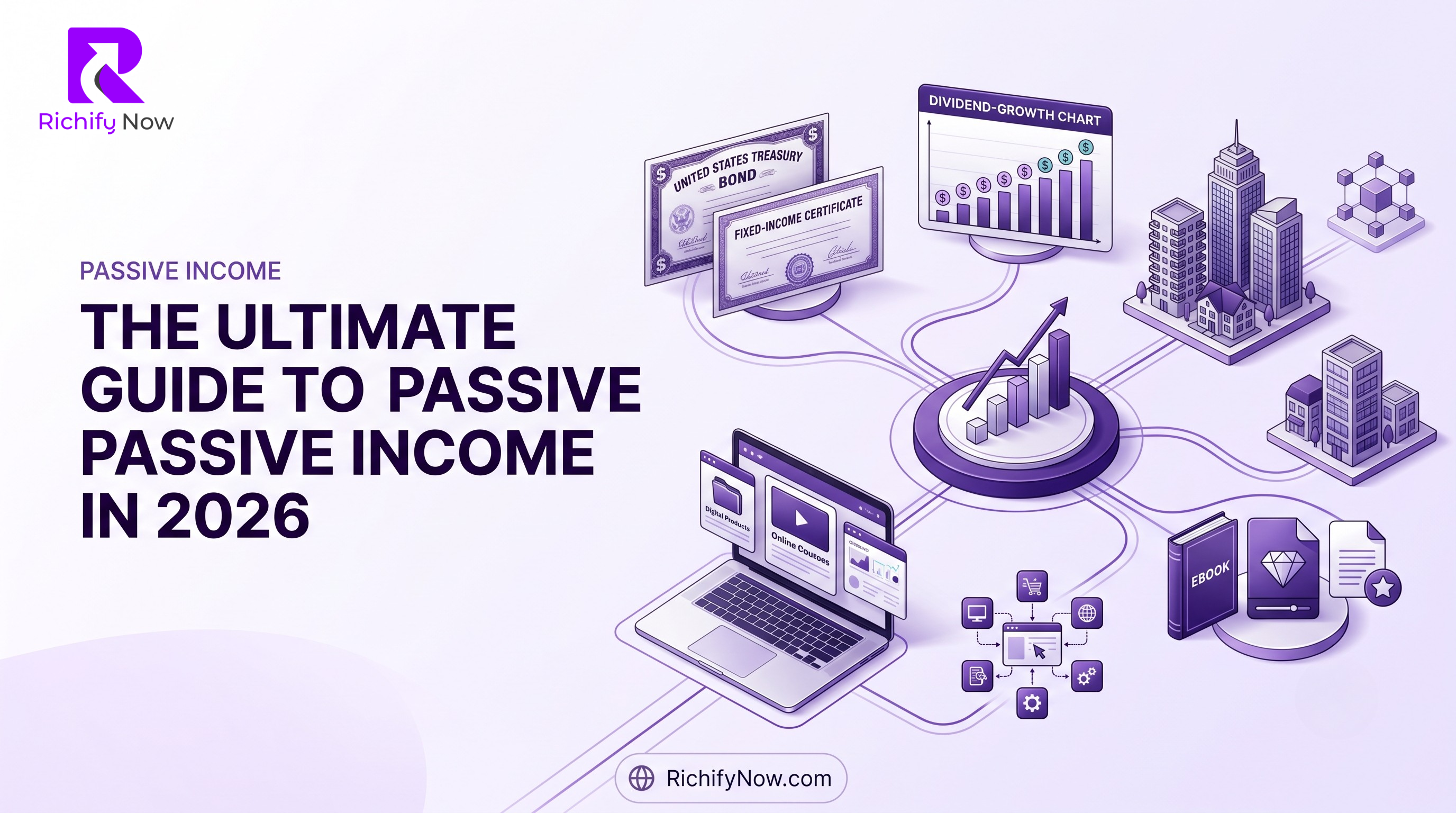
The Ultimate Guide to Passive Income in 2026
A fact-based guide to building diversified passive income in 2026 using Treasuries, bonds, dividend stocks, REITs, real estate, digital assets, royalties and carefully limited alternative income streams.
AEO Answer Card
A resilient passive income system in 2026 requires a layered approach with liquidity first standardized income second and inflation-sensitive or entrepreneurial assets last This reduces risk and provides stability across different economic conditions
1. What Passive Income Really Means 💡
Passive income is income whose ongoing time requirement is low relative to the capital, intellectual property or operating system already put in place. It is not necessarily income with zero effort, zero risk or guaranteed permanence.
Most passive-income streams are powered by one of three engines. The first is financial capital, where money is exchanged for a contractual or ownership claim on future cash flow. Treasury bills, bonds, dividend stocks and REITs belong here. The second is a real or contractual asset, such as rental property, private loans or licensing agreements. The third is intellectual property and business systems, including books, software, templates, courses, affiliate media, subscription products and acquired online businesses.
These engines can all produce recurring income, but they do not behave the same way. A Treasury bill is standardized, liquid and backed by the U.S. government. A rental property is local, leveraged and operational. A digital product may have almost no delivery cost, yet its revenue can disappear if audience demand or platform visibility declines. Calling all three "passive" does not make their risks comparable.
Income yield is not the same as economic return
A central distinction in this guide is the difference between income yield and total economic return. A bond coupon may provide predictable cash, but inflation can erode its purchasing power. A property may distribute less cash today while building equity through mortgage repayment. A dividend stock may yield only 2%, yet earnings growth and price appreciation may create a stronger long-term result than an asset paying 7% with declining value.
The same principle applies to creator assets. A book platform may advertise a 70% royalty option, but that percentage is not a portfolio yield. It is a share of sales. If the product attracts no buyers, a generous royalty schedule produces almost nothing. The quality of demand, durability of distribution and cost of customer acquisition matter more than the headline percentage.
Taxes change the result you actually keep
The U.S. tax system treats interest, qualified dividends, rental income, royalties, capital gains and business profit differently. Treasury interest is generally subject to federal income tax but exempt from state and local income taxes. Qualified dividends and long-term capital gains may receive preferential rates, while bond interest and many royalty payments are commonly taxed as ordinary income. Rental real estate and royalties are generally reported on Schedule E, although active business circumstances can change the treatment.
This means a 5% gross yield can be more valuable than a 6% gross yield after tax, depending on the account, location and income type. Asset location—deciding what belongs in a taxable account versus a retirement or other tax-advantaged account—is therefore part of passive-income design, not an administrative detail to consider later.
2. Why Passive Income Matters in 2026 🌍
Passive-income decisions are shaped by the economic environment. The playbook that worked when short-term interest rates were close to zero is not the same playbook required when safe assets produce meaningful nominal income, inflation remains uncomfortable and borrowing costs are elevated.
The supplied research describes a sharp change from June 2024, when the federal-funds target range was 5.25%–5.50%, to December 2024, when the range had fallen to 4.25%–4.50%. By December 2025 it stood at 3.50%–3.75%, and the Federal Reserve maintained that range in June 2026. This matters because cash and high-quality fixed income once again offer real starting income, reducing the need to force money into opaque products merely to escape a near-zero cash yield.
Inflation complicates the picture. May 2026 CPI inflation was reported at 4.2% year over year, while PCE inflation was 4.1%. Core measures were lower but still relevant. A nominal yield that looks attractive can provide only a modest increase in purchasing power once inflation and taxes are considered. This is one reason a durable system usually combines contractual income with assets that retain some capacity for earnings, rent or price growth.
Labor and growth data also suggest an environment that is neither a classic crisis nor an easy-money boom. June 2026 unemployment was 4.2%, nonfarm payrolls increased by 57,000, and first-quarter 2026 real GDP growth was 2.1% annualized after only 0.5% in the fourth quarter of 2025. The IMF projected U.S. growth of 2.3% for 2026, while an OECD scenario projected 2.0% and emphasized energy-related uncertainty. The practical message is simple: the economy may be investable, but it is not predictable enough to justify relying on a single cash-flow engine.
Why recurring cash flow has behavioral value
The personal saving rate was reported at only 3.0% in May 2026. When household saving is weak, recurring income can reduce dependence on selling assets during market declines or using expensive credit for unexpected costs. This behavioral advantage is easy to underestimate. A portfolio that generates modest, dependable cash may help its owner remain invested through volatility, while a portfolio built entirely around future appreciation can create pressure to sell at the worst time.
Real estate reflects the same regime shift. Mortgage financing is expensive, national home-price growth had slowed to 1.7% year over year in the first quarter of 2026, and the rental vacancy rate was 7.3%. Investors cannot assume rapid appreciation will rescue a weak acquisition. Rent economics, financing structure, vacancy, maintenance and local supply matter again. Appreciation should be treated as potential upside rather than the foundation of the deal.
3. How the Major Passive-Income Streams Work ⚙️
The useful question is not "Which stream pays the most?" A better comparison asks what produces the cash, how stable it is, what can permanently impair it, how much capital and attention it needs, how liquid it is and how the income is taxed.
| Income stream | Cash-flow driver | 2026 economics | Main risks | Capital and time | Tax considerations | Typical fit |
|---|---|---|---|---|---|---|
| Direct real estate | Rent less vacancy, expenses and financing | Income-led return profile; leverage remains expensive | Vacancy, maintenance, leverage, local oversupply | High capital; moderate ongoing work unless outsourced | Schedule E; residential depreciation generally over 27.5 years | Investors comfortable with illiquidity and operations |
| Dividend stocks | Corporate earnings and board payout policy | Broad-market yield is modest; dividend funds pay more, but equity risk dominates | Drawdowns, dividend cuts, sector concentration | Low entry capital through funds; low time | Qualified dividends may receive long-term capital-gains rates | Long-term investors seeking growth plus income |
| Bonds and Treasuries | Contractual interest and principal repayment | Meaningful yields are available again | Duration, credit, inflation, reinvestment | Low entry capital; low time | Treasury interest is state/local-tax exempt; corporate interest usually ordinary income | Conservative and liability-focused investors |
| REITs | Property cash flow distributed through listed vehicles | Higher income than broad equities with equity-like volatility | Rates, sector cycles, market drawdowns | Low entry capital; very low operational work | Most distributions are ordinary in character; tax mix varies | Investors wanting property exposure without landlord duties |
| P2P lending | Consumer or business loan payments | Historical returns range widely by platform and credit mix | Defaults, platform failure, regulation, illiquidity | Low minimums on some platforms; moderate monitoring | Generally interest or ordinary income; losses can be complex | Small satellite allocations with credit-risk tolerance |
| Royalties and IP | License fees, book sales, music, apps or patents | No standardized yield; results depend on demand and royalty terms | Platform dependence, piracy, hit-driven outcomes | Low financial capital; high creation effort upfront | Often ordinary income and commonly reported on Schedule E | Creators and niche specialists |
| Digital products | Sales of templates, courses, software and media | High gross margins are possible, but platform take rates matter | Demand decay, refunds, advertising cost, competition | Low capital; high upfront work, low marginal delivery cost | Usually ordinary business or royalty-type income | Experts with distribution or a defined audience |
| Affiliate marketing | Commission on referred sales | Depends on traffic, conversion and category rates | Algorithm changes, platform policy, compliance | Low capital; substantial audience-building time | Usually ordinary business income | Publishers with trusted traffic |
| Automated businesses | Profit from SaaS, content, ecommerce or niche services | Small online businesses may trade at low profit multiples | Churn, key-person risk, platform dependence, poor diligence | Medium/high capital; ongoing oversight | Usually ordinary pass-through business income | Operators able to evaluate and systemize businesses |
| Crypto staking and DeFi | Protocol rewards, lending spreads and network fees | Rates vary substantially and can change quickly | Token volatility, smart contracts, oracles, regulation | Low minimum through pooled products; active monitoring required | Digital-asset income is taxable; reporting can be complex | Strictly limited speculative allocations |
🏠 Direct Real Estate and REITs
Direct property remains a valid income asset, but 2026 rewards underwriting rather than blind optimism. A 6.43% average 30-year mortgage rate makes leverage expensive. Slower national price growth means investors should demand that rent, expenses, vacancy and financing produce a sensible result without relying on aggressive appreciation assumptions.
Direct ownership provides control over financing, renovation, tenant strategy and operations, but it also concentrates capital in a local asset. Property management can reduce the time burden, yet management fees, repairs and tenant turnover reduce the cash available to the owner.
Public REITs offer a cleaner route for investors who want property exposure without landlord work. The supplied Nareit figures showed a 3.40% dividend yield for equity REITs and a 30-year compound annual total return of 8.94% for the FTSE Nareit All Equity REITs Index. The historical return is not a promise, but it demonstrates why REITs may combine current income, liquidity and long-run property participation.
💵 Dividend Stocks, Bonds and Treasuries
Dividend stocks are often marketed as pure income investments, but their long-term result is still driven largely by earnings growth and market valuation. The supplied examples listed a 1.12% dividend yield for the broad SPY fund and 2.41% for the dividend-focused SDY fund. That difference matters, yet neither yield removes equity-market risk.
Qualified dividends may be attractive in taxable accounts because they can receive long-term capital-gains tax treatment. However, a dividend is not guaranteed. Companies may reduce payouts when earnings, balance sheets or industry conditions weaken. High dividend yields can sometimes be warning signals created by falling share prices.
Bonds and Treasuries are more standardized. The research showed 3-month Treasury bills near 3.89%, the 10-year Treasury at 4.48%, investment-grade corporate bonds at approximately 5.20% and high-yield bonds at 6.98%. The higher yield on lower-quality debt is compensation for default and drawdown risk, not free income. Duration also matters: longer bonds can lose market value when interest rates rise, even if the issuer continues making payments.
📊 Standardized Yield Snapshot
🤝 P2P Lending, Royalties and Digital Products
P2P lending sits between public bonds and private credit. Prosper reported a 5.3% average historical return and minimum investments as low as $25, but the underlying loans are unsecured and investor losses are not protected by FDIC insurance. An international platform, Mintos, reported a 9.3% net investment return for 2024 after a negative result in 2022. The difference illustrates why platform structure, borrower quality, legal rights, collections and geography matter more than a promotional average.
Royalties and digital products are entrepreneurial assets. Amazon KDP offers 35% and 70% ebook royalty options, while paperback royalty rates can be 50% or 60% depending on price and marketplace. Apple's qualifying small-business program offers a 15% commission rate, while Gumroad's supplied fee structure charged 10% plus $0.50 for direct sales and 30% for customers discovered through its marketplace.
These economics can create attractive gross margins because one digital file can be delivered repeatedly at minimal incremental cost. Yet the income is rarely passive at the beginning. Product research, writing, design, development, customer support, search visibility and audience building all require active work. A digital asset becomes passive-ish only after it demonstrates demand and has reliable systems for delivery, updates, refunds and promotion.
Affiliate income is even more dependent on distribution. Amazon's standard schedule has category-specific commission rates, including examples around 4.5%, 5% and 10%. The result is driven by traffic quality, reader trust, click-through rate, conversion, refund behavior and compliance. Without an audience, the commission rate has little economic meaning.
🧩 Automated Businesses and Micro-SaaS
Acquired online businesses may offer the highest upside in this guide, but they are also the most frequently mislabeled as passive. Acquire.com's January 2026 report placed confirmed SaaS profit multiples in the low-to-mid 4x range and reported average margins of 71% for SaaS businesses published on its marketplace in 2025. Empire Flippers described many small businesses as trading around 1x to 4x annual SDE or EBITDA.
A 4x profit multiple implies a 25% pre-tax earnings yield before financing, reinvestment and deterioration. Lower multiples can imply even higher apparent yields. But those figures compensate buyers for risks that do not exist in Treasury bills: churn, concentrated traffic sources, weak code, overstated profit, key-person dependence, customer concentration and platform policy changes.
A business becomes more passive only after processes are documented, vendors are replaceable, customer retention is measured, access controls are secure and the owner can step away without revenue collapsing. Until then, the asset is an operating business. That is not a flaw; it simply requires honest classification.
🪙 Crypto Staking and DeFi
Crypto can produce income, but it should be treated as a speculative sleeve rather than a replacement for fixed income. Ethereum's official staking system requires 32 ETH for solo validation, while pooled products lower the entry amount. The supplied Coinbase estimate showed approximately 1.77% for Ethereum staking at the cited time, even though broader platform marketing advertised much higher rates on selected assets.
DeFi lending can display rates that appear comparable with conventional cash instruments. The cited Aave reserve page showed a USDC supply APY of approximately 3.05%. However, this return includes smart-contract, oracle, liquidity, collateral and regulatory risks. A 2026 Aave governance post-mortem described an oracle-related event involving wstETH that triggered substantial liquidations after a relatively small change in the effective exchange rate used by the protocol.
Digital-asset tax reporting adds another layer of complexity. Rewards may create taxable income, while later token sales or exchanges may generate gains or losses. On-chain activity can produce many reportable events. The administrative burden alone supports keeping this category small, particularly for investors whose primary goal is reliable household cash flow.
4. Step-by-Step Passive-Income Framework 🧭
The most reliable construction method is to build from the bottom up. Each layer has a different job. Higher-risk layers should not be expected to perform the role of emergency cash or contractual income.
- Stabilize earned income and essential expenses.
Passive investing cannot compensate for a household budget that consistently runs at a deficit. Know the minimum monthly amount required for housing, food, insurance, debt and other essential costs. - Build emergency liquidity.
Use cash or short-term government instruments for expenses that may arise soon. This layer protects longer-term assets from forced sales. - Create a standardized income core.
Short and intermediate Treasuries, high-quality bonds and diversified funds can establish transparent income before more complex assets are introduced. - Add inflation-sensitive and growth-sensitive assets.
Dividend equities and REITs may provide lower initial cash yield but stronger long-term growth potential than a portfolio built only from fixed payments. - Add alternatives only where you have an edge.
P2P lending, royalties, digital products and acquired businesses should be sized according to your ability to analyze credit, demand, systems and platform dependence. - Place assets with tax awareness.
Evaluate whether taxable bonds and REITs belong preferentially in tax-advantaged accounts and whether qualified-dividend equities are comparatively efficient in taxable accounts. - Reinvest until the cash flow matters.
Small distributions become powerful through repetition. Reinvestment can increase the number of income-producing units before withdrawals begin. - Re-underwrite every year.
A stream that no longer compensates for its risk should be reduced or replaced. Passive income should be monitored, not romanticized.
Illustrative model allocations
The following examples reproduce the broad portfolio logic of the source article. They are illustrations, not recommendations, and they assume no unusual tax, liquidity or personal constraints.
| Profile | Illustrative allocation | Why the structure may work |
|---|---|---|
| Conservative income | 40% short Treasuries / 30% investment-grade bonds / 20% dividend equities / 10% REITs | Prioritizes contractual income and liquidity while retaining modest growth and property exposure |
| Balanced income-growth | 25% short Treasuries / 20% IG bonds / 25% dividend equities / 15% REITs / 10% P2P or private credit / 5% creator-IP or small-business opportunities | Maintains a substantial liquid core while adding measured higher-return satellites |
| Entrepreneurial income | 15% Treasuries / 15% IG bonds / 20% dividend equities / 15% REITs / 10% P2P or private credit / 15% digital business assets / 5% royalties / 5% staking or DeFi | Accepts greater complexity and idiosyncratic risk in exchange for business-like upside |
Using the supplied yields, the conservative illustration produces an approximate starting portfolio yield of about 4.1% before fees and taxes—roughly $4,128 annually or $344 per month on $100,000. That figure is not dramatic, but it is transparent, liquid and more credible than expecting a single fragile source to pay 10% indefinitely.
5. Passive-Income Comparison Checklist ✅
Use this checklist before committing money, time or reputation to an income stream. It prevents a high headline rate from distracting you from the quality of the underlying cash flow.
A useful comparison also separates standardized market instruments from business assets. Treasuries, listed bonds and public funds publish prices and yields continuously. Private loans, royalties, websites and micro-SaaS businesses do not have a single market yield. Their value must be estimated from cash-flow durability, transferability, customer behavior and the amount of owner involvement still required.
6. Common Passive-Income Mistakes 🚫
1. Comparing yields without comparing risks
A Treasury yield, a high-yield bond yield, a P2P historical return and a stablecoin APY are not interchangeable. Each exists inside a different legal structure and depends on a different source of repayment. The extra rate on a risky product is compensation for uncertainty, not evidence of a bargain.
2. Ignoring taxes and account location
Gross income is not spendable income. Treasury interest may receive state-tax advantages. Qualified dividends may receive preferential federal treatment. REIT distributions, corporate bond interest, royalties and business profit may be taxed differently. A portfolio designed only around gross yield can become inefficient after tax.
3. Pretending a business is passive before it has systems
A KDP catalog, affiliate website, course library or micro-SaaS can become low-maintenance, but only after demand, customer support, compliance, updates and distribution have been solved. Underinvesting in those systems because the owner expected instant passivity often prevents the asset from ever becoming durable.
4. Mistaking technological novelty for diversification
Owning several DeFi tokens does not necessarily create diversification if all positions depend on the same collateral, oracle, chain or liquidity pool. Real diversification comes from owning different cash-flow mechanisms with different failure modes.
5. Assuming appreciation will repair weak income
This error is especially dangerous in real estate and growth-sensitive assets. If the property or business does not make sense under reasonable operating assumptions, expected appreciation should not be used to justify it.
6. Concentrating on a single platform
Creator and affiliate income can disappear after an account suspension, commission change, search update or payment-policy revision. Email lists, direct customer relationships, multiple traffic sources and portable intellectual property reduce this risk.
7. Risks and Limitations ⚠️
No passive-income stream is risk free. Even government debt carries inflation and reinvestment risk. A complete plan identifies not only the expected distribution but the scenario in which the stream stops working.
- Interest-rate risk: Longer-duration bonds and rate-sensitive equities may lose market value when yields rise.
- Credit risk: Corporate borrowers, P2P borrowers and private businesses can fail to pay.
- Inflation risk: Fixed payments may lose real purchasing power.
- Liquidity risk: Property, private loans and small businesses may take months to sell, particularly during stress.
- Operational risk: Tenants, code, vendors, customer service and regulatory requirements can turn a "passive" asset into active work.
- Platform risk: Marketplaces, affiliate programs, app stores and exchanges can change fees or access.
- Technology risk: Software, digital products and protocols may become obsolete or suffer security failures.
- Valuation risk: A good asset purchased at an excessive price can produce a poor return.
- Tax and reporting risk: Incorrect classification or incomplete records can create penalties and unexpected liabilities.
- Behavioral risk: Investors may chase recent winners, sell during drawdowns or spend distributions before the system is large enough.
The figures in this guide are snapshots. Treasury yields, fund distributions, mortgage rates, staking rewards and DeFi APYs can change daily. Marketplace fees and tax rules may also be revised. Historical platform returns are not forecasts, and model allocations cannot account for an individual reader's income, debt, age, country, risk tolerance or legal obligations.
8. The Best Next Step 🎯
Begin with the role you need passive income to play. A person seeking emergency stability should not begin with an illiquid business acquisition. An investor building wealth over twenty years should not necessarily optimize only for current distributions. An experienced operator may rationally accept business risk that would be unsuitable for a hands-off saver.
🛡️ Liquidity-first investor
A person with $100,000 who values stability can begin with the conservative model. An approximate 4.1% starting cash yield may produce about $344 per month before tax. The early objective is reinvestment and resilience, not immediate financial freedom.
⚖️ Balanced builder
A person with stable employment and $300,000 may pair a liquid core with a limited P2P sleeve and one royalty or digital-product project. The portfolio pays even if the project stalls, while the project can scale without destabilizing the core.
🚀 Operator-investor
An experienced operator may find more upside in a well-underwritten micro-SaaS or content business than in another income fund. Treasury and bond reserves can prevent a forced sale while systems, retention and vendor redundancy are improved.
📅 A practical 30-day action plan
Week 1: calculate essential monthly expenses, existing savings, debt costs and required emergency reserves. Week 2: classify every current asset by safety, liquidity, inflation sensitivity and income. Week 3: compare two or three suitable income streams using the checklist above. Week 4: implement one small, measurable change—such as building a Treasury ladder, increasing a diversified income allocation or validating one digital product before investing heavily.
The strongest one-sentence framework is this: build passive income from the bottom up—liquidity first, standardized income second, inflation-sensitive assets third, and speculative or entrepreneurial yield last. Done in that order, passive income becomes a resilient wealth-building system rather than a collection of unrelated promises.
9. Frequently Asked Questions ❓
Is passive income really passive?
Usually not at the beginning. Market assets require capital and monitoring, property requires management, and creator or business assets require substantial upfront work. The objective is low marginal effort after a reliable system has been built.
What is the safest passive-income starting point in 2026?
For many U.S. investors, insured cash and short-term Treasury instruments are among the clearest starting points for liquidity and standardized income. Safety still depends on matching maturity, tax needs and access to funds.
Are dividend stocks better than bonds?
They perform different roles. Bonds provide contractual payments and repayment terms, while dividend stocks offer ownership, growth potential and greater market volatility. A diversified plan may use both rather than treating them as substitutes.
Is direct real estate still worthwhile with high mortgage rates?
It can be, but the transaction must work through rent, realistic expenses, vacancy and financing. High borrowing costs make weak deals less forgiving, so appreciation should not be the main justification.
Can digital products create meaningful passive income?
Yes, particularly when the creator solves a valuable niche problem and owns reliable distribution. However, revenue is highly uneven, and products require research, updates, support and marketing before they become low-maintenance.
Should crypto staking be part of an income portfolio?
Only as a carefully limited speculative allocation for someone who understands token-price, custody, protocol, tax and regulatory risks. It should not replace household liquidity or high-quality fixed income.
How many passive-income streams are enough?
There is no fixed number. Diversification should come from different cash-flow mechanisms rather than collecting many versions of the same risk. A few well-understood streams may be stronger than ten poorly monitored ones.
When should distributions be spent rather than reinvested?
That depends on the purpose of the portfolio. During accumulation, reinvestment can accelerate compounding. During retirement or a planned income phase, distributions may support expenses, provided the withdrawal rate does not weaken the system.
10. Sources and Methodology 📚
This version restructures the supplied PDF into the fixed RichifyNow framework while preserving its core arguments, comparative data, examples and approximate length. The research method prioritizes official government statistics, official fund or platform disclosures, tax guidance and established industry sources. Market rates and platform terms are presented as snapshots rather than promises.
The comparative table treats listed securities and standardized debt differently from private, creative and entrepreneurial assets. It avoids inventing "average yields" for creator products or businesses because their economics are determined by product demand, acquisition price, owner involvement and platform dependence.
- Federal Reserve — June 2024 monetary policy statement
- Federal Reserve H.15 — Selected interest rates
- U.S. Bureau of Labor Statistics — Consumer Price Index
- U.S. Bureau of Economic Analysis — Personal income and outlays
- Federal Reserve Bank of St. Louis FRED — Treasury and yield data
- Freddie Mac — Primary Mortgage Market Survey
- U.S. Census Bureau — Housing vacancy survey
- International Monetary Fund — April 2026 World Economic Outlook
- Nareit — Domestic REIT returns and yields
- Nareit — Tax treatment of REIT investment
- State Street — SPY fund information
- FRED — U.S. high-yield corporate effective yield
- IRS Topic 403 — Interest received
- IRS Topic 404 — Dividends
- Prosper — Investor information and historical return disclosure
- Amazon KDP — Ebook royalty options
- Apple — App Store Small Business Program
- Amazon Associates — Standard commission income statement
- Acquire.com — January 2026 acquisition multiples report
- Ethereum.org — Staking documentation
- Aave — Protocol risk documentation
- IRS — Digital asset tax reporting
Passive Income Asset Scorecard
Download the editable RichifyNow workbook with instructions, working fields, disclaimer, and the complete source-document specification.

Loading comments…