
The Sales Funnel That Turns Cold Visitors Into Paying Customers
Cold visitors rarely become paying customers after one click. This RichifyNow guide explains how to build a sales funnel that moves people from awareness to trust, intent, purchase, and retention using SEO, paid ads, social media, email, content, automation, CRM tracking, and continuous optimisation

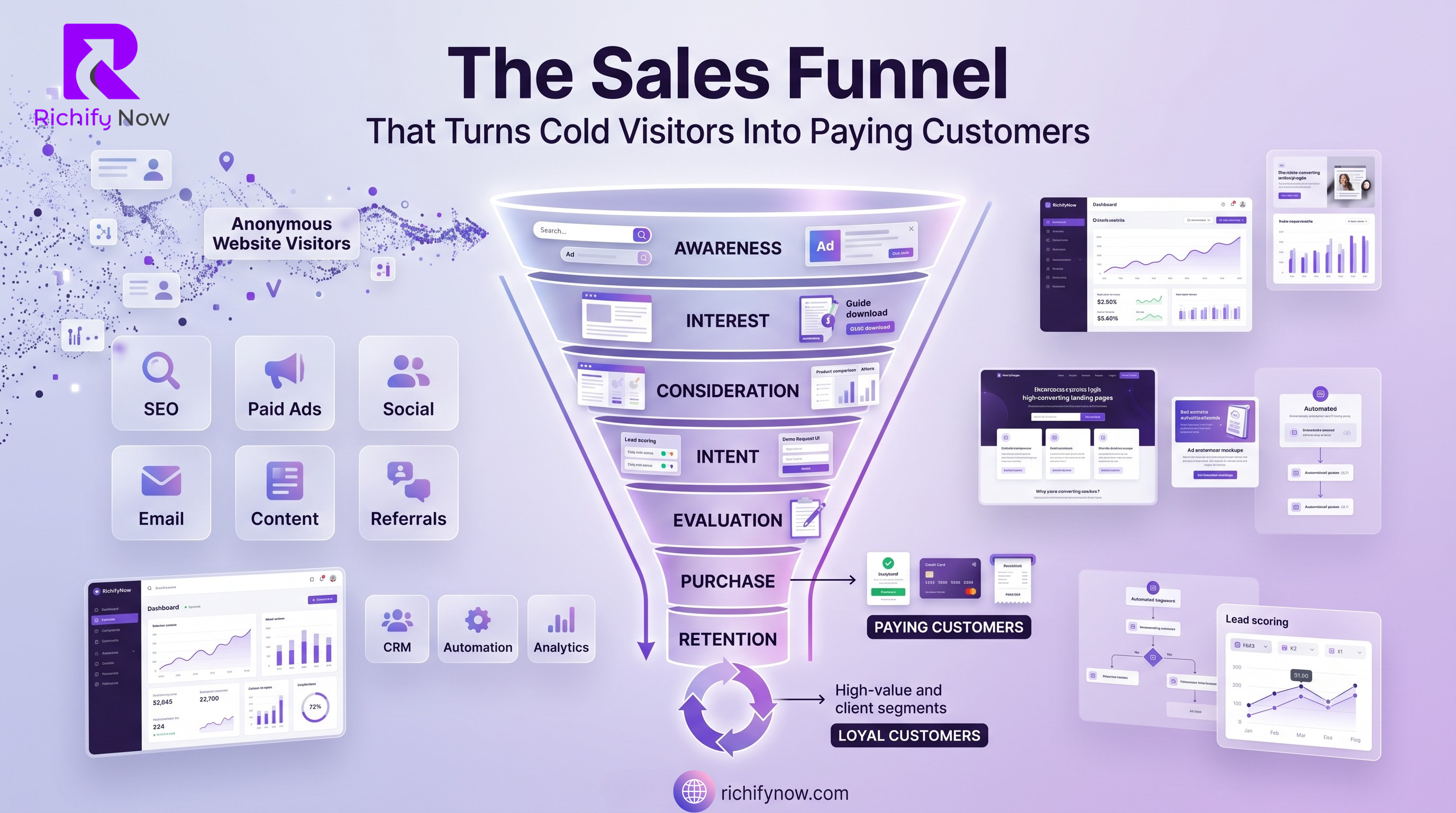
The Sales Funnel That Turns Cold Visitors Into Paying Customers
A research-backed guide to building a funnel that moves strangers from awareness to purchase and retention using SEO, paid media, social, email, content, referrals, testing, automation, and disciplined measurement.
AEO Answer Card
Building an effective sales funnel requires matching content to each buyer stage measuring conversion rates between stages testing improvements systematically and using integrated CRM and analytics tools to turn cold visitors into loyal customers
Executive Summary
A sales funnel works when it matches buying behaviour rather than forcing prospects through a linear internal process. Cold visitors rarely buy on first contact because they first need relevance, proof, low-friction next steps, and repeated signals that your offer is trustworthy and worth the cost. In B2B, this is even more pronounced: Gartner reports that 61% of buyers prefer a rep-free buying experience, 73% actively avoid irrelevant supplier outreach, and 6sense reports that buyers execute roughly two-thirds of the journey before talking to sellers. That means the funnel must do much of the selling before the sales team ever joins the conversation.
The strongest funnels are stage-specific. Awareness relies on discoverability and message-market fit. Interest depends on landing pages, useful content, and clear calls to action. Consideration is usually won through education, email sequences, product pages, demos, case studies, and retargeting. Intent is captured through high-intent search, pricing pages, comparisons, and strong sales follow-up. Evaluation needs social proof, objection handling, ROI framing, and low-friction conversion mechanics. Purchase depends on checkout or closing efficiency, and retention turns a single sale into repeat revenue and referrals. Returning visitors matter disproportionately: Contentsquare's 2026 benchmarks show they account for 52.8% of traffic and convert at 2.9%, versus 1.7% for new visitors.
Benchmarks vary by industry, but several practical anchors are clear. Unbounce's Q4 2024 benchmark found a median landing-page conversion rate of 6.6% across industries, while SaaS landing pages converted at 3.8%. Mailchimp's benchmark data places average email open rate at 34.23% and average click-through rate at 2.66%. Ruler Analytics' 2026 channel benchmarks put average conversion at 5.4% for paid search, 4.9% for organic search, 4.9% for email, 4.8% for referrals, and roughly 2.1%–2.2% for social. Worldwide ecommerce purchase conversion remains low at about 1.4%, while Baymard continues to find roughly 70% cart abandonment.
The implication is straightforward: most growth does not come from "more traffic" alone. It comes from better stage-to-stage progression, better intent matching, stronger measurement, and faster optimisation loops. High-performing teams use a unified CRM, marketing automation, analytics, and experimentation stack so that every stage can be measured and improved. This article lays out exactly how to build that funnel, what to measure at each stage, how to test it, what tools to use, and how to implement it over 90 days without losing strategic focus.
Why Most Funnels Leak
Most "funnels" fail because they are really just disconnected tactics: a bit of SEO, a few ads, a landing page, an email tool, and a CRM that only sales uses. Cold traffic then lands in a system that does not recognise stage, intent, or readiness. The result is predictable: top-of-funnel traffic is judged by bottom-of-funnel standards, high-intent leads are left waiting, and social or content channels are written off because last-click attribution undervalues their role earlier in the journey. Ruler's 2026 data is a useful reminder here: social has relatively low direct conversion rates, which is consistent with upper-funnel influence rather than proof of low value.
The second reason funnels leak is that the buyer journey is now multi-touch and often multi-device. Contentsquare reports that mobile drives almost 70% of traffic, but desktop conversion rates remain materially higher, suggesting that many journeys begin casually on mobile and complete later when users are ready to act. Google's own materials recommend setting conversion goals for multiple stages of the purchase journey precisely so that drop-offs can be seen and prioritised rather than guessed at.
The third reason is messaging mismatch. Awareness-stage visitors need relevance and clarity, not hard-sell purchase language. Evaluation-stage visitors need proof, pricing, guarantees, and comparison help, not generic education. In B2B, poor timing is especially costly because buyers want to research independently and avoid irrelevant outreach. Funnel design is therefore not just about moving people forward; it is about giving each person the next reasonable step for their stage.
Funnel Stages, KPIs, and What Good Looks Like
The most useful way to manage a funnel is by matching each stage to a specific visitor question. Awareness asks, "Who are you and why should I care?" Interest asks, "Is this relevant to my problem?" Consideration asks, "Why you over alternatives?" Intent asks, "Can I take a serious next step?" Evaluation asks, "Is this safe and worth it?" Purchase asks, "Can I complete this easily?" Retention asks, "Was that a good decision, and should I stay?"
| Stage | Primary job | Typical assets | Main KPIs | Benchmark cue |
|---|---|---|---|---|
| Awareness | Earn attention from strangers | SEO pages, paid social, video, PR, creator content | Impressions, reach, CTR, new users, branded search lift | Organic result #1 averages 27.6% CTR; top 3 capture 54.4% of clicks in one large study |
| Interest | Make the visitor want more | Landing pages, lead magnets, topical blog content, product explainers | Engaged sessions, bounce rate, LP conversion rate, scroll depth | Median landing-page conversion rate 6.6%; SaaS landing pages 3.8% |
| Consideration | Educate and qualify | Email nurture, webinars, comparison pages, case studies | MQLs, email open rate, email CTR, content-assisted conversions | Average email open 34.23%; email CTR 2.66% |
| Intent | Capture expressed buying signals | Pricing pages, demo booking, free trial, high-intent search ads | Demo rate, trial starts, call bookings, paid-search conversion | Paid search averages 5.4% conversion across Ruler's 2026 dataset |
| Evaluation | Remove risk and friction | ROI calculators, references, proof, FAQs, objection handling | SQL rate, opportunity rate, sales-cycle length, proposal-to-close | No universal cross-industry standard specified; use internal stage leakage as the benchmark |
| Purchase | Turn readiness into revenue | Checkout, contracts, payment flow, assisted close | Purchase conversion, close rate, AOV, CAC payback | Global ecommerce conversion ~1.4%; cart abandonment ~70.19% |
| Retention | Drive repeat revenue and advocacy | Onboarding, lifecycle email, support, loyalty, win-back | Repeat purchase, churn, retention rate, CLV, referral rate | Returning visitors convert at 2.9% vs 1.7% for new visitors |
Benchmarks compiled from Backlinko, Unbounce, Mailchimp, Ruler Analytics, Statista, Baymard, and Contentsquare. Evaluation benchmarks are often company-specific because source sets usually report website, channel, or purchase conversion rather than every internal handoff.
Awareness
Awareness is usually won by discoverability plus message relevance. For B2B, HubSpot's 2026 marketing data says websites, blogs, and SEO remain the most popular and impactful channels. For consumer brands, HubSpot's 2025 data ranks email, paid social, and content among the strongest ROI channels, which matters because awareness often starts in feeds or search and matures later into direct or branded traffic.
Interest and consideration
Interest is where the landing page earns its keep. Unbounce's benchmark is valuable because it is based on 464 million visits and 57 million conversions. If you are materially below the 6.6% median without a good reason, the issue is often one of offer clarity, page-message match, or friction. For SaaS, the lower 3.8% median is a reminder that more complex offers typically need stronger education and proof before visitors convert. Email then becomes the bridge from interest to consideration, and Mailchimp's benchmark provides a realistic starting point for subject-line, segmentation, and creative quality.
Intent, evaluation, and purchase
Intent is where paid search, demo forms, pricing pages, comparison pages, and retargeting usually outperform broad awareness channels. Ruler's 2026 channel data places paid search as its highest-converting tracked source on average. In B2B, evaluation also increasingly happens before a human conversation. That is why pages such as "Why us?", "Pricing", "Security", "Implementation", "ROI", "Compare", and "Case studies" are not support materials; they are revenue assets. Purchase is the final proof of funnel quality, but it is also the most fragile stage in ecommerce. Baymard's persistent cart-abandonment data makes the point clearly: checkout friction still destroys a large amount of purchase intent.
Channel Tactics That Support Each Stage
No single channel carries the whole funnel. The right mix depends on business model, sales cycle, and average order value, but the pattern is consistent: search captures intent, social expands reach, email nurtures interest, content builds trust, paid media accelerates discovery and remarketing, and referrals compress the trust gap. Nielsen's 2021 trust study found that 88% of global respondents trust recommendations from people they know more than any other channel, which helps explain why referral traffic often converts well once it lands.
Source: Ruler Analytics 2026 cross-industry conversion benchmarks.
| Channel | Best stage fit | What it does best | Practical KPI |
|---|---|---|---|
| SEO | Awareness, interest, consideration | Compounds over time and captures active information demand | Organic CTR, non-brand traffic, assisted conversions |
| Paid search | Intent, purchase | Captures high-intent queries and accelerates demand capture | CVR, CPA, ROAS, impression share |
| Paid social | Awareness, retargeting | Creates attention quickly and supports audience shaping | CTR, CPM, view-through assists, retargeting CVR |
| Consideration, retention | Nurtures, educates, recovers carts, drives repeat action | Open rate, CTR, revenue per recipient, win-back rate | |
| Content | Awareness through evaluation | Builds trust, answers objections, improves search surface area | Engaged sessions, assisted pipeline, demo-influenced content views |
| Referrals and partners | Evaluation, purchase | Transfers trust from third parties and lowers perceived risk | Referral CVR, partner-sourced revenue, win rate |
For ecommerce, abandoned-cart and browse-abandon flows deserve their own mention. Shopify supports automated abandoned-checkout emails out of the box, and Klaviyo's latest benchmark reporting says abandoned-cart flows deliver the highest revenue per recipient of any flow, with a placed-order rate a little above 3%. That makes them one of the clearest examples of automation supporting both the purchase and retention sides of the funnel.
Source: Contentsquare 2026 Digital Experience Benchmarks.
Optimisation, A/B Testing, and the Right Tech Stack
A funnel cannot improve if each team measures a different truth. At minimum, marketing, sales, and lifecycle teams should agree on the same definitions for visitor, lead, MQL, SQL, opportunity, customer, CAC, payback, and retention. HubSpot's 2026 statistics note that lead-to-customer conversion is one of the most important KPIs for marketers, while Salesforce's State of Sales continues to show that a large share of rep time is still lost to non-selling work and poor data flows.
For testing, use proper randomised A/B experiments rather than anecdotal design swaps. Google Analytics defines A/B testing as a randomised experiment with two or more variants shown simultaneously to random user samples. Firebase's documentation is a useful practical guide: use significance thresholds carefully, read confidence intervals, avoid declaring winners too early, and let experiments run long enough to gather representative data; for many product experiments, Google recommends at least two weeks. Google Search Central also warns that website tests should avoid cloaking and should use proper canonical signals so that experimentation does not damage search performance.
Headline-message match, CTA wording, form length, trust badges, pricing-page structure, demo-booking friction, checkout steps, and abandoned-cart timing usually beat cosmetic tweaks.
Testing too many variables at once, stopping early, using vanity metrics as winners, and ignoring downstream revenue quality.
| Stack layer | Lean option | Growth option | Enterprise option | Why it matters |
|---|---|---|---|---|
| CRM | HubSpot Free / Starter | HubSpot Pro or Pipedrive + enrichment | Salesforce | Unifies lead status, routing, and revenue attribution |
| Marketing automation | Mailchimp / Brevo | HubSpot, ActiveCampaign, Klaviyo | Marketo / Salesforce Marketing Cloud | Nurtures leads and automates lifecycle communication |
| Analytics | GA4 + Search Console | GA4 + Looker Studio + ad platform data | GA4 + warehouse + BI + attribution | Measures stage conversion and channel efficiency |
| Experimentation | Native CMS tests / low-volume tests | VWO / AB Tasty / Convert | Optimizely / enterprise experimentation | Improves conversion without blindly scaling spend |
| Session and funnel analysis | GA4 funnels | Hotjar / Microsoft Clarity | Contentsquare | Shows where users hesitate, drop, or rage-click |
Tool examples are recommendations, not benchmarked rankings. Where vendors publish performance claims, treat them as directional and validate against your own environment. Salesforce notes that 53% of teams that fully implemented AI first consolidated their tech stacks, and only 35% of sales professionals completely trust their organisation's data, which underlines why integration comes before sophisticated automation.
Case Studies, Examples, and Common Pitfalls
SaaS example: HubSpot's customer story for iAdvize reports 3x website traffic, 4x lead generation, and a 50% shorter sales cycle after implementing a more automated inbound engine. This is a good example of how SaaS funnels often improve not by forcing more demos at the top, but by matching content and automation to stage. Vendor case studies are not neutral benchmarks, but they are useful pattern recognition.
Ecommerce example: Google Ads highlights several merchant results, including Branch Basics reporting that it tripled sales revenue with Performance Max, Oliver Pluff & Co. saying it nearly doubled ecommerce revenue, and VIM & VIGR claiming roughly £5 revenue for every £1 invested. These examples illustrate the role of paid demand capture and AI-assisted campaign optimisation when intent already exists. They do not remove the need for strong product pages and checkout design.
B2B example: LinkedIn's 7Speaking story shows how targeted professional demand generation can support a long-consideration funnel: the company reports more than 800 MQLs, CTR above 3%, and over 10,000 landing-page views after using LinkedIn Lead Gen Forms integrated with CRM. ScreenCloud's LinkedIn case adds the downstream view, reporting 2.6x ROAS and a 61% close rate on opportunities touched by LinkedIn in its attribution model.
Common pitfalls
The most common funnel errors are familiar: sending all traffic to the homepage, mixing traffic sources without dedicated pages, failing to track phone calls or offline conversions, optimising for cheap leads instead of qualified revenue, retargeting too broadly, and neglecting post-purchase journeys. Another frequent problem is expecting awareness channels to produce last-click efficiency. Social often looks weak on a last-click dashboard because its influence occurs earlier. That is why multi-touch measurement, impression-level awareness, and return-visit analysis matter.
Step-by-Step Implementation Plan
The fastest way to build a real funnel is not to do everything at once. It is to create a minimum viable funnel, instrument it properly, then improve the largest leak each cycle.
| Step | Action | Output |
|---|---|---|
| Audit | Map traffic sources, offers, pages, forms, sales handoff, checkout, and existing email flows | Leak map and priority list |
| Define stages | Agree shared definitions for visitor, lead, MQL, SQL, opportunity, customer, churned customer | One funnel language across teams |
| Instrument data | Set up GA4 events, UTMs, call tracking if relevant, CRM source fields, revenue attribution | Reliable baseline |
| Build entry points | Create high-intent landing pages and source-specific campaigns | Better message match |
| Nurture | Deploy welcome, education, abandoned-cart, or demo follow-up sequences | Consideration engine |
| Support evaluation | Add case studies, pricing FAQs, comparisons, testimonials, ROI proof, guarantee language | Decision-stage confidence |
| Test | Prioritise one high-friction step at a time and test against a revenue-linked goal | Compounding conversion gains |
| Retain | Build onboarding, support triggers, repeat-purchase prompts, win-back and referral asks | Higher lifetime value |
Practical checklist
GA4 events, conversions, UTMs, CRM source mapping, paid platform conversions, Search Console.
Dedicated landing pages for paid traffic, clear CTA hierarchy, proof near the form, mobile-first speed checks.
Welcome flow, demo follow-up, cart recovery, proposal follow-up, win-back, referral invitation.
Lead scoring, SLA for response time, ownership rules, stage definitions, enrichment and notes.
Case studies, testimonials, pricing FAQs, ROI calculator, implementation timeline, security answers.
One hypothesis per experiment, enough traffic, defined success metric, QA before launch, read-outs every fortnight.
Budget ranges vary widely by business model and geography. No universal monthly budget standard was specified in the sources reviewed, so use paid media, content, and tooling allocations as illustrative planning inputs rather than external benchmarks.
FAQ
A marketing funnel usually covers awareness through lead generation, while a sales funnel often begins when a lead is qualified and moves through intent, evaluation, and close. In practice, high-performing teams treat them as one connected system.
There is no single best channel. SEO and content are strong for long-term compounding, paid social is strong for rapid awareness, and paid search is strongest when demand already exists. The best mix depends on your sales cycle, audience, and offer.
Unbounce's latest broad benchmark puts the median at 6.6% across industries, but SaaS pages are lower at 3.8%. A good rate is therefore context-specific.
Because social frequently creates or shapes demand earlier in the journey, while the final conversion is captured later through direct, branded search, email, or paid search.
Until it has enough data to produce a reliable result. Google's Firebase guidance recommends a minimum of about two weeks for many typical experiments, but required duration depends on traffic and conversion volume.
Measure stage-to-stage progression: visit to lead, lead to MQL, MQL to SQL, SQL to opportunity, opportunity to closed-won, and customer to repeat purchase or renewal. The weakest ratio is usually where to test first.
High-Level References
- HubSpot, State of Marketing 2026 and Marketing Statistics 2026. Used for channel ROI priorities, CRO usage, and marketer KPI priorities.
- Unbounce, Landing Page Conversion Benchmark and SaaS benchmark pages. Used for median landing-page conversion rates across industries and SaaS.
- Mailchimp, Email Marketing Benchmarks. Used for average open rate and CTR.
- Ruler Analytics, Conversion Rate Benchmarks 2026. Used for cross-channel conversion benchmarks.
- Backlinko, Organic CTR study, plus Advanced Web Ranking CTR datasets. Used for organic CTR context.
- Gartner, B2B buyer preference for rep-free buying, and 6sense, B2B Buyer Experience Report 2025. Used for B2B buying behaviour and dark-funnel reality.
- Baymard Institute, Cart and checkout usability research. Used for cart-abandonment benchmark.
- Statista search results for 2026 ecommerce conversion rate. Used for global ecommerce purchase-conversion reference.
- Contentsquare, Conversion benchmarks 2026 and related retention material. Used for returning-vs-new visitor conversion behaviour and retention context.
- Nielsen, Trust in Advertising Study commentary. Used for referral trust.
- Google Analytics and Firebase, GA4 A/B testing, Firebase A/B testing concepts, and Google Search Central A/B testing best practices. Used for experimentation guidance.
- Salesforce, State of CRM and State of Sales 2024 summary. Used for tech-stack consolidation, data trust, and AI-assisted sales workflow context.
- HubSpot, iAdvize case study and ROI Report 2025. Used for case examples and integrated-platform directional claims.
- Google Ads official business site, Google Ads results examples. Used for ecommerce case illustrations.
- LinkedIn Marketing Solutions, 7Speaking case study and ScreenCloud case study. Used for B2B demand-generation examples.
- Shopify Help, Recovering abandoned checkouts, and Klaviyo, abandoned cart benchmark reporting. Used for checkout-recovery automation examples.
Business Growth Systems Checklist
Download the editable RichifyNow workbook with instructions, working fields, disclaimer, and the complete source-document specification.

Loading comments…