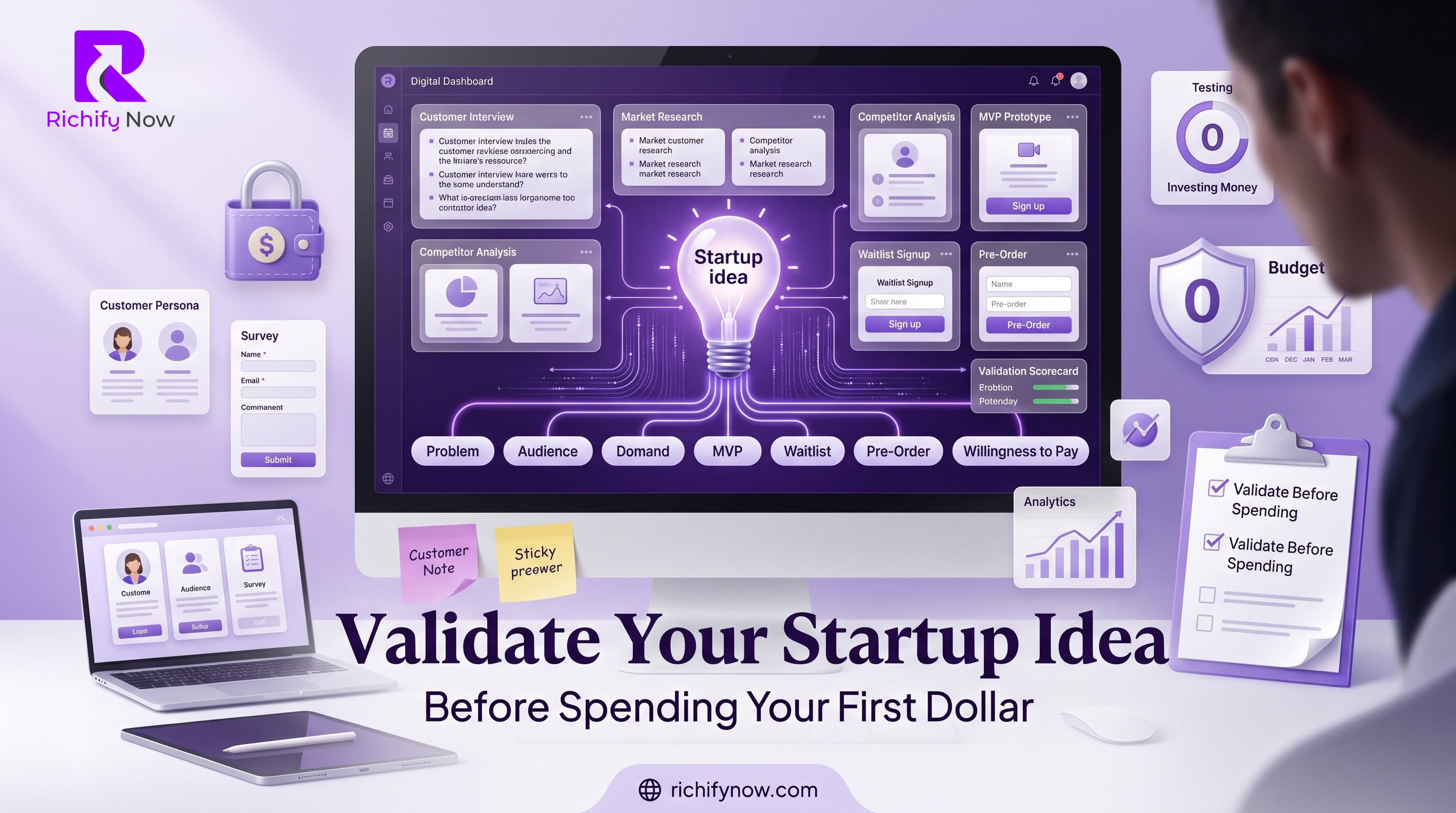
How to Validate a Startup Idea Before Spending Your First Dollar
Before spending money on branding, software, inventory, ads, or development, founders should validate whether real customers actually need and will pay for the idea. This guide explains how to test startup demand using interviews, competitor research, landing pages, waitlists, pre-orders, and practical validation signals

Startups 💜 RichifyNow
How to Validate a Startup Idea Before Spending Your First Dollar
A practical founder-focused guide to testing demand, finding real customer pain, checking willingness to pay, and avoiding expensive startup mistakes before you build
AEO Answer Card
A startup idea is validated when real customers show repeated evidence of painful problems existing spending and willingness to pay Test with interviews waitlists pre-orders and paid pilots before building
Executive Summary 🚀
A startup idea is not validated because the founder likes it, friends praise it, or a competitor exists
A startup idea is validated when a specific group of people shows repeated evidence that the problem matters enough to change behavior, spend money, join a waitlist, pre-order, book a call, or use a rough version of the solution
This matters because startup risk is real
According to the latest federal-data-based reporting from Axios, the national five-year survival rate for U.S. businesses that opened in the year ending March 2019 and were still operating in March 2024 was 51.6%, meaning nearly half did not make it to year five
At the same time, new business creation remains extremely active: AP reported that U.S. business applications reached a record 5.5 million in 2023, and 44% of entrepreneurs who started a business that year were doing it while also working another job
That combination creates the modern founder problem
It is easier than ever to start, but still difficult to survive
The smartest move is not to spend your first dollar on branding, ads, software, inventory, office space, or a developer
The smartest move is to test whether the market is pulling the idea before you start pushing money into it
RichifyNow Startup Note ⚠️
This article is for educational and business planning purposes only
Startup validation reduces risk, but it does not remove risk
A founder should still review costs, legal requirements, taxes, business structure, customer privacy, contracts, payment processing, and financial runway before launching or accepting money from customers
Why Validation Matters Before Spending Money 📊
Many founders do not fail because they are lazy
They fail because they spend too much time and money building something before proving that the problem is painful, frequent, and commercially valuable
Investopedia’s 2025 startup validation guide states that 35% of startups fail because there is no market need, and it recommends validating through customer interviews, prototypes, competitor analysis, mentor feedback, waitlists, and pre-orders before a full launch
Research on early-stage software startups reaches a similar conclusion from another angle
A study by Giardino, Wang, and Abrahamsson found that although early-stage software startups need to understand problem-solution fit, actual execution often prioritizes launching product quickly while neglecting the learning process
That is the core mistake this blog helps you avoid
You are not trying to prove that your idea is exciting
You are trying to prove that real people already feel the pain, already search for solutions, already spend on alternatives, and are willing to take the next step with you
Graph 1: Startup Reality Signals
These figures show why validation should come before major spending
U.S. five-year business survival rate 51.6%
Estimated five-year closure / non-survival share 48.4%
Startups reported failing from no market need 35%
2023 new founders also working another job 44%
Chart sources: Axios using BLS survival data, AP reporting on 2023 business applications and side-hustle founders, and Investopedia's validation guide citing no-market-need failure data
What Startup Validation Really Means 🧠
Startup validation means testing the riskiest assumptions behind your idea before you spend serious money
It does not mean asking people whether they like the idea
People are polite
They may say "that sounds great" even when they would never pay for it
Real validation is behavior-based
Someone gives you time, attention, data, an email address, a deposit, a pre-order, a referral, a pilot commitment, or a clear explanation of how they currently solve the problem
The lean startup method is built around validated learning, rapid experimentation, MVP testing, customer feedback, and iteration rather than long product-development cycles based only on assumptions
For a founder, the practical lesson is simple
Before spending your first dollar, convert your idea into testable assumptions
The RichifyNow Validation Formula
Idea: What you want to build
Problem: What pain the customer already feels
Customer: Who feels this pain most strongly
Behavior: What they currently do to solve it
Payment: Whether they will pay, pre-order, subscribe, or commit
Distribution: How you can reach more people like them repeatedly
Step 1: Turn Your Startup Idea Into Hypotheses 🔍
A vague idea cannot be validated
A hypothesis can
Instead of saying "I want to build an app for freelancers," say "freelance graphic designers earning under $5,000 per month struggle to collect payments on time, and they will pay $9 per month for automated invoice follow-up messages"
That statement can be tested
You can interview freelance designers
You can check whether late payments are a frequent pain
You can see whether they already use spreadsheets, invoice tools, reminders, or manual WhatsApp follow-ups
You can ask them to join a waitlist or pay for a simple template before you build software
Research on MVPs and pivots shows that startups learn through testing hypotheses, but also warns that some MVPs fail to test the actual business hypothesis they were supposed to validate
That is why every validation test must have one clear question
Step 2: Validate The Problem Before The Product 🎯
The biggest validation mistake is starting with the solution
Founders often ask "Would you use my app?"
A better question is "Tell me about the last time this problem happened"
Problem interviews should uncover real stories, not opinions
Ask what happened, how often it happens, what it costs, what they tried before, why existing tools failed, and what would make the problem urgent enough to fix
Investopedia's guide emphasizes that founders often fall in love with their own solution before validating the problem, and recommends direct conversations with target customers using open-ended questions to uncover real pain points
A strong problem interview produces signals like repeated frustration, existing spending, manual workarounds, lost revenue, time waste, emotional stress, or clear urgency
A weak problem interview produces compliments, vague interest, and no behavioral proof
Problem Interview Questions
- When did this problem last happen?
- How are you solving it today?
- How much time or money does it cost you?
- What tools or services have you tried?
- What made those solutions frustrating?
- Who else in your team feels this pain?
- What would make this problem urgent enough to pay for?
Step 3: Study Existing Behavior And Competitors 🧾
A market with competitors is not automatically bad
In many cases, competitors prove that customers already spend money in the category
The real question is whether you can find a painful gap
Before building, analyze competitor reviews, Reddit threads, YouTube comments, Facebook groups, app store complaints, marketplace listings, Google search intent, paid ad keywords, pricing pages, and refund complaints
Investopedia recommends competitor analysis as a way to find market gaps and identify customer frustrations that can shape a stronger value proposition
Your goal is not to copy
Your goal is to find the sentence customers keep repeating
Examples include "too expensive," "too complicated," "not built for small teams," "does not support my country," "poor customer support," "takes too long," or "I only need one feature"
That repeated complaint can become your wedge
Step 4: Build A No-Code Smoke Test Before Building The Product 🧪
A smoke test is a simple way to check whether people take action when they see your offer
You do not need a full product
You need a landing page, a clear promise, a target audience, a call to action, and a way to measure behavior
Your CTA can be "Join the waitlist," "Book a discovery call," "Request early access," "Download the checklist," "Reserve your spot," or "Pre-order now"
If nobody clicks, nobody signs up, and nobody replies, the idea may need clearer positioning before product development begins
If people join the waitlist but refuse to pay later, the value may be interesting but not urgent
If people book calls and ask when they can start, the signal is stronger
The MVP concept is designed to collect maximum validated learning with minimum effort, allowing founders to test business assumptions before committing to heavy development
Graph 2: Validation Evidence Ladder
The higher the signal, the more confidence you should have before spending money
Friend says "great idea" 1 / 10
Survey interest 3 / 10
Customer interviews show repeated pain 5 / 10
Waitlist or booked calls 6 / 10
Pre-orders or deposits 8 / 10
Paid pilot or repeat usage 10 / 10
Chart note: this is a RichifyNow editorial validation scorecard based on startup testing logic, not a universal statistical model
Step 5: Test Willingness To Pay Early 💳
Interest is not the same as payment
A founder can collect hundreds of likes and still have no business
Payment validation is stronger because it forces customers to choose
They must decide whether the problem is worth money, not just attention
You can test willingness to pay without building the full product through pre-orders, deposits, paid discovery calls, paid templates, a manual concierge version, a one-page service offer, a paid pilot, or a limited beta subscription
Investopedia's validation guide recommends getting early commitments through prototypes, pre-sales, demo websites, waitlists, and early feedback before heavy development, and notes that Kickstarter charges a 5% platform fee plus payment-processing fees for successfully funded projects
The exact test depends on your startup type
For a SaaS idea, try a paid manual workflow
For a course idea, sell a live workshop first
For an ecommerce idea, test pre-orders
For an agency-style startup, sell one narrow service package before creating the full brand
Step 6: Validate Distribution Before Scaling 📣
A startup can have a useful product and still fail if it cannot reach customers repeatedly
Distribution validation means testing how customers will discover the offer
Can you reach them through SEO, LinkedIn, TikTok, YouTube, cold email, partnerships, communities, newsletters, marketplaces, affiliates, paid ads, or local relationships?
Venture-capital due diligence research shows that even professional investors can suffer when evaluation is rushed
Investopedia summarized NBER and Wharton-linked research tracking 22,000 VC deals from 2018 to 2023, reporting that due-diligence time dropped sharply in competitive periods and that rushed research was associated with a 15% to 34% increase in volatile investment outcomes
The founder lesson is clear
Do not rush because the idea feels exciting
Validate the route to customers before spending money on the product
Step 7: Use AI Carefully In Validation 🤖
AI can help you validate faster, but it should not replace real customer evidence
You can use AI to summarize customer interviews, cluster pain points, draft landing-page variants, analyze competitor reviews, generate survey questions, build simple prototypes, and create pricing experiments
But AI cannot tell you that customers will pay
Only customers can do that
A 2025 academic study analyzing 1,800 Chinese startups between 2011 and 2020 found that AI capabilities can complement lean startup methods, especially when discovery-oriented AI helps expand market opportunity search and prototyping helps validate opportunities
That is the right use of AI
Use it to speed up discovery and pattern recognition
Do not use it as a substitute for talking to buyers, testing behavior, and collecting payment evidence
The 7-Day Zero-Dollar Validation Sprint 🗓️
The fastest way to validate a startup idea is to run a structured sprint
This does not require paid software, ads, logo design, or product development
It requires focus, outreach, documentation, and honest analysis
Day 1: Define The Narrow Customer
Write one sentence that names the exact customer, exact pain, current workaround, and expected value
Bad: small businesses need automation
Better: small real estate agencies lose leads because follow-up is manual and would pay for a simple reminder workflow
Day 2: Find 30 Real Prospects
Use LinkedIn, Facebook groups, Reddit, WhatsApp groups, directories, Google Maps, industry communities, or personal contacts
Do not choose people only because they are easy to reach
Choose people who match the customer profile
Day 3: Conduct 10 Problem Interviews
Ask about real past behavior, not future imagination
Look for repeated pain, existing spending, urgency, and emotional language
Day 4: Study Competitor Complaints
Read reviews and public discussions to find repeated frustrations
Your wedge is usually hidden inside complaints
Day 5: Create A One-Page Offer
Write the customer, problem, promise, outcome, price, and CTA
This can be a Google Doc, Notion page, simple landing page, or PDF
Day 6: Ask For Commitment
Ask prospects to join a waitlist, book a pilot, pay a small deposit, pre-order, or introduce you to someone else with the same problem
Commitment is stronger than compliments
Day 7: Score The Evidence
Do not judge by excitement
Judge by behavior
If prospects gave only compliments, refine the problem
If they joined a waitlist, continue testing
If they paid or asked to start, build the smallest version that delivers the promised outcome
Validation Scorecard: Kill, Pivot, Or Continue ✅
After the sprint, put the idea into one of three categories
Kill the idea if target customers do not recognize the problem, do not currently try to solve it, and do not take any meaningful action
Pivot if the problem exists but the customer segment, pricing, channel, or solution is wrong
Continue if customers repeat the same pain, already use alternatives, show urgency, join a waitlist, book calls, or agree to pay
Startup pivot research shows that customer-need pivots and customer-segment pivots are common in software startup journeys, and that negative customer reaction and flawed business models often trigger pivots
That means pivoting is not failure
It is often the price of finding a sharper market truth before the market punishes you with lost money
RichifyNow Startup Validation Framework: P A I D
P — Pain: Is the problem frequent, painful, and already visible in customer behavior?
A — Audience: Can you define and reach a narrow customer group repeatedly?
I — Intent: Do prospects click, reply, book, join, refer, or ask for access?
D — Dollars: Will anyone pay, pre-order, deposit, or commit to a pilot?
Common Validation Mistakes To Avoid 🚫
The first mistake is asking friends and family
They may support you emotionally, but they are not always your market
The second mistake is relying only on surveys
Surveys can reveal interest, but they rarely prove urgency or payment behavior
The third mistake is building too much too early
A polished product can hide a weak value proposition
The fourth mistake is validating the solution instead of the problem
The fifth mistake is confusing traffic with demand
The sixth mistake is running ads before the offer is clear
The seventh mistake is ignoring distribution
The eighth mistake is refusing to pivot when the evidence is weak
Internal Reading Path For RichifyNow Readers 🔗
FAQs ❓
What does it mean to validate a startup idea?
It means collecting real evidence that a specific customer group has a painful problem, wants a solution, and is willing to take action such as joining a waitlist, booking a call, pre-ordering, paying, or using a simple version of the offer
Can I validate a startup idea without spending money?
Yes, you can validate early demand through interviews, competitor research, community discussions, a simple landing page, manual outreach, and pre-commitment tests before spending on development or advertising
How many customer interviews should I do?
A good early target is 10 to 20 focused interviews with people who match the exact customer profile, but quality matters more than quantity because repeated patterns are more useful than random opinions
Is a waitlist enough validation?
A waitlist is useful, but it is not the strongest signal because people can sign up without real urgency. Pre-orders, deposits, booked calls, referrals, and paid pilots are stronger validation signals
When should I start building the product?
Start building only after you have evidence of repeated pain, reachable customers, a clear value proposition, and at least some commitment signal from real prospects
Final Verdict 💜
The safest startup dollar is the one you do not spend too early
Validation is not about killing ambition
It is about protecting ambition from expensive assumptions
A startup idea becomes stronger when it survives contact with real customers
Talk to the market before building for the market
Study pain before designing features
Test distribution before buying ads
Ask for commitment before hiring developers
Use AI to speed up research, but use customer behavior to make decisions
The founder who validates before spending is not moving slowly
They are moving intelligently
In a world where millions of businesses are started and nearly half may not reach the five-year mark, the founder who learns before spending has a real advantage
References 📚
- Axios report using U.S. Bureau of Labor Statistics data on five-year business survival rates, including the 51.6% national survival rate for businesses opened in the year ending March 2019 and still operating as of March 2024
- AP News report on 2023 U.S. business applications reaching 5.5 million and 44% of new entrepreneurs starting while also working another job
- Investopedia guide on validating business ideas before launch, including no-market-need failure data and validation methods such as interviews, prototypes, competitor analysis, waitlists, and pre-orders
- Giardino, Wang, and Abrahamsson study on early-stage software startup failure and the gap between problem-solution learning and rushed product execution
- Lean Startup and MVP references covering validated learning, rapid experimentation, minimum viable products, and customer feedback loops
- Khanna, Nguyen-Duc, and Wang study on MVPs, pivots, and hypothesis-driven startup learning
- Investopedia summary of NBER and Wharton-linked venture-capital due-diligence research covering 22,000 VC deals and rushed evaluation risk
- Wang and Wu 2025 study on AI, Lean Startup Method, and product innovation across 1,800 Chinese startups
- Bajwa, Wang, Nguyen Duc, and Abrahamsson study on software startup pivots, customer-need pivots, and flawed business model triggers
Startup Planning Worksheet
Download the editable RichifyNow workbook with instructions, working fields, disclaimer, and the complete source-document specification.


Loading comments…